Rowing Machine Cardio Workout Guide
If you want a cardio routine that builds strength, burns serious calories, and protects your joints in one smooth motion, the rowing machine cardio workout is hard to beat. Unlike treadmills or bikes that isolate your upper or lower body, rowing activates roughly 85% of your muscles in a single stroke. This makes it a true full-body conditioning tool for beginners and elite athletes alike. In this guide, you will learn how to master proper form, choose the right drag settings, and follow proven workout protocols that deliver real results.
Master the Rowing Stroke Sequence
Break Down the Four Key Phases
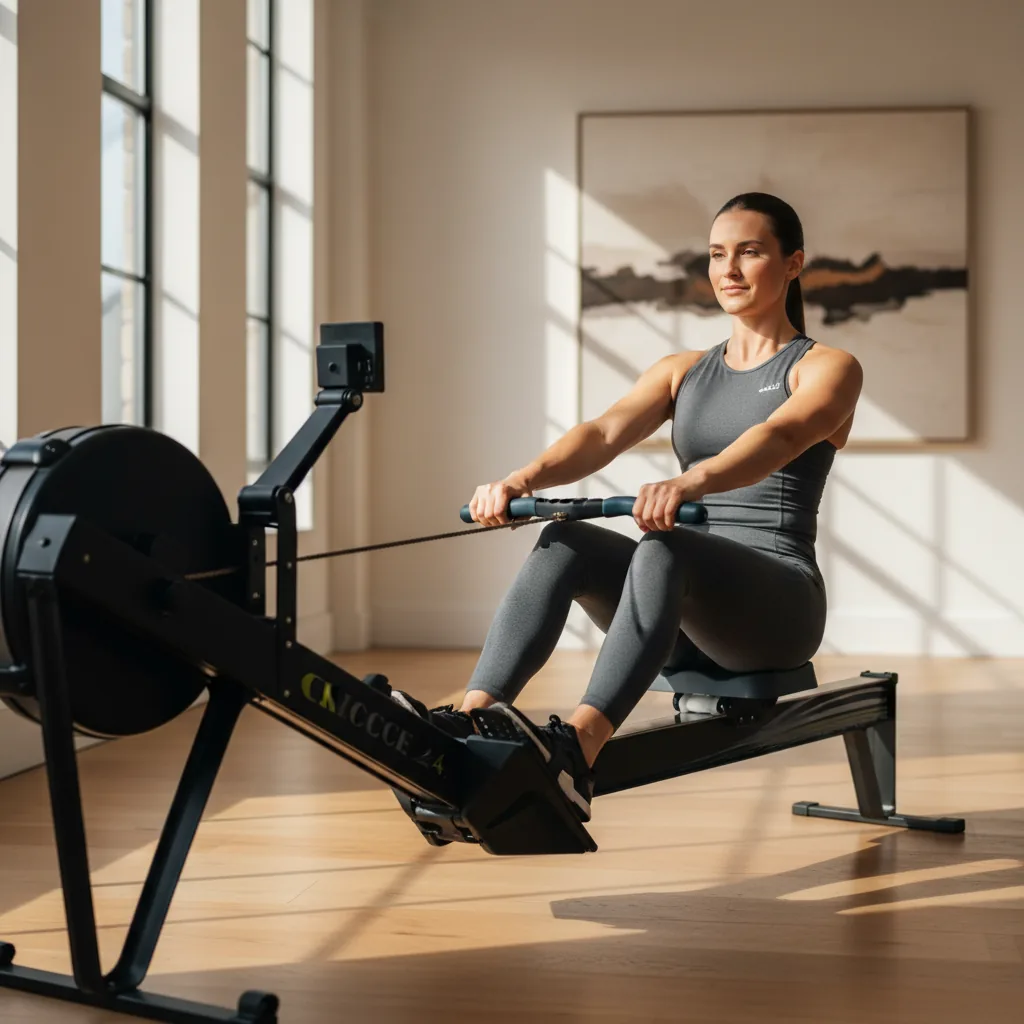
The power of any rowing machine cardio workout comes from executing a precise, repeatable stroke. Each cycle has four phases: Catch, Drive, Finish, and Recovery. Mastering this sequence ensures maximum power, efficiency, and joint safety.
1. The Catch (Start Strong)
Sit tall with a slight forward lean from the hips, not your lower back. Keep knees bent with shins vertical. Extend arms straight, holding the handle close to your ankles. Engage your core and imagine a bucket of water on your stomach tilting forward.
2. The Drive (Power Up)
This is where force is generated. Follow the sequence: legs first, then body, then arms. Push hard with your legs while keeping arms straight. At halfway extension, hinge back at the hips. Only when legs are fully extended do you pull the handle to your lower chest.
Pro Tip: Your legs and hips do 60–70% of the work. Never lead with your arms.
3. The Finish (Complete the Pull)
Lock your legs out, lean back slightly to an 11 o’clock position, and pull the handle to nipple line with elbows bent at 90 degrees. Keep your back flat and core engaged. Avoid over-leaning, which strains the lower back.
4. The Recovery (Reset with Control)
Reverse the sequence: extend arms first, hinge forward at the hips, then bend the knees to slide back. Use your hamstrings to control the slide. Do not yank yourself forward with the foot straps, as this causes knee strain.
Fix Common Form Mistakes
Even experienced users develop bad habits. Avoid these errors to protect your body and boost performance:
- Arms-First Pulling: Starting the stroke by bending arms kills power. Always lead with leg drive.
- Hunching the Back: A rounded spine usually means tight hamstrings. Stretch before rowing.
- Knee Pop: Knees lifting early in recovery cause your hands to rise over your knees. Slow down and focus on controlled leg bend.
- Dying Salmon Flail: No rhythm, no power. Fix with drills and slower stroke rates.
Visual Cue: If your head moves in a straight line forward and back, your form is smooth. If it bobs up and down, you are out of sequence.
Set Drag, Not Resistance

Choose the Right Drag Factor
Most rowers think turning the damper to 10 makes the workout harder. This is a myth. The damper controls airflow into the flywheel, not resistance like a bike. Think of it like boat weight: high drag equals a heavy boat that is hard to accelerate, while low drag equals a racing shell that needs high stroke rates.
Optimal Settings:
– General Use: Drag factor 3–6
– Endurance Rows: Drag factor 3–5
– Sprints and Power: Drag factor 6–8
– Elite Benchmark: World-record rower Phil Clapp uses 6–8, not 10
Expert Insight: Even top athletes avoid setting 10. It is too heavy to maintain speed and wrecks form.
Control Stroke Rate (SPM) Smartly
Strokes Per Minute should match your goal, not maxed out blindly.
- Beginners: 20–24 SPM (focus on power per stroke)
- Endurance: 18–24 SPM (long, efficient pulls)
- HIIT and Sprints: 28–35+ SPM (fast turnover)
- Recovery: 16–20 SPM (slow reset)
Key Rule: Speed comes from power, not just SPM. A 24 SPM stroke with strong leg drive beats a 30 SPM flail every time.
Build Stamina with Endurance Workouts
Execute Steady-State Rows
This is the foundation of aerobic fitness. Row continuously at a moderate pace for 20–30+ minutes at 60–70% of your max heart rate with an 18–24 SPM stroke rate. Focus on consistent split times and fluid motion.
Beginner Tip: Start with 10 minutes and add 2–3 minutes weekly. Prioritize form over distance.
Row Set Distances for Progress
Track improvement by timing fixed distances like 2,500m, 5,000m, or 10,000m. Start slightly below goal pace and finish strong. Aim to beat your time every 2–3 weeks.
Try the 4 x 4 Minute Interval
Build aerobic capacity with structured effort. Warm up for 5–10 minutes, then alternate 4 minutes hard at 75% effort with 2 minutes easy for 4 rounds. Cool down for 5 minutes.
Pro Strategy: Increase effort each round and finish with everything you have.
Use Power Tens for Active Recovery
Every minute, perform 10 max-effort strokes followed by easy rowing for the remainder of the minute. Continue for 20 minutes. This maintains power and aerobic base on light days.
Burn Calories with HIIT Rowing
Crush Tabata Intervals
Maximize calorie burn in under 10 minutes. Warm up for 5 minutes, then alternate 20 seconds all-out at 30+ SPM with 10 seconds of gliding rest for 8 rounds. Cool down for 5 minutes.
Afterburn Effect: EPOC (excess post-exercise oxygen consumption) keeps metabolism elevated for hours.
Run the Pyramid HIIT
Build mental toughness and endurance with this sequence: 1 min hard / 1 min easy, 2 min hard / 2 min easy, 3 min hard / 3 min easy, then back down 2 min / 2 min and 1 min / 1 min. Total time is 30–35 minutes including warm-up.
10-20-30 for Fat Loss
Ideal for time-crunched sessions. Cycle through 10 seconds max, 20 seconds moderate, and 30 seconds easy for 4 rounds. Total time is 20–25 minutes.
Bonus: Studies show 10-20-30 intervals improve VO2 max faster than steady cardio.
40 On / 20 Off for Conditioning
Alternate 40 seconds hard rowing with 20 seconds easy for 10 minutes of intervals. Keep split times consistent across rounds.
All-Out 100m Sprints
Perfect as a finisher after strength training. Row 100 meters at max effort with 40+ SPM, rest 2 minutes, and repeat 6–8 times.
Warning: Only attempt with solid technique. Form breaks down fast at max effort.
Build Muscle with Power Workouts
Perform Power Strokes
Turn each stroke into a strength builder. Row 5 minutes steady at 20 SPM, then burst into 10 max-power strokes focusing on leg drive. Recover for 2 minutes easy and repeat for 3–5 cycles.
Goal: Maximize watts per stroke, not speed.
Sprint 500m for Peak Power
Test or train high-intensity endurance with a fastest 500m effort at 70–85% max heart rate and 26+ SPM. Rest 3–5 minutes between attempts.
Combine Rowing with Strength Circuits
Fuse cardio and resistance for lean muscle growth. Try this circuit for 3–4 rounds:
1. 1 min dumbbell lunges
2. 1 min push-ups
3. 3 min row at moderate intensity
Efficiency: Full-body burn in under 30 minutes.
Try Partner AMRAP
Add competition and fun. Person A rows 500m while Person B does 5 push-ups, 10 squats, and 15 sit-ups repeatedly. Swap after each round and continue for 20 minutes total.
Refine Technique with Drills
Practice the Catch Drill
Row normally, then pause at the catch. Check that shins are vertical, arms are straight, and back is flat. Repeat 5–10 pauses during a 10-minute row.
Isolate Leg Drive
From the catch, extend legs only without swinging your back or pulling arms. Focus on feeling glutes and quads fire. Do 10 reps per set.
Benefit: Reinforces proper sequencing.
Train Arm-Only Pulls
Start at the finish with legs extended and body leaned back. Extend arms, then pull back without body movement. Focus on shoulder retraction and lat engagement.
Use the 20-to-30 Wave
Alternate 1 minute at 20 SPM with 1 minute at 30 SPM for 10 rounds (20 minutes total). Focus on smooth transitions and consistent power.
Master the 1-2-3-4 Pyramid
Row at your 2K race pace following this pattern: 1 min / rest 1 min, 2 min / rest 2 min, 3 min / rest 3 min, 4 min / rest 4 min, then back down. The descending ladder creates a psychological boost at the end.
Follow Level-Based Training Plans
Start with the Beginner Plan
Build consistency and form with 2–3 rowing sessions per week. A sample session includes a 2-minute warm-up at 16–20 SPM, 10 minutes moderate at 20–24 SPM, and a 3-minute cool-down. Add 2 strength sessions weekly and focus on form over speed.
Progress with Intermediate Workouts
Add variety and intensity with 3–4 sessions per week. Options include a 30-minute steady-state row, interval combos like 2 min row / 2 min run, or 4 x 4 minute intervals. Balance endurance, power, and technique.
Train Like an Advanced Athlete
Peak for performance with 4+ sessions per week. Workouts include 45-minute steady-state rows, 1-2-3-4-3-2-1 pyramids, and 500m sprints with short rest. Cross-train with SkiErg, bike, squats, and trap bar deadlifts.
Strengthen with Rowing-Specific Exercises
Build a supporting strength circuit with 8–12 reps each, repeating 3–4 rounds with 1 minute rest between rounds:
- Lat Pulldown – Mimics arm pull and builds back strength
- Dumbbell Romanian Deadlift – Strengthens hamstrings, glutes, and posterior chain
- Plank to High Plank – Core stability for torso swing
- Leg Press – Raw leg drive power
- Box Jump – Explosive hip extension
- Single-Arm Bent-Over Row – Corrects imbalances and boosts back endurance
Why It Works: These moves directly support the rowing stroke mechanics.
Prevent Injury and Optimize Results
Warm Up Properly
Never skip warm-up, as it prevents back strain. Do 3–4 minutes of dynamic stretches like lunges, squats, and side lunges before the machine. Then row easy for 5–10 minutes before HIIT.
Avoid Common Injuries
- Lower Back Pain: Caused by rounding the spine. Keep core tight and back flat.
- Shin Strain: From pulling with foot straps. Use hamstrings to bend knees.
- Shoulder Tension: Keep shoulders down and relaxed at the catch.
- Hip Flexor Pain: Caused by aggressive recovery. Slow down the slide.
Stay Consistent and Varied
Even 15 minutes daily builds fitness over time. Mix steady-state, HIIT, and drills to avoid plateaus. Use music to lock in stroke rate and stay motivated.
Know Who Benefits Most
- Beginners: Low-impact and easy to learn
- Injury Recovery: Joint-friendly conditioning
- Seniors: Prevents muscle loss and boosts heart health
- Busy Professionals: 20 minutes equals a full-body workout
- Visually Impaired: Rhythmic and predictable motion
Frequently Asked Questions About Rowing Machine Cardio Workouts
Is a rowing machine good for cardio?
Yes. A rowing machine cardio workout engages roughly 85% of your muscles while elevating your heart rate, making it one of the most efficient cardio options available. It also strengthens the posterior chain, which improves posture and reduces back pain from sitting.
How long should a rowing machine cardio workout last?
For endurance, aim for 20–30+ minutes at a steady pace. For HIIT, sessions can be as short as 15–20 minutes including warm-up and cool-down. Beginners can start with 10 minutes and build up gradually.
What drag factor should I use on a rowing machine?
Most people perform best at a drag factor of 3–6. Use 3–5 for endurance rows and 6–8 for sprints or power work. Avoid setting the damper to 10, as it is too heavy to maintain good form and speed.
How many calories does a rowing machine cardio workout burn?
Calorie burn depends on intensity, duration, and body weight. High-intensity interval sessions can burn significant calories during the workout and continue elevating metabolism for hours afterward through the EPOC effect.
Can beginners do a rowing machine cardio workout?
Absolutely. Rowing is low-impact and easy to learn. Beginners should start with 2–3 sessions per week at 20–24 SPM, focusing on form before increasing intensity or duration.
Is rowing better than running for cardio?
Rowing is lower impact than running, making it gentler on joints while still providing excellent cardiovascular and full-body strength benefits. It is a strong alternative for anyone seeking joint-friendly conditioning.
Key Takeaways for Your Rowing Machine Cardio Workout
A well-structured rowing machine cardio workout is one of the most efficient tools in fitness. It builds lean muscle, burns calories, and protects your joints while improving posture and mental focus. The key to success is mastering the four-phase stroke sequence, choosing the right drag factor, and mixing workout styles to match your goals. Start with steady-state rows to build your base, add HIIT intervals to torch calories, refine technique with drills, and support your rowing with targeted strength training. Stay consistent, listen to your body, and every stroke will move you closer to your fitness goals.