Cardio Kickboxing Exercises: Quick Steps
You wake up sluggish, stress bubbling from yesterday’s workload. Instead of scrolling through emails, you lace up your sneakers. Not for a run, but for a 25-minute cardio kickboxing session in your living room. Within seconds, your heart pounds, fists fly, and legs snap out powerful kicks. By the final round, sweat drips down your back, your breath is deep, and your mind feels lighter. That’s the magic of cardio kickboxing exercises: a high-energy fusion of martial arts and fitness that torches calories, builds strength, and melts stress, all without stepping into a gym or needing equipment.
Cardio kickboxing isn’t about fighting. It’s about feeling strong. These dynamic movements blend punches and kicks from boxing, Muay Thai, and karate into rhythmic, heart-pumping combinations that work your entire body. Whether you’re aiming to lose weight, boost endurance, or just blow off steam, cardio kickboxing delivers fast results in minimal time. You’ll engage your core with every twist, fire up your glutes with each kick, and sharpen focus through coordinated strikes.
In this guide, you’ll master the essential cardio kickboxing exercises, learn proper form to prevent injury, and follow science-backed routines that maximize fat burn. From beginner-friendly stances to advanced combos that challenge even seasoned athletes, we’ve broken down everything you need. No experience required.
Master the Fighting Stance First
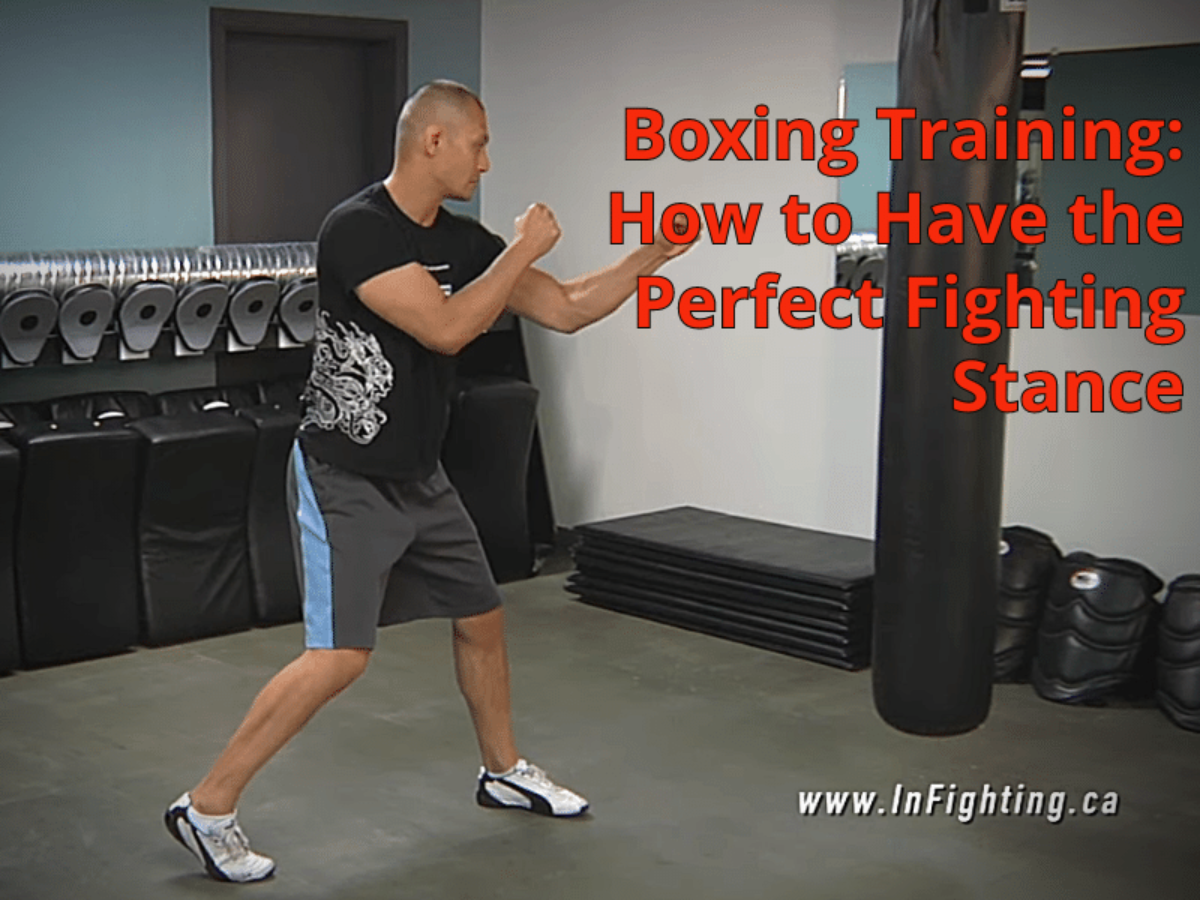
Before throwing punches or launching kicks, your foundation matters most. A correct stance protects your joints, improves balance, and generates power from the ground up.
Choose Your Base: Horse or Fighter?
You’ll typically use one of two stances:
- Horse Stance (Forward-Facing): Feet hip-width apart, facing forward. Ideal for drills focusing on coordination and core stability.
- Fighter Stance (Side-Facing): One foot slightly ahead, shoulders squared sideways. Mimics real boxing posture and allows rotational force in hooks and kicks.
Pro Tip: Start with the fighter stance if you’re new. It’s more functional and widely used in structured classes.
Key Alignment Cues
Use these visual checkpoints every time you reset:
- Feet: Hip-width apart, weight on the balls of your feet.
- Knees: Slightly bent, never locked.
- Core: Tight as if bracing for a light punch.
- Hands: Fists at chin level, elbows tucked.
- Shoulders: Down and slightly forward (protracted), not hunched.
- Wrists: Keep them straight when punching to avoid strain.
- Breathing: Inhale through the nose, exhale sharply with each strike.
Common Mistake: Letting hands drop after a combo. Stay “on guard” and protect your face at all times.
Essential Punching Techniques
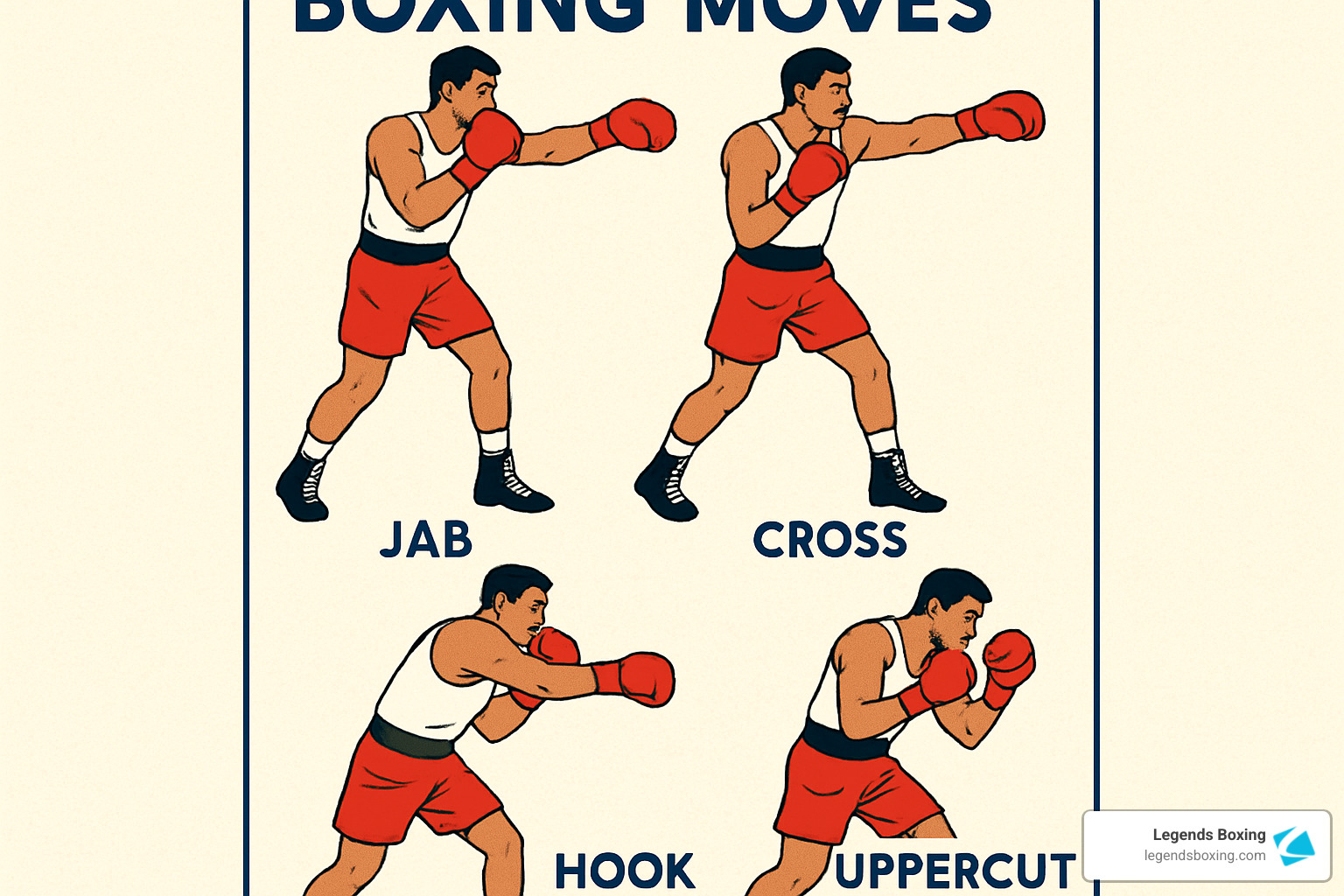
Punches are the engine of cardio kickboxing. Done right, they ignite your shoulders, chest, back, and core while spiking your heart rate.
Jab: The Speed Starter
- How: Step slightly forward with your lead foot and shoot your front hand straight ahead.
- Form Focus: Retract quickly; rear hand guards your chin.
- Purpose: Sets up combos, improves reaction speed.
Pro Tip: Imagine poking a balloon. Quick, sharp, and back in guard.
Cross: Power from Rotation
- How: Drive your rear hand straight forward, rotating your hips and shoulders.
- Form Focus: Push off the back foot; let your hip follow the toe line.
- Purpose: Builds rotational strength and cardiovascular intensity.
Visual Cue: Your back heel should lift slightly during execution.
Hook: Circular Force Generator
- How: Bend elbow to 90°, swing arm horizontally like a door opening.
- Form Focus: Keep forearm parallel to floor; power comes from hip twist.
- Variations: Lead hook, rear hook, body hook (to ribs), head hook.
Warning: Don’t “wind up.” Keep motion compact to avoid over-rotation.
Uppercut: Explosive Core Driver
- How: Start low, drive fist upward under imaginary chin.
- Form Focus: Slight knee bend, core tight, elbow close to body.
- Purpose: Activates abs and obliques with every upward snap.
Pro Tip: Think “punching up through butter.” Smooth but forceful.
Speed Bag Drill: Rhythm Builder
- How: Make large, alternating circular motions with arms (4-count pattern).
- Form Focus: Maintain guard between motions; shoulders relaxed.
- Purpose: Enhances coordination and shoulder endurance.
Beginner Hack: Practice slowly first. Speed comes with timing, not force.
Core Kicking Movements
Kicks elevate cardio kickboxing beyond standard boxing. They target legs, glutes, and balance, and burn serious calories.
Front Kick: Controlled Forward Strike
- How: Chamber knee, extend heel forward, snap back to chamber.
- Form Focus: Keep torso upright; don’t lean back.
- Target Zone: Mid-thigh height for safety and control.
Why It Works: Engages quads, hip flexors, and core stabilizers.
Side Kick: Lateral Powerhouse
- How: Shift weight to standing leg, kick opposite leg straight out to the side.
- Form Focus: Open hips fully; strike with the heel or ball of foot.
- Visual Cue: Imagine splitting wood. Straight line, full extension.
Beginner Mod: Tap foot out instead of kicking to maintain rhythm without jumping.
Rear Kick (Back Kick): Full-Body Rotation
- How: Step lead foot out at 45°, “choke and rip” with rear arm, kick straight back.
- Contact Point: Shin connects, not the foot.
- Form Focus: Eyes over shoulder; core engaged to prevent arching.
Advanced Option: Add 360° spin after kick. Only attempt once balance is solid.
Switch Kick: Dynamic Footwork Challenge
- How: Hop and switch stance mid-air, then execute a rear kick.
- Form Focus: Land softly in fighting stance; maintain rhythm.
- Purpose: Trains agility, coordination, and fast transitions.
Pro Tip: Practice the hop-switch without the kick first to master the footwork.
Knee Strike: Close-Range Burner
- How: Drive knee upward toward chest or hands (if pulling down overhead).
- Variations: Single knee, double knee, alternating knees.
- Form Focus: Keep back straight; engage core on lift.
Bonus Burn: Combine with uppercuts. “Knee plus punch” doubles core activation.
Boost Intensity with Cardio Integrations
To keep your heart rate in the fat-burning zone, intersperse kickboxing combos with plyometric and cardio boosters.
Jump Rope (Real or Simulated)
- With Rope: Swing wrists only; jump lightly on balls of feet.
- No Rope: Perform “Boxer’s Shuffle” with light hops mimicking rope rhythm.
- Time Saver: Use as warm-up or active rest between rounds.
Pro Move: Add double-unders (rope passes twice per jump) for advanced conditioning.
High Knee Holds & Marches
- How: Lift knees high, either holding at peak or marching.
- Purpose: Transitions between combos; active recovery.
- Form Focus: Chest up, core tight, don’t hunch forward.
Trainer Secret: Add a punch overhead with each knee for extra calorie burn.
Lateral Movements for Agility
- Lateral Lunge Pops: Step side, sink into lunge, pop up explosively.
- Lateral Shuffle: Quick side-to-side steps, staying low.
- Boxer’s Shuffle: Bounce lightly, shifting weight rhythmically.
Why It Matters: Builds hip mobility and prevents workout monotony.
Calisthenics That Complement Kicks
These bodyweight moves blend seamlessly into kickboxing circuits:
- Jumping Jacks + Punches: Add two overhead crosses at the top.
- Burpees with Rear Kick: After push-up, explode into a back kick before standing.
- Jump Lunges: Maximize leg power and aerobic output.
- Mountain Climbers: Drive knees fast. Perfect post-combo finisher.
- Scissor Kicks: Lie flat, alternate leg lifts at 45°. Killer for lower abs.
Expert Note: Use these in AMRAP rounds to test endurance and technique under fatigue.
Strength & Core Finishers
Cardio kickboxing builds functional strength, especially in the core. These targeted moves amplify results.
Plank Taps for Stability
- How: In plank position, alternate tapping shoulders, hips, toes.
- Form Focus: Minimize hip sway and keep pelvis still.
- Muscles Worked: Shoulders, core, glutes.
Challenge Level: Add a push-up after every 4 taps.
Oblique V-Up: Rotational Power
- How: Lie on back, lift legs and torso simultaneously, reaching hands to feet.
- Form Focus: Use abs, not momentum, to rise.
- Variation: Single-leg V-up for imbalance correction.
Pro Tip: Exhale sharply at the top to fully contract obliques.
Reverse Table Top Kick
- How: Sit with hands behind, legs lifted. Perform hip thrust, then extend one leg.
- Form Focus: Keep spine neutral; avoid overarching.
- Purpose: Targets glutes, hamstrings, and hip flexors.
Beginner Mod: Skip the kick and just do hip thrusts with leg lifts.
Side Bend for Oblique Flexibility
- How: Stand tall, reach one arm overhead, bend sideways.
- Form Focus: Keep chest forward and don’t rotate.
- Stretch Benefit: Releases tension built during rotational combos.
Use It Post-Workout: Hold 30 seconds per side during cool-down.
22-Minute Home Workout Protocol
No equipment? No problem. This no-equipment routine burns fat fast and fits in any schedule.
Structure: 50 Seconds Work / 10 Seconds Rest
Complete each block twice (R = right side, L = left):
Interval 1: Basic Combo Flow
- Jab (R) + Cross (R) + Front Kick (R)
- Repeat on left side
Focus: Speed and rhythm. Keep hands up.
Interval 2: Uppercut & Hook Series
- Uppercut (R) x2, Hook (R), Hook (L), Knee (R)
- Repeat on opposite side
Tip: Rotate hips fully on hooks to feel the twist.
Interval 3: Double Knee Burn
- Knee (R) x2 + 3 Uppercuts (R)
- Switch sides
Core Burn: Engage abs like you’re about to be punched.
Interval 4: Elbow Combo
- Jab x2 + Elbow (R) x2 + Elbow (L) x2
- Note: Simulate elbow strikes. No need to hit anything.
Safety: Keep elbows low and don’t flare out.
Interval 5: Combo + Stance Switch
- 2 Hooks + 2 Uppercuts + Switch Kick
- Repeat on opposite side
Challenge: Land quietly and balanced after switch.
Quick Burnout Round (30 Seconds Each)
- High Knee Holds
- Lateral Lunge Pops
- 2 Jumping Jacks + 3 Uppercuts (x3)
Finish Strong: Push pace but maintain form.
5-Round AMRAP Challenge

For those ready to test stamina and precision, this protocol builds mental toughness.
Format: 3 Minutes Work / 30 Seconds Rest
Repeat combo + exercise as many times as possible.
Warm-Up (3 Minutes)
- 1 min Jump Rope (or High Knees)
- 30 sec Sit-Ups
- 1 min Jump Rope
- 30 sec Sit-Ups
Round 1: Jab-Cross + Push-Ups
- Combo: Jab – Cross x10
- Exercise: Push-Ups x10
Form Check: Keep core tight during push-ups. No sagging hips.
Round 2: Triple Punch + Jacks
- Combo: Jab – Cross – Lead Hook x10
- Exercise: Jumping Jacks x10
Punch Tip: Rotate hips on the hook. Power comes from the core.
Round 3: Body & Head Hooks + Climbers
- Combo: Lead Body Hook – Rear Body Hook – Lead Head Hook – Rear Head Hook x10
- Exercise: Mountain Climbers x10
Breathing: Inhale during setup, exhale on each hook.
Round 4: Kick Combo + Jump Lunges
- Combo: Jab – Cross – Lead Hook – Rear Kick x10
- Exercise: Jump Lunges x10
Lunge Form: Land softly, knees aligned over toes.
Round 5: Switch Kick Finale + Burpees
- Combo: Jab – Cross – Lead Hook – Cross – Switch Kick x10
- Exercise: Burpees x5
Final Push: Focus on clean landings. Technique over speed.
25-Minute Core + Cardio Circuit
Blend strength and cardio in four balanced circuits. Ideal for 1–2 weekly sessions.
Circuit One: Kick & Core Sync
- Side Kick + Jumping Jack with Overhead Punch (R/L)
- Lateral Hop + Cross Punch (R/L)
- Plank Taps (Shoulders, Hips, Toes) – 30 seconds
Flow: Move quickly with no rest between exercises.
Circuit Two: Power & Push
- Squat Front Kick (R/L) – 10 reps
- Burpee Rear Kick (R/L) – 8 reps
- Push-Up + Plank Jack – 10 reps
Core Tip: Tuck pelvis during burpee kick to protect lower back.
Circuit Three: Punch Rhythm & Obliques
- Jab x2, Cross x2, 4 Speed Bags – 20 seconds
- Alternating Knee x2, Jab x2 – 20 seconds
- Oblique V-Up – 30 seconds
Rhythm Drill: Sync punches to a beat to increase coordination.
Circuit Four: Glute & Ab Finisher
- Reverse Table Top Hip Thrust + Kick – 10 reps
- Sit-Up + 2 Jabs – 12 reps
Cool Down Prep: Walk in place 1 minute between circuits.
Cool Down: Recover & Rebalance
Post-workout stretching prevents soreness and improves flexibility.
Hold Each Stretch 30–60 Seconds
Side Bend (Each Side)
- Stand hip-width, reach one arm overhead, lean sideways.
- Keep chest forward and don’t twist.
Knee-to-Chest Stretch (Each Leg)
- Lie on back, pull one knee to chest.
- Keep opposite leg straight, lower back flat.
Child’s Pose (Full Minute)
- Knees wide, big toes touching, fold forward.
- Rest forehead on floor, arms extended or by sides.
Bonus Mobility: Add ankle circles and wrist rolls to relieve tension from repeated motion.
Why Cardio Kickboxing Works

Calorie Burn & Fat Loss
A 155-lb person can burn 300–500 calories in 30 minutes of moderate to high-intensity cardio kickboxing. The mix of explosive movements and short rests keeps EPOC (afterburn effect) elevated, meaning you keep burning calories post-workout.
Key Fact: It’s not just cardio. The resistance from bodyweight and repetition builds lean muscle, which boosts resting metabolism.
Full-Body Muscle Activation
Every move engages multiple muscle groups:
– Legs & Glutes: Kicks, lunges, jumps
– Core: Rotation, bracing, knee drives
– Upper Body: Punches, shuffles, push-ups
– Stabilizers: Ankles, hips, shoulders
This total-body demand leads to improved coordination, balance, and functional strength.
Mental Health Boost
The rhythmic, aggressive nature of striking provides a powerful outlet for stress. Rhythmic physical activity like punch combos can reduce anxiety and improve mood through endorphin release.
Real Benefit: You’re not just training your body. You’re clearing your mind.
Frequently Asked Questions About Cardio Kickboxing Exercises
Is cardio kickboxing real fighting training?
No. Cardio kickboxing is fitness-focused, not combat training. Techniques are adapted for safety and repetition rather than real strikes. You won’t learn sparring or defense tactics.
Do I need gloves or equipment?
Not required. You can shadowbox effectively with bare hands. Gloves add comfort and wrist support but aren’t necessary for home workouts.
How often should I do cardio kickboxing?
- Beginners: 1–2 times per week
- Intermediate/Advanced: 2–3 times weekly
- Rest Days: Allow recovery and pair with yoga or walking.
Can I lose belly fat with cardio kickboxing?
Cardio kickboxing contributes to overall fat loss, including visceral fat. However, spot reduction isn’t possible. Combine workouts with a balanced diet and consistent movement for best results.
How do I modify cardio kickboxing for joint pain?
- Low-Impact Swap: Replace jumps with step-taps.
- Reduce Kick Height: Keep kicks below waist level.
- Slow Tempo: Focus on form, not speed.
Safety First: Stop if you feel joint pain, especially in knees or wrists.
Key Takeaways for Building Your Cardio Kickboxing Routine
Cardio kickboxing exercises are more than a trend. They’re a proven, accessible way to build fitness, burn fat, and feel empowered. With no equipment needed and routines that fit in under 30 minutes, it’s one of the most efficient full-body workouts available. Whether you’re a beginner mastering your first jab or an athlete pushing through an AMRAP challenge, every punch and kick brings you closer to a stronger, sharper, more confident you.
Start today. Throw that first jab. Feel the energy rise. And remember: you’re not just moving. You’re transforming.