ACL Surgery Cardio: Safe Exercises Guide
You’ve just had ACL surgery, and your world has slowed to a crawl. Walking hurts. Stairs feel impossible. Running feels like a distant dream. But here’s the reality: smart, phased cardio exercises after ACL surgery can rebuild your fitness without compromising your healing graft.
The right cardio does more than protect your heart. It prevents muscle loss, boosts circulation to the knee, and keeps your mental health intact during months of recovery. The wrong move, too soon, can mean retearing the graft and facing revision surgery.
This guide walks you through exactly which cardio exercises after ACL surgery are safe at each stage, how to progress without setbacks, and the warning signs that mean you need to pause. You’ll get a clear roadmap from day one to your first jog and beyond.
Why Cardio Matters During ACL Recovery
ACL recovery is long, often six to nine months, and inactivity hits your body fast. Muscle strength begins declining after roughly two months of rest, while cardiovascular fitness drops even faster. Cardio counters both.
Beyond the physical, ACL tears take a mental toll. Staying engaged with structured exercise reduces anxiety, builds routine, and gives you a sense of progress when healing feels slow. Focus on consistent, moderate effort rather than rushing back to intensity.
Phase 1: Early Recovery (Weeks 1–4): Protect the Knee

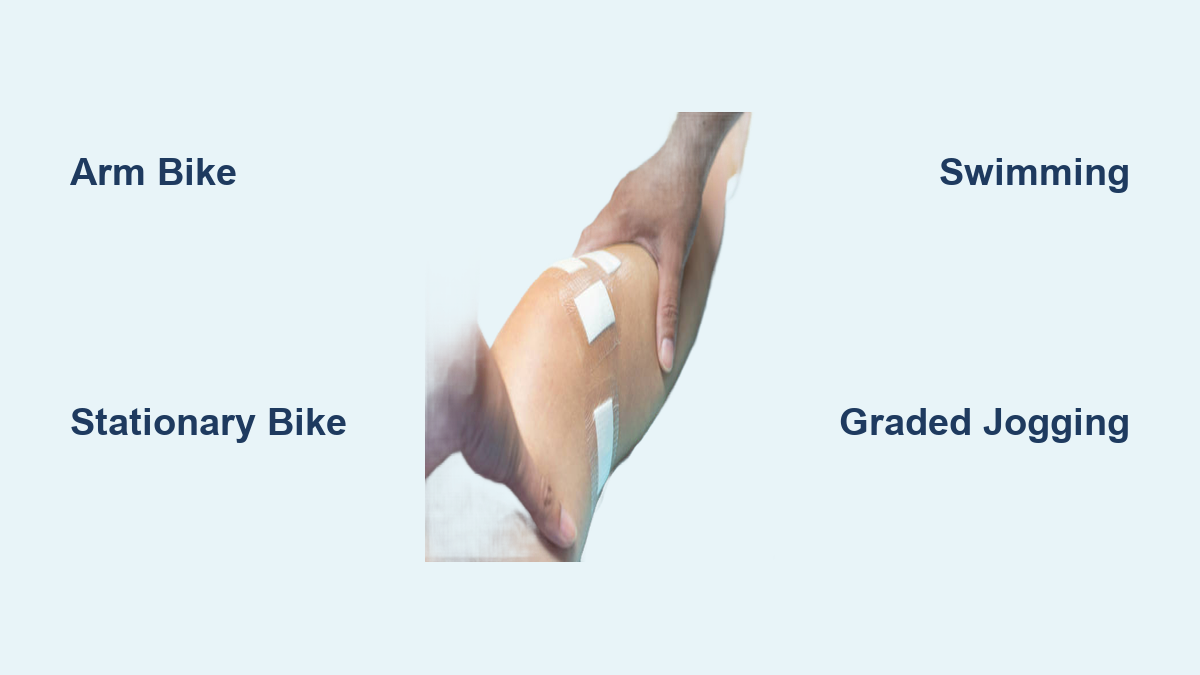
In the first weeks, your knee is fragile. Swelling, limited range of motion, and weakness are normal. Your only cardio goal now is raising your heart rate without loading the joint. Every exercise must be non-weight-bearing and zero impact.
Upper Body Ergometer (Arm Bike)
The arm bike is the gold standard for early-stage cardio. You pedal using only your arms, building endurance with zero stress on the knee.
- Start with 10–15 minutes at low resistance.
- Keep motion smooth and controlled.
- Avoid leaning or using momentum.
- Use daily, once cleared by your physical therapist.
Seated Ski Erg
The seated ski erg mimics Nordic skiing from a stable chair. You pull handles down and forward, engaging arms, shoulders, and core.
- Keep your back straight and knees still.
- Use short intervals: 30 seconds on, 60 seconds off.
- Progress only when pain-free and swelling is controlled.
Seated Cardio Drills
No equipment? No problem. A sturdy chair and some creativity go a long way.
Seated boxing:
– Punch forward, upward, or diagonally with light or no weights.
– Keep movements controlled, no twisting at the waist.
– Start with 2 sets of 30 seconds.
Seated battle ropes:
– Anchor resistance ropes to a wall or post.
– Use alternating or double-arm waves while seated.
– Begin with 30-second intervals, rest 1 minute.
Floor Core Work
Core stability protects the knee during later stages. Safe early options include:
- Heel slides for gentle knee flexion
- Quad sets to activate the thigh
- Glute bridges (if approved)
- Abdominal bracing
Stop immediately if any movement causes pain or swelling.
Phase 2: Intermediate Recovery (Weeks 4–8): Add Low-Impact Motion
Once swelling drops, range of motion improves, and your physical therapist clears you, you can add cardio that involves the legs, as long as it stays low-impact.
Stationary Cycling
The stationary bike is a rehab staple. It provides smooth, controlled motion that gently increases knee flexion without impact.
- Start with no resistance and the seat high so your knee barely bends.
- Aim for 10–15 minutes, 3–4 times per week.
- Focus on smooth pedaling, not speed.
- Increase resistance and duration only as cleared.
You should complete a full pedal stroke without pain or limping.
Swimming and Water Aerobics
Water supports body weight while providing resistance, making it ideal for cardio conditioning.
Safe options:
– Freestyle (front crawl)
– Backstroke
– Water walking
– Water aerobics
Avoid the breaststroke kick, which places rotational stress on the ACL. Get stroke-specific clearance before diving in, and start with 10–15 minutes.
Elliptical Trainer
The elliptical mimics running without the landing impact, serving as a bridge between cycling and jogging.
- Begin around 6–8 weeks post-op, only if cleared.
- Use no incline, no resistance, and hold the rails for stability.
- Start with 5–10 minutes, 2–3 times per week.
- Keep strides short and smooth.
Stop if you notice knee strain or swelling afterward.
Rowing Machine
The rower is low-impact but demands significant knee flexion. Use it only when your range of motion allows full leg extension and flexion.
- Set resistance low.
- Focus on arm-driven motion, not leg power.
- Limit sessions to 10 minutes initially.
- Avoid jerking or locking the knees.
Have your physical therapist supervise your first sessions.
Brisk Walking
Once you’re fully weight-bearing and walking without a limp, brisk walking becomes a foundational cardio exercise.
- Start with 5–10 minutes on flat ground.
- Wear supportive footwear.
- Gradually increase to 30 minutes, 3–5 times per week.
- Avoid hills or uneven terrain early on.
Phase 3: Advanced Recovery (Months 3–4+): Return to Impact

At 3–4 months post-surgery, many patients can begin jogging, provided they’ve met specific milestones:
- Full or near-full range of motion
- No swelling at rest
- Strong quad and hamstring strength
- Medical and PT clearance
Follow a Graded Jogging Plan
Your physical therapist should provide a structured jogging protocol. A typical plan looks like this:
| Week | Activity |
|---|---|
| 1 | Walk 4 min, jog 1 min – repeat 5x |
| 2 | Walk 3 min, jog 2 min – repeat 5x |
| 3 | Walk 2 min, jog 3 min – repeat 5x |
| 4 | Walk 1 min, jog 4 min – repeat 5x |
| 5 | Continuous 25-minute jog |
Rules to follow:
– Run on a flat, soft surface like a track or treadmill.
– Wear supportive shoes.
– Stop if you feel pain, swelling, or instability.
– Never increase time and intensity in the same week.
This slow build-up protects the ACL graft during its most vulnerable phase.
Avoid High-Impact Too Soon
Even after starting to jog, avoid:
- Jumping
- Sprinting
- Cutting or pivoting
- Sports drills
These movements place high rotational and deceleration forces on the knee. Most athletes don’t return to sport until 6–9 months, and only after passing functional tests.
Strength Training: The Cardio Support System

Cardio alone isn’t enough. Strength training protects the knee, improves mechanics, and prevents re-injury.
Key Rehab Exercises
- Straight leg raises to build quad strength without bending the knee
- Heel slides to improve flexion safely
- Hamstring curls to strengthen the back of the thigh
- Clamshells to activate glutes
- Step-ups starting with a 2-inch height and hand support
Do these 2–3 times per week, focusing on form over speed.
Sample Weekly Integration
A balanced weekly plan might look like:
- Monday: Stationary bike + leg exercises
- Tuesday: Upper body ergometer + core
- Wednesday: Rest or light walking
- Thursday: Elliptical + strength circuit
- Friday: Swimming + stretching
- Weekend: Brisk walk or rest
Safety First: Mistakes That Derail Recovery
Never Skip Medical Clearance
Feeling better isn’t the same as being ready. Only start cardio when your doctor or physical therapist says yes. Pushing too early risks:
- Retearing the ACL
- Chronic swelling
- Graft failure
- Revision surgery
Stop If You Feel Pain or Swelling
Pain and swelling are warning signs. If your knee swells after exercise, reduce intensity or stop. Ice, elevate, and report changes to your PT.
Don’t Compare Your Timeline to Others
Recovery isn’t linear. Some days you’ll feel great. Others, not so much. Focus on your progress, not someone else’s journey.
Activities to Avoid Early
- High-impact exercises like running and jumping
- Twisting motions such as lateral cuts and pivoting
- Breaststroke kick in swimming
- Heavy weightlifting without clearance
Track Your Progress
Use a simple log to monitor:
- Exercise type and duration
- Knee swelling (none, mild, moderate, severe)
- Pain level (0–10)
- Any instability or “giving way”
This helps your therapist adjust your plan and keeps you accountable.
Frequently Asked Questions About Cardio Exercises After ACL Surgery
When Can I Start Cardio After ACL Surgery?
You can begin non-weight-bearing cardio like the arm bike within the first week or two, once your physical therapist clears you. Weight-bearing cardio such as cycling typically starts around 4–6 weeks post-op, depending on your range of motion and swelling levels.
Is Stationary Biking Safe After ACL Surgery?
Yes, stationary biking is one of the most recommended cardio exercises after ACL surgery. Start with no resistance and a high seat so your knee barely bends. Focus on smooth, pain-free pedaling before adding intensity.
Can I Swim After ACL Surgery?
Swimming is safe and highly recommended, but avoid the breaststroke kick because it places rotational stress on the ACL. Freestyle and backstroke are preferred, and you should get stroke-specific clearance from your therapist before starting.
When Can I Start Jogging After ACL Surgery?
Most patients can begin a graded jogging program around 3–4 months post-surgery, provided they have full range of motion, no swelling, strong quad and hamstring strength, and explicit medical clearance.
What Cardio Should I Avoid After ACL Surgery?
Avoid high-impact activities like running, jumping, and plyometrics until cleared. Also avoid the breaststroke kick, twisting motions, and any exercise that causes pain or increased swelling.
How Long Does Full ACL Recovery Take?
Full recovery typically takes 6 to 9 months. About 90% of people achieve full recovery with consistent rehabilitation and proper medical guidance.
Key Takeaways for Rebuilding Cardio After ACL Surgery

Cardio exercises after ACL surgery are not just safe, they are essential for physical and mental recovery. Start with non-weight-bearing options like the arm bike and seated drills, progress to low-impact activities like cycling and swimming, and only return to jogging after 3–4 months with a graded plan and medical clearance.
Success comes from patience, precision, and professional guidance. Follow your rehab plan, listen to your body, and never rush the process. With consistency, about 90% of people return to full activity, stronger and smarter than before.
Your next step: schedule a check-in with your physical therapist to confirm which phase you’re in and get personalized clearance for your next cardio milestone.