Cardio After Shoulder Surgery: Safe Exercises
You’re cleared from surgery, your sling is off, and you’re itching to move. But one wrong move could undo months of healing. Cardio exercise after shoulder surgery is absolutely possible, and staying active actually supports recovery, but timing and exercise selection make all the difference between healing well and re-injury.
This guide walks you through exactly what cardio you can do at each stage of recovery, from week one through full clearance. You’ll learn which machines are safe, which movements to avoid, and how to rebuild your endurance without compromising your surgical repair. Whether you had a rotator cuff repair, labral surgery, or shoulder replacement, these evidence-based guidelines will help you stay fit while your shoulder heals.
Early Cardio Options (0–4 Weeks Post-Surgery)
The first month is about protection. Your shoulder is immobilized in a sling, and active movement is strictly off-limits. But that doesn’t mean you have to become a couch potato. Lower-body cardio keeps your heart healthy, improves circulation, and prevents deconditioning during this critical healing window.
Approved Low-Impact Cardio Activities
You can start these almost immediately, assuming your surgeon gives clearance:
- Walking (brisk or casual): Ideal for maintaining aerobic fitness. Keep arms relaxed at your sides.
- Stationary biking (upright or recumbent): Excellent choice. Rest hands lightly on handlebars or keep them on your thighs to avoid weight-bearing.
- Treadmill walking: Only if you can walk without gripping handrails, which can strain the shoulder through compensation.
Avoid: Running, jogging, or any activity involving arm swing. Even slight shoulder motion can disrupt healing tendons.
Safety Rules for Initial Cardio
- No arm support: Do not lean on handles, railings, or walls.
- Short sessions: Start with 10–15 minutes, 3–4 times per week.
- Pain-free only: Stop immediately if you feel pulling, pain, or instability.
- Wear your sling: Keep it on when standing or moving, even during exercise.
Pro Tip: Focus on posture. Slouching or hiking your shoulder to compensate can delay healing and create new problems.
Safe Progression at 4–8 Weeks
By week five, many patients transition from passive to active range of motion. This is a critical window for gradually increasing cardio intensity without overloading the shoulder.
Can You Start Running?
Yes, but cautiously. If your surgeon approves, light jogging may begin around week 5–6 under specific conditions:
- Control arm swing: Keep elbows bent at 90 degrees and avoid aggressive arm motion.
- Short durations: Start with 5–10 minutes of light running, alternating with walking intervals.
- Monitor symptoms: Pain, clicking, or shoulder fatigue means stop and wait longer.
Alternative: Increase walking speed or treadmill incline instead of running to boost cardiovascular load safely.
Elliptical Use Guidelines
The elliptical can be introduced only if your arms remain still:
- Use without engaging the arm handles.
- Keep your upper body upright and relaxed.
- Limit sessions to 15–20 minutes initially.
Warning: If the machine forces arm movement or you feel any pulling, skip it entirely.
Adding Lower-Body Strength to Cardio
You can now incorporate light leg exercises to elevate your heart rate:
- Bodyweight squats
- Sit-to-stands from a chair
- Resistance band leg presses
- Glute bridges
Perform these in circuits (30 seconds per exercise, 3 rounds) to boost cardiovascular fitness safely.
Full Cardio Reintroduction (8–12 Weeks)
By week eight, tissue healing is well underway. Most patients regain passive range of motion and begin active strengthening. This is when low-impact cardio becomes fully permissible and intensity can increase.
Cardio Options Now Allowed
- Stationary bike: Increase resistance gradually as comfort allows.
- Walking/jogging: Progress to 20–30 minute sessions.
- Elliptical: Now safe with light arm movement, if pain-free.
- Light aerobics: Dance-based or step classes that avoid overhead motions.
Progression Rule: Increase duration or intensity by no more than 5–10% per week to avoid overload.
When to Add Resistance Training
At 12 weeks post-op, you may begin light resistance training, but only if:
- Full pain-free range of motion is achieved.
- Rotator cuff strength is improving.
- Your surgeon or physical therapist gives approval.
Start with:
– Light dumbbells (1–3 lbs)
– Resistance bands
– Machine-based exercises that allow natural scapular movement
Avoid free weights overhead or across the body until later phases of recovery.
Advanced Cardio at 3–4 Months
By the three-month mark, most patients are cleared for light gym workouts and sport-specific conditioning. Cardiovascular training can become more dynamic at this stage.
Permitted Activities
- Swimming: Begin with breaststroke or kick-only drills. Avoid freestyle or butterfly, which require overhead motion.
- Cycling classes: Spin classes are okay with upright form and no handlebar pressure.
- Pilates or yoga: Focus on core and breathing; avoid poses that load the shoulder (plank, downward dog).
- Light HIIT: Only non-impact versions like marching, leg drives, or seated jumps.
Combining Strength and Cardio
You can now mix light weights with cardio in circuit format:
- Example: 30 seconds of walking lunges + 30 seconds of light bicep curls (non-operative arm)
- Keep reps low and movements controlled
Rule of thumb: If an exercise causes shoulder shrugging or compensation, skip it.
High-Intensity Return at 6 Months and Beyond

At six months post-surgery, most patients achieve full clearance for all activities, including high-intensity workouts and contact sports, with surgeon confirmation.
Now Safe (If Cleared)
- Running and sprinting
- Rowing machines (with proper form)
- Boxing or kickboxing (no heavy bag work until strength is solid)
- Burpees, push-ups, and planks (only after rotator cuff strength is confirmed)
- Full gym routines, including overhead presses and pull-downs
Important: Even at six months, 28% of rotator cuff patients are still regaining functional strength according to research published in PubMed Central. Don’t assume full function just because time has passed.
Sport-Specific Reintegration
- Golf: Begin with putting at 3 months, full swings at 4–5 months.
- Tennis: Start with groundstrokes at 4 months, serves at 6+ months.
- Swimming: Full strokes allowed after 6 months, if pain-free.
Critical Exercises to Avoid in the First 6 Weeks
Some movements can derail your recovery, even if they feel easy. Avoid these at all costs early on:
Absolute No-Gos
- Push-ups or planks: Place direct load on healing tendons
- Pull-ups or rows: Engage the shoulder girdle aggressively
- Overhead lifts: Risk of re-tear
- Behind-the-back motions: Stretch the anterior capsule
- Rotational exercises: Can displace labral repairs
Equipment to Skip Early
- Rowing machines: Force shoulder extension and pulling
- Chest presses: Even light machines strain the front of the shoulder
- Dip bars: High risk of dislocation or strain
- Massage guns on the shoulder: Can disrupt healing tissue
One case report documented a vertebral artery dissection from improper massage gun use on the neck. Never apply pressure near the surgical area.
Safe Shoulder Mobility Drills During Cardio Recovery
While doing cardio, you can support shoulder recovery with gentle, passive mobility exercises, as long as they don’t strain the joint.
Pendulum Swings
- Purpose: Loosen the joint without muscle activation
- How to do it:
1. Bend forward at the waist.
2. Let the operative arm hang down loosely.
3. Gently swing in small circles, initiated by the hips, not the shoulder. - Frequency: 2–3 times daily, 30 seconds per direction
Wall Crawls (Walk-Up)
- Purpose: Improve forward reach and flexion
- How to do it:
1. Stand facing a wall.
2. “Walk” fingers up as high as comfortable.
3. Hold for 10–20 seconds. - Progress slowly: Aim for incremental gains weekly
Supported Shoulder Rotations
- Sit with elbow at 90°, forearm resting on a table.
- Move your hand side to side (internal/external rotation).
- Keep your shoulder blade down with no shrugging.
Only do these if approved by your physical therapist.
Cross-Training Strategies to Stay Fit
Cross-training helps maintain overall fitness without overloading the shoulder. Focus on lower-body dominance and core stability.
Best Cross-Training Activities
- Stationary cycling: Build leg endurance
- Walking hills or inclines: Boost cardiovascular load
- Leg press machines: Safe strength building
- Swimming (kick-only): Full-body cardio with zero shoulder strain
- Seated cardio machines: Arm-free options only
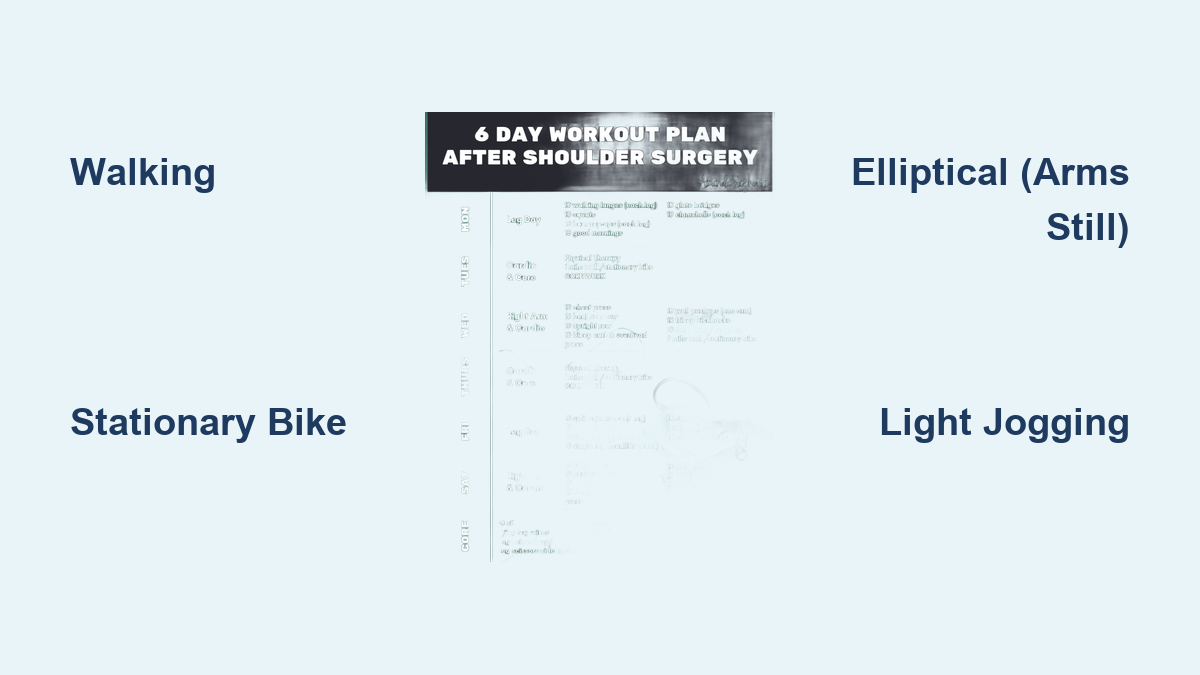
Sample Weekly Plan (Weeks 4–8)
| Day | Activity | Duration |
|---|---|---|
| Monday | Recumbent bike | 15 min |
| Tuesday | Walking + pendulum swings | 20 min |
| Wednesday | Rest or light stretching | — |
| Thursday | Elliptical (arms still) | 15 min |
| Friday | Resistance band leg workout | 20 min |
| Saturday | Brisk walk | 25 min |
| Sunday | Rest | — |
Increase duration by 5 minutes weekly if pain-free.
Nutrition and Recovery Support
You’re less active, but your body needs more fuel to heal. Don’t let reduced movement become an excuse for poor nutrition.
Eat for Healing
- Protein: 1.2–1.6g per kg of body weight (chicken, fish, eggs, legumes)
- Vitamin C: Supports collagen formation (citrus, bell peppers, broccoli)
- Omega-3s: Reduce inflammation (salmon, flaxseed, walnuts)
- Hydration: At least 8 glasses of water daily
Avoid
- Alcohol: Slows tissue repair and increases inflammation
- Processed sugars: Promote swelling and delay healing
- Excess sodium: Contributes to fluid retention
Small, frequent meals help maintain energy without overeating.
Warning Signs to Stop and Seek Help
Your body will tell you when something’s wrong. Don’t ignore these red flags:
- Sharp pain in the shoulder during or after exercise
- Swelling or warmth around the incision
- Persistent fatigue after light activity
- Joint instability (“giving way” sensation)
- Numbness or tingling down the arm
- Fever or redness, which may indicate infection
Contact your surgeon immediately if any of these occur.
Final Clearance Timeline Summary
| Phase | Timeframe | Cardio Allowed | Restrictions |
|---|---|---|---|
| Immobilization | 0–4 weeks | Walking, stationary bike (no arm pressure) | No running, no arm movement |
| Mobilization | 4–8 weeks | Light running, elliptical (arms still) | Avoid arm swing, no resistance |
| Strengthening | 8–12 weeks | All low-impact cardio, light resistance | No overhead or heavy lifting |
| Integration | 3–4 months | Sport-specific drills, light gym weights | No throwing or full swings |
| Full Return | 6+ months | All activities with surgeon clearance | Monitor strength and stability |
Frequently Asked Questions About Cardio Exercise After Shoulder Surgery
When can I start doing cardio after shoulder surgery?
You can begin lower-body cardio almost immediately, often within the first week. Walking and stationary cycling (without leaning on handlebars) are typically safe as soon as your surgeon clears you. Upper-body cardio and running usually wait until 4–6 weeks post-op.
Is it safe to use a treadmill after shoulder surgery?
Yes, but only if you walk without gripping the handrails. Holding onto rails can alter your gait and place compensatory stress on your healing shoulder. Start with short sessions of 10–15 minutes and avoid any arm swing that causes pulling or pain.
Can I ride a stationary bike after rotator cuff surgery?
Stationary biking is one of the best cardio options during recovery. Both upright and recumbent bikes work well. Keep your hands resting lightly on the handlebars or on your thighs to avoid placing weight through the surgical shoulder.
When can I return to running after shoulder surgery?
Light jogging may be possible around weeks 5–6, depending on your surgeon’s approval and your ability to control arm swing. Start with short intervals alternating with walking, and stop immediately if you feel pain, clicking, or shoulder fatigue.
What cardio exercises should I avoid after shoulder surgery?
Avoid any activity involving arm swing, overhead motion, or pushing/pulling through the arms. This includes running (initially), rowing machines, elliptical with arm handles, push-ups, planks, and swimming strokes that require overhead reaching. These restrictions typically last 6–12 weeks minimum.
How long until I can do high-intensity cardio after shoulder surgery?
Most patients reach full clearance for high-intensity workouts around 6 months post-surgery. However, recovery varies significantly. Research shows 28% of rotator cuff patients still regain strength beyond 6 months, so always confirm with your surgeon before pushing intensity.
Key Takeaways for Safely Returning to Cardio After Shoulder Surgery
Recovery is not linear. Some patients regain strength in three months; others take six months or longer. Your surgeon and physical therapist are your final authority, not timelines or online advice. Never add intensity, weight, or new movements without professional approval.
The most important principles are simple: protect the repair in early weeks, progress gradually, listen to your body, and prioritize lower-body cardio while your shoulder heals. By following this phased approach, you can safely maintain cardiovascular fitness, support healing, and return to full activity, stronger and smarter than before.