Punching Bag Drills for Cardio 2026
You’re not just burning calories when you hit the heavy bag. You’re building endurance, power, and mental resilience all at once. Punching bag drills for cardio deliver a full-body, high-intensity workout that torches up to 800 calories per hour while sharpening coordination, agility, and heart health. Unlike monotonous treadmill runs, this dynamic training mimics the stop-and-go rhythm of real combat, pushing your cardiovascular system into peak conditioning through rapid shifts in effort and breathing.
Whether you’re a beginner looking to get in shape or an advanced athlete chasing VO2 max, structured bag work offers scalable intensity with measurable results. In this guide, you’ll learn how to build a cardio-optimized punching bag routine using proven protocols, proper form, and smart progression. No prior boxing experience needed.
Choose the Right Bag and Gear for Cardio Success

Pick Your Ideal Heavy Bag
Not all bags deliver the same cardio benefit. For sustained punching drills, a standard 4 to 5 foot cylindrical heavy bag weighing about half your body weight provides optimal resistance and stability. A 150-pound person should aim for a 75-pound bag. If choosing between 75, 100, or 125 lbs, go with 100 for balance.
Pre-filled bags offer convenience, but custom-filling with textiles like old clothes provides more give and reduces joint strain. Avoid sand-filled bags unless you’re training for power. They’re too rigid for high-rep cardio work.
Prefer home training? A free-standing bag works, but expect some wobble. These bases can slide during aggressive footwork, which may disrupt rhythm. For serious cardio conditioning, a ceiling-mounted bag ensures consistent feedback and better technique development.
Use Correct Gloves and Wraps
Never skip protection. For punching bag cardio, wear 12 to 14-ounce gloves. Skip the 16-ounce sparring gloves, which add unnecessary forearm fatigue. Leather gloves last longer and mold to your hand, while synthetic options are budget-friendly but less durable.
Pair gloves with 180-inch cloth hand wraps. These stabilize the wrist, cushion knuckles, and prevent tendon strain. Quick wraps save time but offer less support. If you’re training three or more rounds weekly, invest in quality wraps to extend your training lifespan.
Master Core Punching Technique Before Going Hard
Set a Strong Fighting Stance
Your stance is the foundation of every cardio-efficient punch. Stand with feet shoulder-width apart, lead foot slightly forward (left for orthodox fighters), knees bent slightly, weight balanced on the balls of your feet.
Keep hands near your cheeks, elbows tucked, chin down. Your body should be staggered, not square, to allow hip rotation and protect your core. From this position, you can pivot, step, and strike with maximum efficiency and minimal energy waste.
Power Comes From the Ground Up
Punching isn’t arm work. It’s full-body movement. Power starts at the feet, transfers through the hips, and explodes through the fist.
- Jab: Quick, straight punch from the lead hand. Extend fully, knuckles turning up, then snap back fast.
- Cross: Rear-hand power shot. Pivot the back foot, rotate hips, and drive the fist straight through the target.
- Hook: Semi-circular punch with elbow at 90 degrees. Rotate torso and pivot the lead foot to generate force.
- Uppercut: Upward punch from the hip. Shift weight to the striking side, palm facing you, and drive upward.
All punches require sharp exhalation on impact. This braces your core, boosts power, and prevents breath-holding, a common cause of early fatigue.
Hit Safely and Accurately
Always strike with the first two knuckles (index and middle finger). Avoid landing punches with the smaller fingers to prevent hand injuries. Aim for 50 to 70% power during most cardio rounds to maintain speed, protect joints, and build endurance.
Beginners should start light. Focus on form, rhythm, and recovery. Speed and power develop with time.
10-Minute Cardio Blast Drill for Fast Fat Burn
Structure: 1-Minute Rounds With 20-Second Rest
This high-volume circuit builds stamina and sharpens technique. Total time runs about 14 minutes.
Round 1: Jab-Cross Flow
Alternate jabs and crosses non-stop. Keep movements tight, fast, and controlled. Retract each punch quickly. Move slightly around the bag to engage footwork. The goal here is rhythm, not power.
Round 2: Left Hand Only (Jabs)
Throw only lead jabs, mixing head and body levels. Keep the rear hand glued to your cheek. Add double jabs to increase speed. This isolates your lead side and reinforces balance.
Round 3: Right Hand Only (Crosses)
Focus solely on rear crosses. Pivot the back foot with each punch and rotate the hips fully. Turn the fist over on impact. Retract fast. This builds power mechanics on your dominant side.
Round 4: Continuous Jab-Cross Combo
Chain jab-cross sequences without pause. Prioritize consistency over speed. Think of it as active recovery. Keep moving, breathing, and punching.
Round 5: Left Power Hooks
Throw only left hooks to head and body. Rotate deeply from the hips. Sit into each punch like you’re driving through an opponent. Use the right hand for balance.
Round 6: Right Power Hooks
Mirror Round 5 with your rear hand. Keep the lead hand high for defense. Vary between standard and overhand hooks to challenge coordination.
Round 7: Fast Jab-Cross Burst
Go rapid-fire on your jab-cross combo. Aim for forehead height to improve reach and shoulder endurance. Keep punches sharp and full with no half-extensions.
Round 8: Left Hand Variety
Use only your lead hand and mix jabs, hooks, uppercuts, and body shots. Double or triple hooks work well here. This forces creativity and strengthens muscle memory.
Round 9: Right Hand Variety
Same as Round 8, but with your dominant hand. Combine crosses, hooks, uppercuts, and overhands. Stay disciplined and don’t drop the non-punching hand.
Round 10: All-Out Finisher
Unleash continuous jab-cross combos. Punch high, extend fully, rotate hips. Push past fatigue. This is mental toughness training. Finish strong.
20-Minute Balanced Cardio Routine for Intermediate Users
3-Minute Rounds With 30-Second Rest
This routine mixes technique, footwork, and defense for intermediate users.
Warm-Up (5 Minutes)
- Arm circles and shoulder rolls for 1 minute
- Jump rope for 2 minutes (mix basic, high knees, double-unders)
- Shadowboxing for 2 minutes (slow, controlled, focus on form)
Round 1: Jab-Cross Rhythm
Throw jab-cross combos with full rotation. Focus on timing and accuracy. Step in and out to vary distance.
Round 2: Hooks and Uppercuts
Alternate powerful hooks and rapid uppercuts. Pivot feet with each strike. Engage the core and don’t swing from the shoulders.
Round 3: Defense and Counters
Add bobbing, weaving, slipping, and blocking. After each defensive move, fire a quick counter (slip to cross). Stay light on your feet.
Round 4: Footwork Plus Combos
Combine all four punches with deliberate steps. Step in with a jab, pivot out with a hook. Control distance like a real fight.
Round 5: High-Intensity Finisher
- 30 seconds straight punches
- 30 seconds hooks and uppercuts
- 30 seconds knee strikes (or high knees if no banana bag)
- Repeat twice
30-Minute Strength and Accuracy Drill
5-Minute Rounds With 5-Minute Cool-Down
Build precision, balance, and muscular endurance.
Warm-Up (5 Minutes)
- Boxer’s shuffle for 1 minute in each direction
- Arm circles for 1 minute forward and backward
- High knees for 1 minute
Round 1: Plank Punches
In a high plank facing the bag, punch with one arm while balancing on the other. Alternate. This drill torches the core and improves stability.
Round 2: 1-2-Hook-Hook Combo
Jab, cross, rear hook, lead hook. Focus on power in the hooks. Imagine a knockout setup.
Round 3: Accuracy Drill
- 4 rapid straight punches to one spot (test precision)
- 10 alternating power body shots (left and right)
Cool-Down (5 Minutes)
- Cobra stretch for 60 seconds
- Cross-body arm pull for 60 seconds per side
- Seated spinal twist for 60 seconds per side
Beginner-Friendly No-Spaz Routine
20 to 25 Minutes Total
Avoid flailing. Build coordination and confidence.
Warm-Up Punches (3 Minutes)
Slow, deliberate jabs, crosses, and hooks. Focus on hip rotation and elbow control.
Combo Rounds (4 Rounds, 45 Seconds On, 30 Seconds Off)
- Combo 1: Jab, Jab, Cross (1-1-2)
- Combo 2: Jab, Lead Hook, Cross
- Combo 3: Jab, Cross, Rear Hook
Rest 30 seconds between rounds. Keep hands up after each punch.
Footwork Integration (5 Minutes)
- Step in with a jab
- Step back with a cross
- Lateral move with a hook
- Pivot to reset
No jumping. Pivot on the balls of your feet.
Full-Body Flow (4 Minutes)
Jab, cross, step forward, lead hook, step back, rear hook, pivot, reset. Keep it smooth.
Key Tip: Space out punches. Never throw all at once. Quality beats chaos every time.
Advanced 6-Round Build Drill for Experienced Athletes

3-Minute Rounds With 1-Minute Rest
This drill includes burpees and tempo shifts for experienced users.
Round 1: Shadowboxing Only
No bag. Move, cut angles, throw all punches. Stay light on your feet and focus on breath.
Round 2: Build Plus Burpees
Cycle through: Jab, Jab-Cross-Hook, Jab-Cross-Hook-Cross. Then 20 fast straight punches followed by 1 burpee. Repeat. For the last 10 seconds, throw non-stop straights. End with 5 burpees.
Round 3: Jab-Cross Variations
Cycle through: Jab-Cross, Jab-Jab-Cross, Jab-Jab-Jab-Cross. Vary speed. Last 10 seconds: max straights. End with 5 burpees.
Round 4: Same-Side Combos
Use only rear hand combos, then only lead hand combos. Last 10 seconds: max straights. End with 5 burpees.
Round 5: Slow to Fast
Throw 5 slow, soft punches followed immediately by 3 hard, fast punches. Repeat. Last 10 seconds: max straights. End with 5 burpees.
Round 6: 7-Second Drill
- 7 seconds max punch (hard and fast)
- 7 seconds rest (hands up, knees bent, move head)
- Repeat for 3 minutes
- Last 30 seconds: non-stop straights
- Finish with 5 burpees
Boost Cardio With Circuit Training
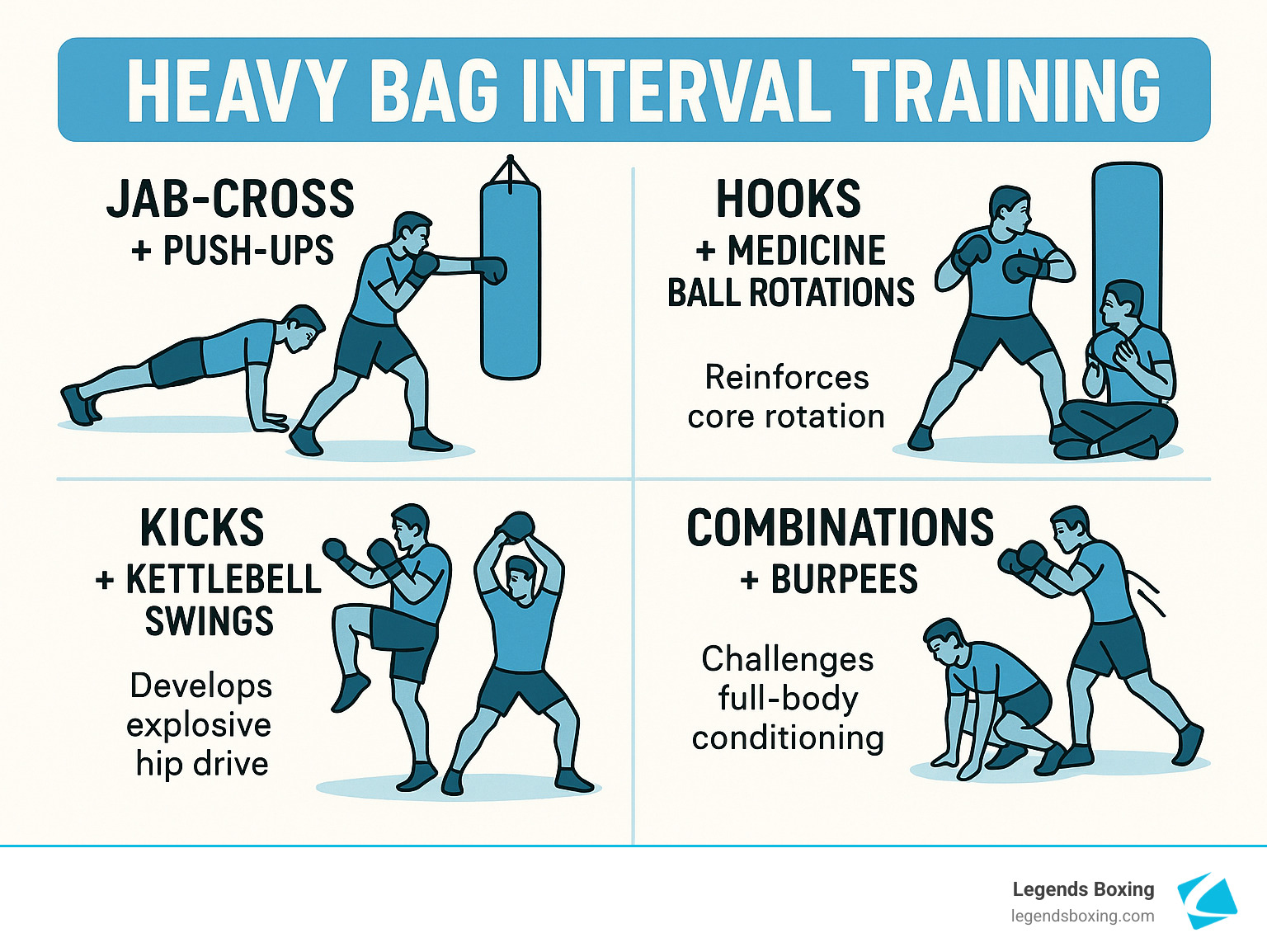
5 Rounds: 30 Seconds Work, 10 Seconds Rest
Maximize calorie burn and metabolic spike.
- Straight Punches: Right-Left-Left-Right
- Kick Combinations: Alternating leg kicks
- Jumping Lunges: Switch mid-air
- Power Hooks: Right-left, left-right
- Kick Combos: Repeat
- Pushup Plus Shoulder Tap: Tap opposite shoulder at top
Rest 1 minute between rounds. Repeat 5 times.
Track Progress and Avoid Common Mistakes
Measure Your Improvement
- Heart Rate: Aim for 160+ bpm during intense rounds. Use a monitor to track recovery. Elite fitness shows a 30+ bpm drop within 2 minutes.
- Punch Count: Target 100 to 120 punches per minute during VO2 drills.
- Perceived Exertion: Rate your effort at 8 out of 10. Talking should be hard and breathing heavy.
Common Beginner Errors and Fixes
Wild Flailing
Fix: Slow down. Focus on form. Keep the non-punching hand up. Practice in front of a mirror.
Breath Holding
Fix: Exhale sharply on every punch. Say “ha” or “tch” with impact to build rhythm.
Flat-Footed Punching
Fix: Stay on the balls of your feet. Shift weight, pivot, move. Imagine the bag fights back.
Wrong Gloves
Fix: Use 12 to 14 oz gloves for bag work. Wrap hands every time. No exceptions.
Overtraining
Signs: Heart rate stays high more than 5 minutes post-workout, joint pain, persistent fatigue.
Fix: Take rest days. Alternate hard and light sessions. Listen to your body.
Frequently Asked Questions About Punching Bag Drills for Cardio
How many calories do punching bag drills burn?
Intense punching bag workouts can burn up to 800 calories per hour. The exact amount depends on your weight, intensity, and round duration. High-intensity intervals with minimal rest burn more than steady-state bag work.
What size heavy bag is best for cardio?
A 4 to 5 foot cylindrical bag weighing approximately half your body weight works best. If choosing between 75, 100, or 125 lbs, the middle option (100 lbs) provides the best balance of resistance and stability for most adults.
How often should I do punching bag cardio workouts?
Beginners should start with 1 to 2 sessions per week and scale up as recovery allows. Daily training is possible but requires alternating intensity levels and incorporating rest days or complementary strength training.
Do I need boxing experience to start punching bag cardio?
No prior boxing experience is needed. Start with basic jabs and crosses at 50% power. Focus on form and rhythm before adding combinations, footwork, or defensive moves.
What gloves should I use for heavy bag cardio?
Use 12 to 14-ounce gloves for bag work. Heavier 16-ounce sparring gloves cause premature forearm fatigue. Pair gloves with 180-inch cloth hand wraps for wrist stability and knuckle protection.
How do I know if I’m overtraining on the heavy bag?
Warning signs include heart rate staying elevated more than 5 minutes after your workout, joint pain, and persistent fatigue. If recovery slows significantly, reduce intensity or volume for your next session.
Key Takeaways for Building Your Punching Bag Cardio Routine
Punching bag drills for cardio are more than a workout. They’re a mental reset, a confidence builder, and a fat-burning furnace rolled into one. Start with proper form and the right equipment. Build volume gradually using structured protocols like the 10-minute blast or 20-minute balanced routine.
Track your heart rate, punch count, and recovery time to measure real progress. Within weeks, you’ll notice sharper reflexes, stronger core control, and improved stamina.
Pick one routine from this guide, commit to it for two weeks, and watch your endurance transform. The bag doesn’t judge. It only responds to the effort you bring.