How to Calculate Zone 2 Cardio
You’re not alone if your runs feel punishing yet fail to deliver results. Many fitness enthusiasts unknowingly train too hard on easy days, missing one of the most effective tools for endurance, fat burning, and long-term health: Zone 2 cardio. This aerobic sweet spot builds your body’s fat-burning engine without piling up fatigue. But to unlock these benefits, you need to calculate your range correctly. The good news? With simple formulas, real-time feedback, and a heart rate monitor, you can pinpoint your exact Zone 2 range in minutes.
In this guide, you’ll learn how to calculate Zone 2 cardio using science-backed methods, avoid common mistakes, and apply it to real workouts. Whether you’re a beginner or an advanced athlete, this breakdown will help you train smarter.
Choose Your Calculation Method
There are two main ways to determine your Zone 2 heart rate: percentage of maximum heart rate (%MHR) and Heart Rate Reserve (HRR). One is simple, the other more precise. Pick the method that fits your goals.
Use %MHR for Simplicity
The %MHR method estimates your Zone 2 as 60–70% of your max heart rate. It is easy, widely used in fitness apps, and great for beginners.
Step 1: Estimate Max Heart Rate
– Classic Formula: 220 − Age
Example: A 40-year-old → 220 − 40 = 180 bpm
– Tanaka Formula (More Accurate for Adults): 208 − (0.7 × Age)
Same 40-year-old → 208 − (0.7 × 40) = 180 bpm
If both give similar results, use that number. If they differ, treat the values as a range.
Step 2: Calculate Zone 2 Range
– Lower limit: MHR × 0.60
– Upper limit: MHR × 0.70
Example (180 bpm MHR):
180 × 0.60 = 108 bpm
180 × 0.70 = 126 bpm
Target Zone 2: 108–126 bpm
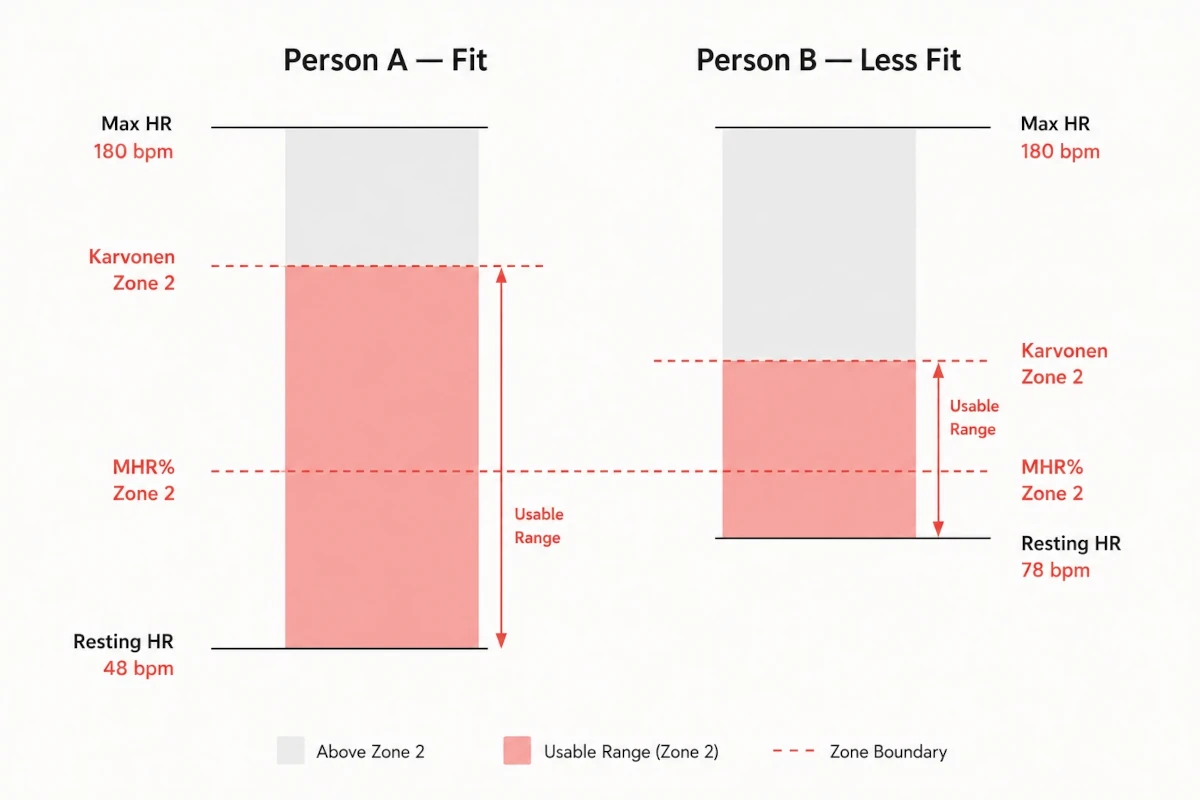
This method works well for general fitness but does not account for fitness level. Two people with the same age but different resting heart rates will get the same range, even if one is highly trained.
Apply HRR for Precision
The Karvonen method, or %HRR, adjusts for your resting heart rate (RHR), making it ideal for serious athletes or those with a low RHR due to fitness.
Step 1: Gather Your Metrics
– Max HR (MHR): Use Tanaka formula or field test
– Resting HR (RHR): Measure upon waking for 3–5 days, average the result
Example:
MHR = 183 bpm (Tanaka)
RHR = 58 bpm → Verified over a week of morning checks
Step 2: Calculate Heart Rate Reserve
HRR = MHR − RHR
183 − 58 = 125 bpm
Step 3: Set Zone 2 Boundaries
In endurance training models like McMillan, Zone 2 is 55–78% of HRR:
- Lower limit:
(HRR × 0.55) + RHR→ (125 × 0.55) + 58 = 69 + 58 = 127 bpm - Upper limit:
(HRR × 0.78) + RHR→ (125 × 0.78) + 58 = 98 + 58 = 156 bpm
Target Zone 2: 127–156 bpm
Notice how this range is higher than the %MHR method? That is normal. The HRR method accounts for fitness, so if you have a low RHR, your Zone 2 starts higher.
Pro Tip: If you are new to Zone 2, start with the %MHR method. Upgrade to HRR once you have tracked your RHR consistently.
Adjust for Gender Accuracy

While the physiology of Zone 2 is the same across genders, women often have higher max heart rates than men of the same age. Using male-centric formulas like 220 − Age can underestimate a woman’s true capacity.
Use the Gulati Formula for Women
For greater accuracy, women should use:
206 − (0.88 × Age)
Example (45-year-old woman):
206 − (0.88 × 45) = 206 − 39.6 = 166 bpm
Then apply either:
– %MHR: 60–70% of 166 = 100–116 bpm
– %HRR: If RHR = 55, HRR = 111 → Zone 2 = (111×0.55)+55 ≈ 116 to (111×0.78)+55 ≈ 142 bpm
A woman using 220 − Age would get 175 bpm, overestimating her max by nearly 10 bpm and throwing off her entire Zone 2 range.
Validate with the Talk Test
Numbers are helpful, but your body speaks louder. The talk test is the gold standard for confirming you are in Zone 2, regardless of what your monitor says.
Pass the Conversation Check
- Zone 2: You can speak in full sentences. Try reciting a 30-second paragraph. If you finish without gasping, you are in.
- Too High (Zone 3+): You can only say short phrases like “Nice… weather…” before needing a breath.
- Too Low (Zone 1): You could sing comfortably. Great for recovery, but not optimal for aerobic building.
If your heart rate says Zone 2 but you cannot talk easily, slow down. If your HR says Zone 3 but you are conversing smoothly, trust your breath. This real-world check overrides device errors or temporary spikes from heat, caffeine, or stress.
Account for Heart Rate Interference
Heart rate is not static. External and internal factors can push it up, making you think you are in Zone 3 when you are still in Zone 2. Adjust instead of panicking.
Manage Cardiac Drift
After 60–90 minutes of steady effort, your heart rate naturally rises 5–15 bpm even if pace stays the same. This is cardiac drift, caused by dehydration, rising core temperature, and reduced blood volume.
What to do:
– Do not slow down drastically to stay in range.
– Keep effort conversational.
– Accept that HR may climb to the top of Zone 2 or briefly touch Zone 3 in the final 20 minutes of a long session.
A 2-hour run might start at 130 bpm and end at 142 bpm, both within your HRR-based Zone 2. That is normal.
Adapt to Heat and Humidity
In hot (90°F+) or humid conditions, your heart beats faster to cool your body. Blood is diverted to the skin, so your heart pumps harder to deliver oxygen to muscles.
Fix: Rely on perceived effort, not pace or HR. Slow down to maintain a conversational rhythm. If it feels hard, it is too intense, even if your device says “Zone 2.”
Handle Caffeine and Fatigue
- Caffeine: Can raise resting and exercise HR by 2–6 bpm.
- Poor Sleep/Stress: Elevates resting HR, which inflates exercise HR at any given pace.
- Dehydration: Reduces plasma volume, forcing the heart to work harder.
If your RHR is 8–10 bpm above normal, consider an easy walk instead of a planned Zone 2 session.
Select the Right Monitoring Tool
You do not need expensive gear, but accurate data helps. Here is how to choose.
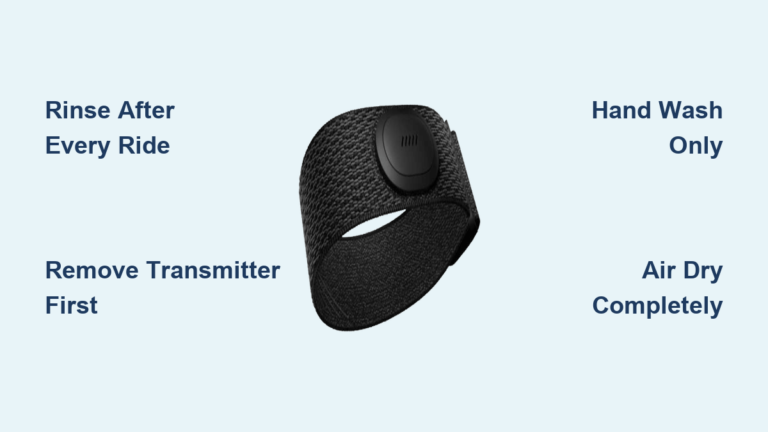
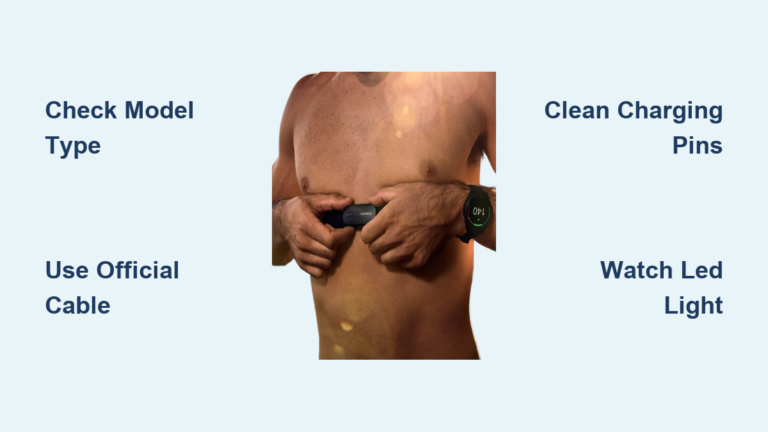
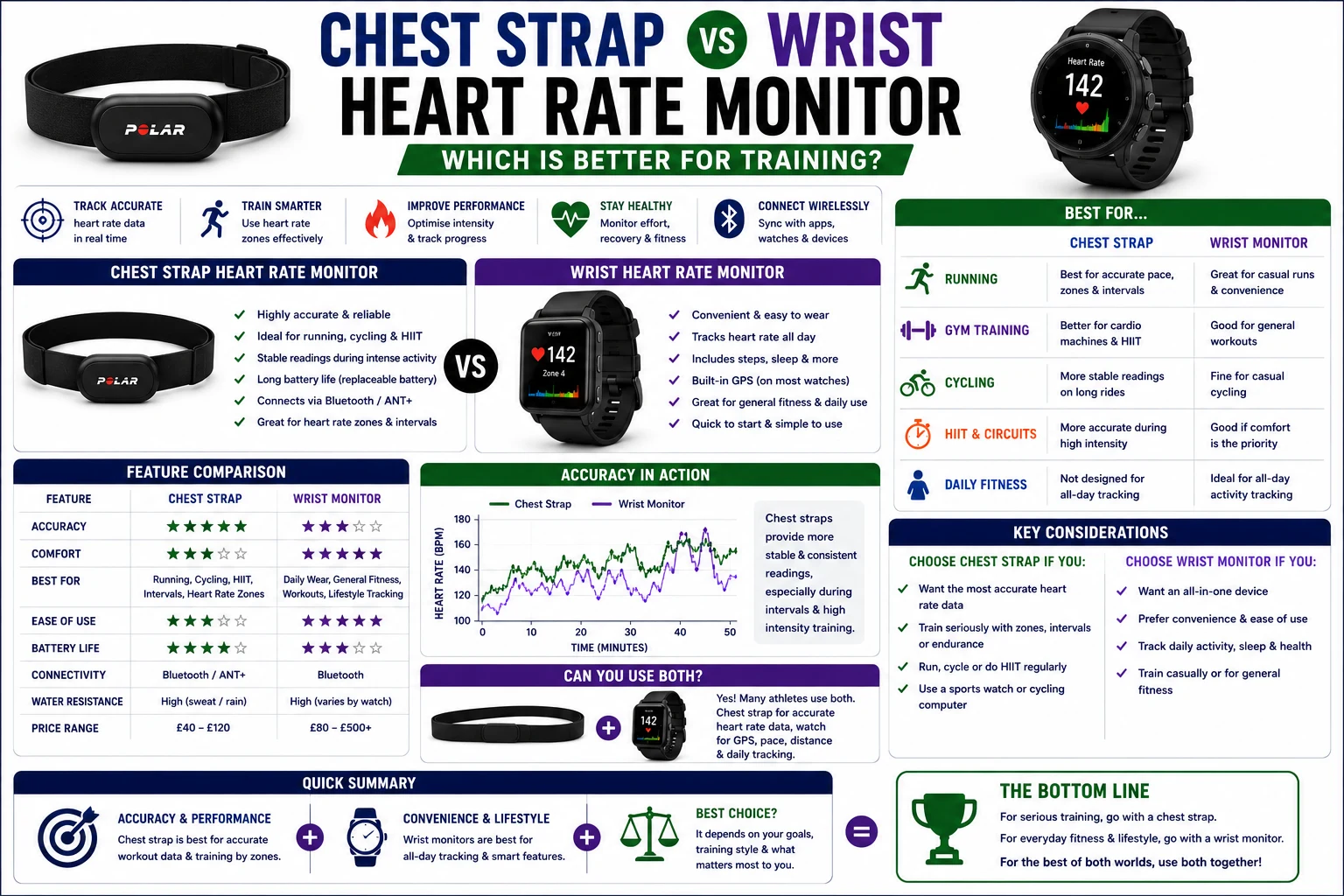
Chest Strap vs. Wrist Sensor
| Feature | Chest Strap | Wrist-Based Monitor |
|---|---|---|
| Accuracy | ECG-level, instant response | Good for steady effort, lags during changes |
| Best For | Precision training, athletes | General fitness, consistency |
| Comfort | Can be tight | Always-on, convenient |
Use a chest strap if you are serious about Zone 2. Use a wrist device if you prioritize convenience and consistency.
Manual Pulse Check (No Tech?)
No monitor? No problem.
How to check:
1. Stop briefly during activity.
2. Place fingers on wrist (radial) or neck (carotid).
3. Count beats for 6 seconds.
4. Multiply by 10 to get instant heart rate.
Example: 13 beats in 6 seconds = 130 bpm
Use this to spot-check every 10–15 minutes during a Zone 2 workout.
Structure Your Zone 2 Workouts
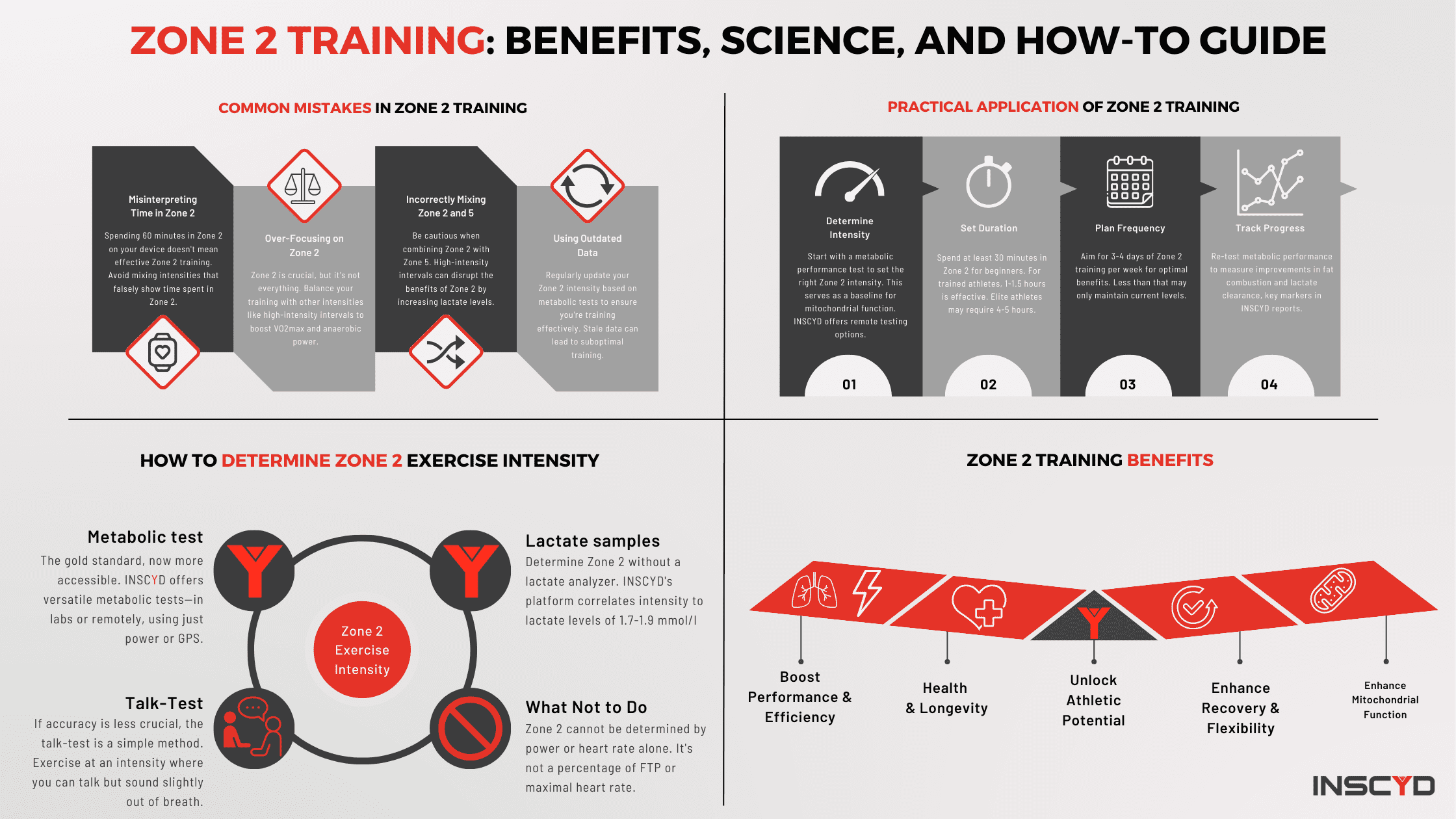
Now that you have calculated your zone, it is time to train. Zone 2 is not a single workout; it is an intensity applied across sessions.
Start with Easy Runs (45–60 Min)
- Goal: Build aerobic base
- Effort: Steady Zone 2 from start to finish
- Pace: Conversational throughout
Do not chase pace. Let it come naturally. Over 8–12 weeks, you will run faster at the same heart rate.
Schedule Long Slow Distance (90 Min–2.5 Hr)
- Goal: Maximize time in Zone 2 for endurance
- Effort: Start at lower end, allow cardiac drift upward
- Pacing: Duration over speed
This is where fat adaptation and mitochondrial growth peak. Ideal for marathoners, cyclists, or anyone building stamina.
Try Run-Walk Intervals (Beginners)
If running pushes you into Zone 3, walk to reset.
Example:
– 4 minutes jogging (monitor HR)
– 1 minute walking (let HR drop)
– Repeat for 30–45 minutes
Gradually increase run intervals as fitness improves.
Add a Progressive Long Run
- Goal: Slight intensity boost without burnout
- Structure: First 60 min at the bottom of Zone 2, final 20–30 min gradually rising to the top of Zone 2 or light Zone 3
Useful in the 6–8 weeks before a race.
Track Progress Over Time
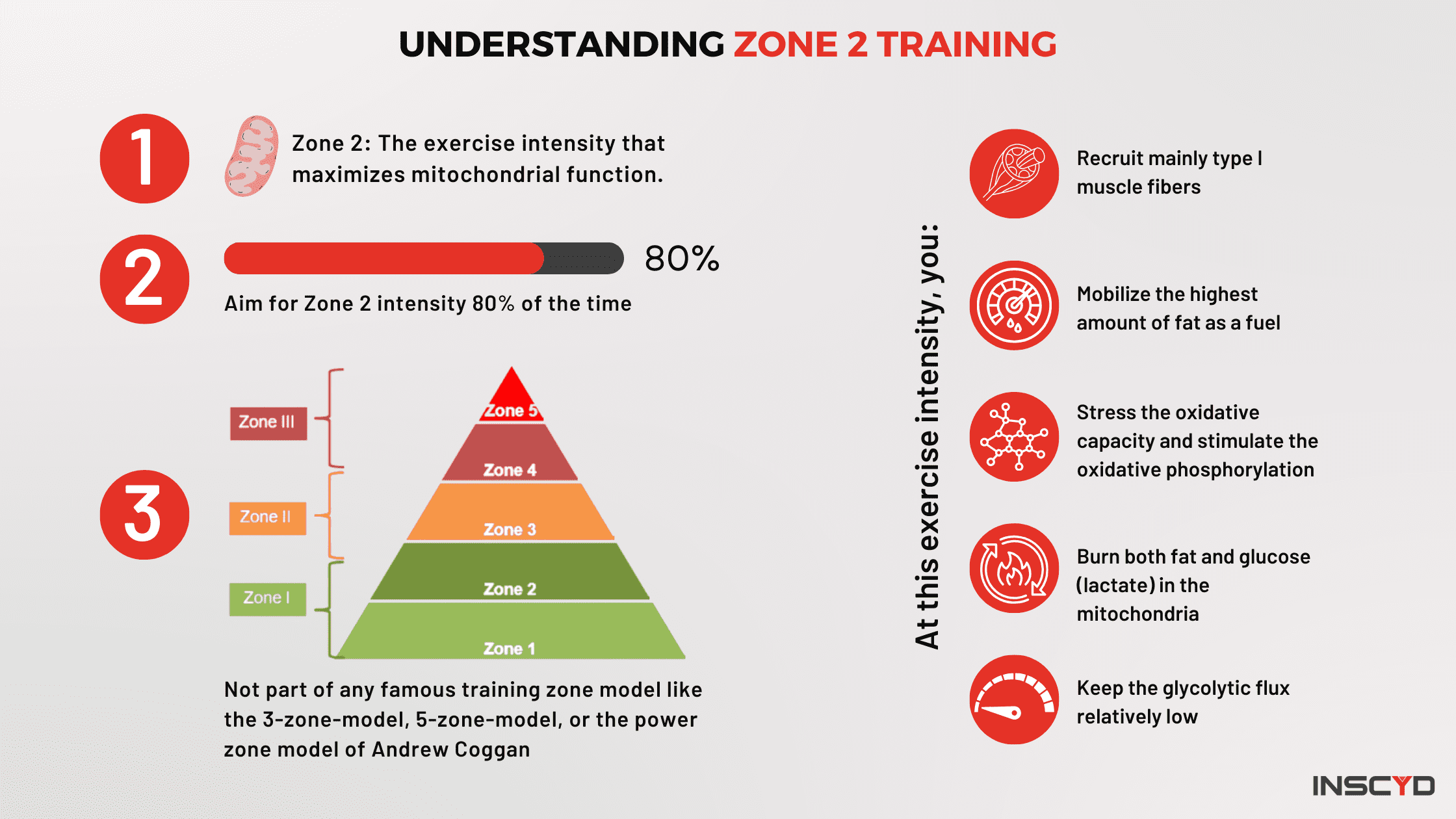
Zone 2 success is not measured daily; it is revealed in trends.
Monitor Key Metrics Weekly
| Metric | What It Tells You | Healthy Trend |
|---|---|---|
| Resting HR (RHR) | Cardiovascular fitness | Decreasing |
| HR Recovery | How fast HR drops post-exercise | Faster drop |
| Pace at Zone 2 HR | Aerobic efficiency | Faster pace at same HR |
| Time to Reach Zone 2 | Warm-up efficiency | Shorter warm-up needed |
If your 6-minute mile now holds at 130 bpm (previously 145 bpm), your aerobic engine has grown.
Avoid Common Mistakes
Even with perfect calculations, errors derail progress.
Do Not Train Too Fast
“This feels too slow” is the number one complaint. Most runners live in Zone 3, the “grey zone” that is too hard to recover from and too easy to build VO2 max.
Fix: Embrace slow. True Zone 2 feels easy. If it does not, your aerobic base needs rebuilding.
Do Not Ignore Fat Loss Realities
Zone 2 burns the highest percentage of fat during exercise. But total fat loss depends on calorie balance, not just workout fuel.
Maximize fat loss with Zone 2 by:
– Doing longer sessions (60+ min)
– Training 3–5x/week
– Pairing with strength training and nutrition
It is sustainable volume, not intensity, that drives results.
Do Not Go 100% Zone 2 Forever
- Beginners: Train all cardio in Zone 2 for 8–12 weeks to build a base.
- Advanced athletes: You need Zone 4 (threshold) and Zone 5 (VO2 max) for speed, power, and race readiness.
Ideal distribution:
– 70–80% Zone 2
– 20–30% higher intensity (Zones 3–5)
This “polarized model” is proven in elite endurance sports.
Prevent Injury and Aid Recovery
Zone 2 is low-risk and high-reward.
Reduce Injury Risk
- Lower impact forces
- Less muscle damage
- Can be done frequently with minimal recovery
Perfect for active recovery days between hard efforts or strength training.
Use as Cross-Training
Zone 2 is not just running. Try:
– Cycling: Low-impact, great for leg recovery
– Elliptical: Full-body aerobic workout
– Brisk walking (especially uphill): Effective for older adults or injury-prone individuals
– Swimming: Excellent, but use a chest strap for accurate HR
A steep treadmill walk (12% incline, 3 mph) can easily push you into Zone 2, no running required.
Frequently Asked Questions About Zone 2 Cardio
What Is the Easiest Way to Calculate Zone 2 Heart Rate?
Use the %MHR method: estimate your max heart rate with 208 − (0.7 × Age), then multiply by 0.60 and 0.70. For example, a 35-year-old gets a Zone 2 range of 111–130 bpm.
Why Is My Zone 2 Heart Rate Different with the HRR Method?
The HRR (Karvonen) method includes your resting heart rate, which reflects your fitness level. People with lower RHRs get higher Zone 2 ranges because the formula accounts for a stronger cardiovascular baseline.
How Accurate Is the Talk Test for Zone 2?
The talk test is highly reliable for confirming Zone 2. If you can speak in full sentences without gasping, you are likely in the correct zone, even if your monitor reads slightly higher due to heat, caffeine, or stress.
Can Beginners Do 100% Zone 2 Training?
Yes. Beginners can safely perform all cardio in Zone 2 for 8–12 weeks to build an aerobic base before adding higher-intensity work.
How Often Should I Do Zone 2 Workouts Per Week?
Start with 2–3 sessions weekly, aiming for at least 150 minutes of moderate cardio. Advanced athletes may accumulate 3–5 hours or more per week in Zone 2.
Does Zone 2 Burn the Most Fat?
Zone 2 burns the highest percentage of fat during exercise, but total fat loss depends on overall calorie balance and weekly training volume.
Key Takeaways for Calculating Zone 2 Cardio
Calculating Zone 2 cardio is simple, but sticking to it is where most people struggle. The magic lies in repetition, not the formula itself. Train at the right intensity 2–4 times per week for 8–12 weeks, and you will unlock faster fat burning, greater endurance, a lower resting heart rate, and improved recovery.
Whether you use 220 − Age or the HRR method, whether you run, walk, or cycle, keep it conversational, keep it consistent, and let your aerobic engine grow. Start today. Your future self will run faster, recover quicker, and feel stronger, all because you learned how to go slow.