Lower Body Cardio Workouts: Quick Guide
You’ve probably logged countless miles on the treadmill or pedaled for hours on a stationary bike, only to find your legs looking the same months later. The frustrating truth is that traditional steady-state cardio rarely builds noticeable muscle, and it often leaves key leg muscles completely underdeveloped. That’s exactly where lower body cardio workouts built around high-intensity interval training (HIIT) change the game.
These routines fuse explosive, multi-planar movements with heart-pumping intensity to torch calories, build lean muscle, and sculpt powerful glutes, quads, and hamstrings in under 30 minutes. By recruiting fast-twitch muscle fibers through dynamic exercises like jump squats, skater hops, and plyo lunges, you trigger muscle growth while spiking your heart rate. The result is greater endurance, improved athleticism, and sustained fat burn long after your workout ends.
Why HIIT Outperforms Traditional Cardio for Leg Development
Standard cardio like jogging and cycling burns calories but rarely builds leg strength. Lower body HIIT, however, merges cardiovascular conditioning with muscular development by pushing your body into intense effort zones that activate both aerobic and anaerobic systems. This dual activation recruits fast-twitch fibers responsible for power and growth, making HIIT far more effective than jogging for shaping strong, defined legs.
When you perform short bursts of high-intensity movement followed by brief recovery, your body adapts by increasing muscle endurance, improving metabolic efficiency, and enhancing coordination. You burn more calories during and after your workout, achieve better leg definition, and boost athletic performance. To unlock these benefits, intensity matters: you should feel significantly winded within 30 to 60 seconds of starting each exercise. If you’re not breathing hard, you’re not working hard enough to stimulate growth.
How HIIT Fixes the Gaps in Steady-State Cardio
Jogging and cycling are low-impact and accessible, but they fall short for full lower body development. Cycling, for example, heavily targets the quads while barely engaging the glutes, hamstrings, or adductors. Over time, this creates muscular imbalances and limits both aesthetic and functional gains.
HIIT corrects this with full-range, compound movements that engage multiple muscle groups across different planes of motion. Exercises like kettlebell swings, side lunges, and skater hops activate the posterior chain, lateral stabilizers, and core, areas often neglected in standard cardio. Plus, because HIIT taps into glycogen stores and elevates EPOC (the afterburn effect), you continue burning calories for hours post-workout.
| Feature | LISS (Jogging/Cycling) | Lower Body HIIT |
|---|---|---|
| Muscle Growth | Minimal | Moderate to High |
| Calorie Burn After Workout | Low | High (via EPOC) |
| Time Efficiency | 45+ mins needed | 20–30 mins effective |
| Leg Muscle Engagement | Partial (quads only) | Full (glutes, hams, quads, adductors) |
Structure Your HIIT Circuit for Maximum Results
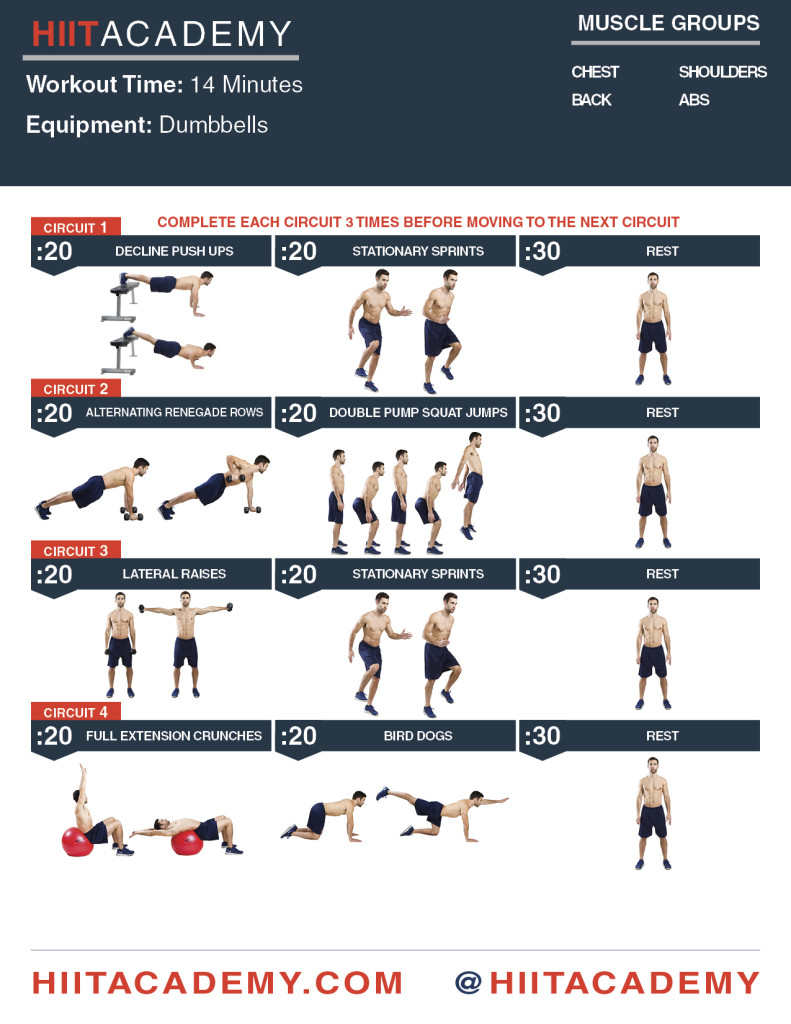
A well-designed lower body cardio workout isn’t just about going hard. It’s about smart programming that builds capacity, prevents burnout, and ensures progressive overload. Without a clear structure, even intense efforts can lead to poor form, early fatigue, or uneven development.
The most effective approach uses timed rounds, minimal rest between exercises, and gradual increases in work duration. This keeps your heart rate elevated while allowing you to build endurance and strength over time.
Use the Progressive Time-Domain Model
One powerful method is the time-domain progression, where each round increases the work interval:
- Round 1: 45 seconds per exercise
- Round 2: 60 seconds per exercise
- Round 3: 75 seconds per exercise
There’s no rest between individual exercises, only 60 seconds of rest between full rounds. This model builds muscular endurance and mental toughness, making it ideal for those aiming to grow leg strength while maintaining cardiovascular output.
Perform this routine twice weekly, either as a standalone session or after resistance training like squats or deadlifts. Avoid doing it daily because your muscles need recovery to adapt and grow.
Follow Standard HIIT Parameters for Simpler Sessions
For beginners or time-crunched schedules, a simpler format works best:
- Work: 30 to 45 seconds per exercise
- Rest: 15 to 30 seconds between exercises
- Rounds: Start with 2, progress to 5
- Total Time: About 20 minutes (plus warm-up and cool-down)
This version fits easily into a lunch break and still delivers major metabolic and muscular benefits.
Warm Up Properly to Prevent Injury
Jumping straight into high-intensity moves increases injury risk and reduces performance. A proper 5-minute warm-up prepares your joints, muscles, and nervous system for explosive work.
Start with light cardio to raise your core temperature:
- Jog in place: 60 seconds
- High knees: 30 seconds
- Arm circles: 30 seconds forward and backward
Then activate key muscle groups with these movements:
- Bodyweight squats: 15 reps
- Lunges (no jump): 10 reps per leg
- Glute bridges: 15 reps
This sequence increases blood flow, improves joint mobility, and primes your nervous system for powerful contractions, setting you up for safer, more effective workouts.
Target Quads and Glutes with Explosive Movements
These exercises combine vertical power with deep knee and hip flexion to maximize quad and glute engagement.
Jump Squats
- Stand with feet hip-width apart, toes slightly out.
- Lower into a full squat with thighs parallel to the floor.
- Explode upward into a jump, driving arms back for momentum.
- Land softly with knees bent, then descend directly into the next rep.
Pro Tip: Hold a dumbbell at chest level for added resistance. Use this as a finisher to exhaust the quads.
Alternating Jump Lunges
- From standing, step into a lunge with your right leg forward.
- Press through the front heel and jump, switching legs mid-air.
- Land softly in a lunge with your left leg forward.
- Continue alternating rapidly.
Caution: This is a high-impact movement. Maintain control to protect your knees. Beginners can step instead of jump.
Plyo Lunges
Similar to jump lunges but initiated from a static lunge position. Explode upward and switch legs mid-air. Focus on soft landings and core stability throughout.
Blast Fat with Lateral Movements
Most cardio ignores the adductors and glute medius, which are key muscles for hip stability and a sculpted lower body. Lateral movements fix this gap.
Skater Hops
- Stand on your right foot with your left foot lifted behind.
- Jump laterally to the right, landing on your right foot.
- Bring your left leg across behind and swing your arms for momentum.
- Immediately jump to the left, switching sides.
Why It Works: This trains balance, burns serious calories, and fires up the outer glutes and adductors.
Alternating Side Lunges
- Step your right leg out wide, keeping toes pointed forward.
- Lower into a squat on the right side while keeping your left leg straight.
- Press through the right heel to return to center.
- Repeat on the left side.
Form Cue: Keep your chest up and back straight. Add a dumbbell at your chest for extra intensity.
Side Lunge to Curtsy Lunge
- Step right into a side lunge.
- Push off and cross your right leg behind your left into a curtsy lunge.
- Return to center and repeat for 30 seconds before switching sides.
This combo hits the glutes, quads, and hip rotators, making it perfect for building hip mobility and strength.
Build Power with Plyometrics
Plyometric exercises enhance explosive strength and neuromuscular efficiency, making them essential for athletic lower body development.
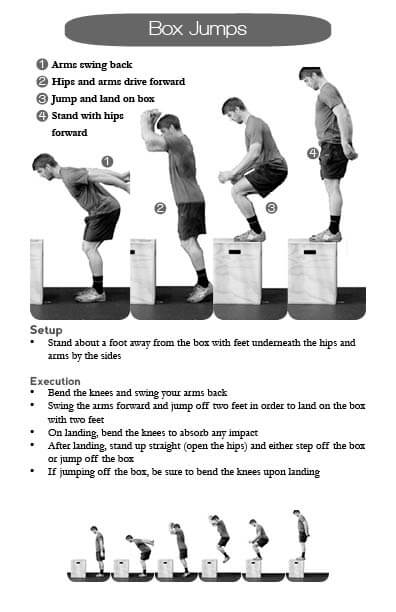
Box Jumps
- Stand in front of a stable plyo box (12 to 24 inches high).
- Dip into a half-squat with arms behind you.
- Swing your arms forward and jump onto the box, landing with both feet flat.
- Step down (don’t jump down) and repeat.
Safety First: Land softly with knees over toes. Only increase height when your form is perfect.
Quick Feet
- Get into an athletic stance with knees bent and hips low.
- Run in place as fast as possible on the balls of your feet.
- Drive your arms to increase intensity.
Time: 45 seconds. This is great for warming up or spiking your heart rate mid-circuit.
Activate Glutes and Hamstrings
The posterior chain is often undertrained in cardio. These moves ensure your glutes and hamstrings get the attention they deserve.
Kettlebell Swings
- Place a kettlebell on the floor and stand over it.
- Hinge at your hips, grab the bell with both hands.
- Drive your hips forward explosively, swinging the bell to chest height.
- Let it fall back between your legs and repeat.
Key Point: Power comes from the hips, not the arms. Keep your back flat throughout.
Glute Bridge Pulse
- Lie on your back with knees bent and feet flat.
- Lift your hips to form a straight line from shoulders to knees.
- Lower halfway, then pulse back up.
- Repeat for 60 seconds.
Upgrade: Add a dumbbell on your hips or perform single-leg pulses for a greater challenge.
Kettlebell RDLs
- Hold a kettlebell in front of your thighs.
- Hinge at your hips, keeping your back flat, and lower the bell toward the floor.
- Feel the stretch in your hamstrings, then drive your hips forward to stand.
In HIIT, perform these rapidly but with strict form to elevate your heart rate safely.
Integrate Core and Stability Work
True lower body power requires a rock-solid core. These exercises link leg drive with trunk control.
Touch and Hop (Single Leg Deadlift to Knee Drive)
- Balance on your right leg with a slight bend in the knee.
- Hinge forward, touching your left hand to the floor in a single-leg deadlift.
- Jump up, driving your left knee to your chest.
- Land and repeat for 30 seconds before switching sides.
Challenge: This tests balance, fires the glutes, and boosts coordination.
Crab Toe Touches
- Sit on the floor with hands behind you, fingers facing out.
- Lift your hips into a reverse tabletop position.
- Kick your right leg up and reach with your left hand to touch your right foot.
- Alternate sides quickly for 45 seconds.
This engages the core, glutes, and shoulders, a combination rarely found in traditional cardio.
Sample Workouts You Can Start Today

Use these proven protocols based on your goals and equipment access.
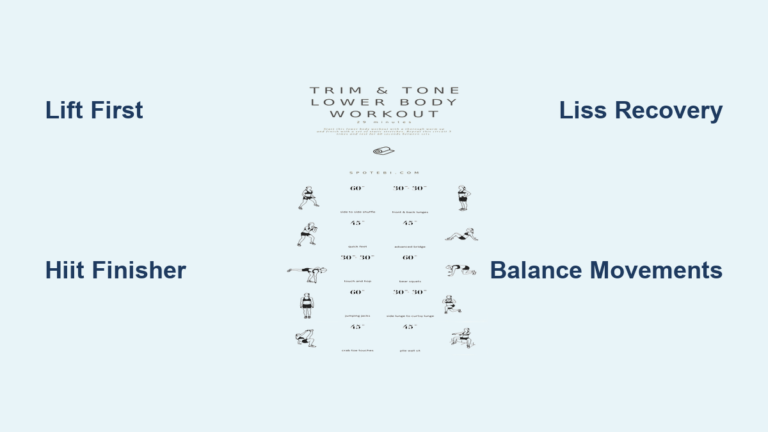
No-Equipment HIIT Circuit
Best for fat loss and endurance with zero gear needed.
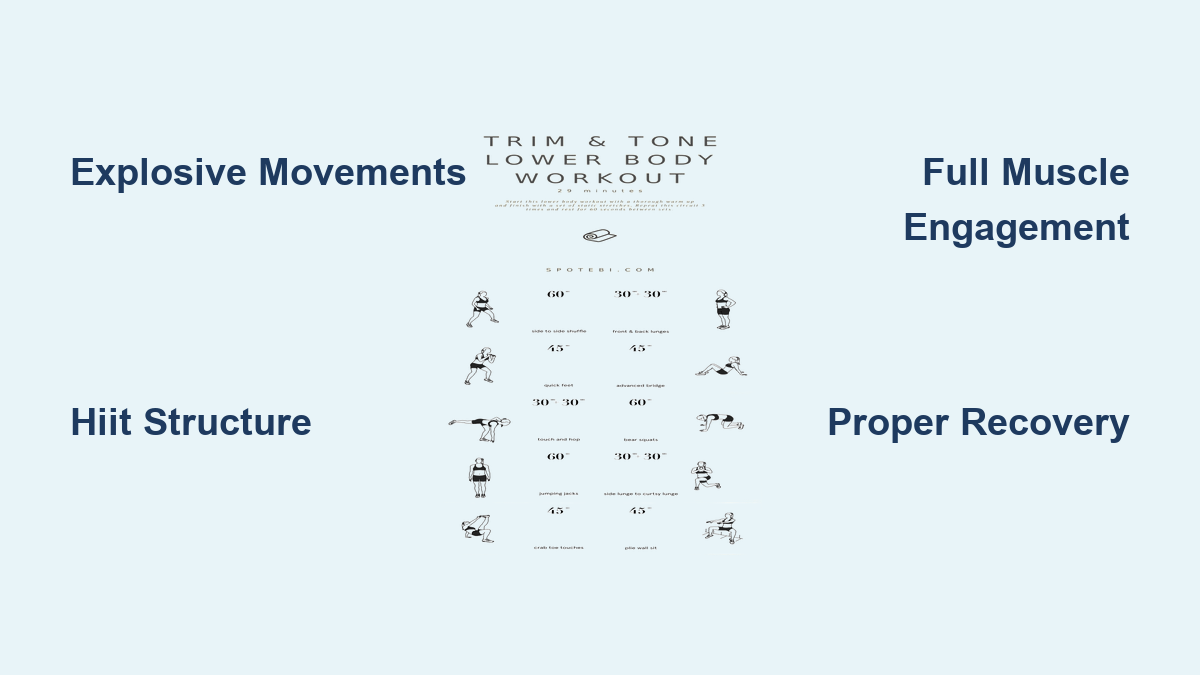
3 Rounds | 60 sec rest between rounds
- Side Shuffle: 60 sec
- Front and Back Lunges: 30s per leg
- Quick Feet: 45 sec
- Advanced Bridge: 45 sec
- Touch and Hop: 30s per side
- Bear Squats: 60 sec
- Jumping Jacks: 60 sec
- Side Lunge to Curtsy: 30s per side
- Crab Toe Touches: 45 sec
- Plie Wall Sit: 45 sec
Beginner Mod: Step instead of jump, and reduce round count to 2.
Progressive Leg Builder
For muscle growth and power using bodyweight or light weights.
3 Rounds | 0 rest between exercises | 60 sec rest between rounds
- Round 1: 45 sec per exercise
- Round 2: 60 sec per exercise
- Round 3: 75 sec per exercise
Exercises:
1. Bodyweight Squats
2. Plyo Lunges
3. Kettlebell Swings (or hip hinges)
4. Kettlebell RDLs (or good mornings)
5. Fast Feet
6. Squat Jumps
7. Pulse Squats
8. Wall Sits
Progression: Add dumbbells or increase to 4–5 rounds over time.
20-Minute HIIT Blast
Perfect for busy days with max results in minimal time.
2–5 Rounds | 30–45 sec work | 30 sec rest
- Alternating Jump Lunges
- Skater Hops
- Jump Squats
- Alternating Side Lunges
Complete all four exercises, rest 60 seconds, then repeat. Start with 2 rounds and build to 5.
Avoid These Common Mistakes
Even with the best exercises, poor execution kills results.
Starting Too Fast
Many beginners go all-out immediately and burn out by the third exercise. Instead, start at 80% intensity and focus on form. Build pacing so you can sustain effort across all rounds.
Training Too Light
If you’re not winded, you’re not working hard enough. The goal is to reach near-breathlessness within each interval. Adjust your speed or add resistance if needed.
Skipping Exercise Variety
Doing only squats and lunges ignores lateral and posterior muscles. Include side, backward, and rotational moves to build balanced, functional legs.
Cool Down for Better Recovery
Never skip the 5–10 minute cool-down. It reduces soreness, improves flexibility, and supports long-term consistency.
Perform these static stretches:
- Seated Forward Fold: 30 sec (hamstrings)
- Butterfly Stretch: 30 sec (adductors)
- Lying Glute Stretch: 30 sec per side
- Quad Pull: 30 sec per leg
Breathe deeply and let your heart rate return to normal.
Who Should Do These Workouts?
Beginners should start with bodyweight only. Focus on mastering form before increasing speed or rounds. Use stepping instead of jumping to reduce impact.
Advanced lifters can add dumbbells, use the progressive time model, or pair HIIT with heavy squats on alternate days. Aim for 4–5 rounds with minimal rest.
Athletes should incorporate box jumps, skater hops, and lateral bounds to boost agility, power, and sport-specific endurance.
Stay Safe and Train Smart
Protect Your Joints
High-impact moves like jump lunges and box jumps stress knees and ankles. If you have joint issues, modify by replacing jumps with step lunges or swapping box jumps for glute bridges or RDLs.
Prioritize Form Over Speed
Speed without control leads to injury. Focus on soft landings, knee alignment, and core engagement on every rep.
Allow Time for Recovery
Due to high intensity, limit these workouts to 2x per week. Allow 48 hours between sessions for muscle repair and growth.
Frequently Asked Questions About Lower Body Cardio Workouts
Can lower body cardio workouts build muscle?
Yes, when structured as HIIT with compound, multi-planar movements, these workouts recruit fast-twitch muscle fibers responsible for growth. Unlike steady-state cardio, they provide both cardiovascular and hypertrophic benefits.
How often should I do lower body HIIT?
Perform these workouts twice per week with at least 48 hours between sessions. This frequency allows for muscle recovery and adaptation while providing enough stimulus for growth and fat loss.
Do I need equipment for effective lower body cardio?
No. Many effective exercises like jump squats, skater hops, and glute bridges use only bodyweight. Optional equipment like dumbbells, kettlebells, or a plyo box can add resistance and variety.
What’s the difference between HIIT and LISS for legs?
LISS (jogging, cycling) primarily burns calories with minimal muscle engagement. HIIT alternates intense bursts with rest, recruiting fast-twitch fibers for muscle growth, elevated EPOC, and improved power in a shorter time.
Are lower body HIIT workouts safe for beginners?
Yes, with modifications. Beginners should start with bodyweight exercises, use stepping instead of jumping, and limit sessions to 2 rounds. Focus on mastering form before adding intensity or resistance.
How long should a lower body cardio workout last?
A complete session including warm-up, circuit, and cool-down typically lasts 20–30 minutes. The work portion itself usually fits within a 15–20 minute window.
Final Thoughts on Lower Body Cardio Workouts
Lower body cardio workouts built around HIIT offer a smarter path to stronger, more defined legs without spending hours on a treadmill. By combining explosive, multi-directional exercises with strategic work-to-rest ratios, you can build lean muscle, torch fat, and boost athletic performance in under 30 minutes.
The key principles to remember: prioritize intensity that leaves you winded, include movements across all planes of motion, warm up properly, and allow adequate recovery between sessions. Start with the no-equipment circuit to master your form, then progress to weighted variations as you build capacity.
Your next step is simple. Pick one of the sample workouts above, set a timer, and commit to two sessions this week. Track how your legs feel and how your performance improves over the next month. Consistency with smart programming will deliver results that steady-state cardio simply cannot match.