Does Cardio Kill Gains? The Truth
You’ve probably heard the gym bro mantra: “Cardio kills gains.” Maybe you’ve even avoided the treadmill or skipped post-lift walks for fear of losing hard-earned muscle. But is there any real truth to this claim? The short answer: no. When done right, cardio doesn’t kill gains. In fact, it can help you build more muscle and recover faster.
The idea that cardiovascular exercise sabotages muscle growth stems from a 1980s study showing reduced strength gains when endurance and resistance training were combined. This became known as the interference effect. But modern science has evolved. Today, we know that for most people, cardio enhances, not hinders, hypertrophy and strength, provided it’s programmed intelligently.
This article breaks down the real science behind cardio and muscle growth. You’ll learn how to choose the right type, time your workouts properly, and fuel your body to avoid interference. Whether you’re trying to build muscle, lose fat, or just stay healthy, you don’t have to choose between strength and stamina.
The Truth About the Interference Effect
What Is the Interference Effect?
The interference effect refers to the idea that endurance training blunts muscle and strength gains from resistance training. It originates from a 1980 study by Robert Hickson, where participants doing both cardio and weights gained less strength than those lifting alone.
But context matters. The subjects did high-volume endurance work (6 days per week of running or cycling) immediately after lifting, with minimal recovery. That’s not the norm for most lifters today.
Modern research shows the interference effect is real but limited. It mainly affects:
– Elite athletes maximizing both strength and endurance
– Lifters doing excessive cardio, such as marathon training
– Those who train both modalities back-to-back without recovery
For the average person, cardio does not stop muscle growth, especially when volume, intensity, and recovery are managed.
Who Actually Experiences Interference?
- Recreational lifters: Minimal to no interference with 2–3 moderate cardio sessions per week
- Beginners: Often see better gains with concurrent training due to higher overall stimulus
- Elite powerlifters and sprinters: Most at risk, especially if cardio impacts explosive power or recovery
- Older adults: Benefit greatly from cardio, which can actually boost muscle protein synthesis
If you’re not training 20+ hours a week or chasing world records, cardio is not your enemy.
Why Cardio Doesn’t Kill Muscle (And Can Help)
mTOR vs. AMPK: The Molecular Myth
You’ve likely heard this: “Cardio turns on AMPK, which shuts off mTOR, so you can’t build muscle.” Sounds scientific, but it’s oversimplified.
- mTOR drives muscle growth after lifting
- AMPK activates during endurance work to boost energy efficiency and mitochondria
Yes, AMPK can inhibit mTOR, but only temporarily and under extreme conditions. Your body adapts. With proper timing and recovery, these pathways coexist.
The conflict is acute, not chronic. Separate your workouts, eat well, and your body will respond to both stimuli.
How Cardio Actually Supports Hypertrophy
Contrary to myth, cardio can enhance muscle growth through several mechanisms:
-
More Capillaries, Better Nutrient Delivery
Cardio increases capillary density around muscle fibers, improving oxygen and amino acid delivery for repair and growth. -
Faster Recovery Between Sets
Improved aerobic capacity means less fatigue during workouts. You can lift heavier, do more reps, and handle higher training volumes, which is the biggest driver of hypertrophy. -
Mitochondria Boost = More Energy
More mitochondria mean better ATP recycling. This delays fatigue, allowing you to train harder and recover faster. -
Active Recovery Reduces Soreness
Low-intensity cardio like walking increases blood flow, flushing out metabolic waste and reducing DOMS so you’re ready for your next heavy session. -
Improved Insulin Sensitivity
Cardio enhances glucose uptake, helping shuttle carbs and amino acids into muscle cells, especially post-workout.
Best Cardio Types for Lifters

Not all cardio is equal. Some forms support gains; others increase interference risk.
Low-Intensity Steady State (LISS): Zone 2
Best for: Recovery, fat loss, and muscle preservation.
- Heart rate: 60–70% max (or 70–80% HRR)
- Effort: Light sweat, full sentences possible
- Duration: 20–45 minutes
- Examples: Incline walking, cycling, elliptical, swimming
This is the top choice for lifters wanting cardio benefits without interference. It causes minimal CNS fatigue, low glycogen depletion, and enhances recovery via blood flow.
HIIT: High-Intensity Interval Training
Best for: Time efficiency and VO2 max.
- Structure: 30–60 sec all-out effort, 1–2 min rest (e.g., sprints, bike intervals)
- Frequency: 1–2x per week max
- Duration: 15–25 minutes
Pros: Improves cardiovascular fitness fast, can stimulate leg hypertrophy, increases afterburn effect.
Cons: High CNS fatigue, depletes glycogen, interferes with leg recovery if done before lower-body days.
Rule: Never do HIIT before leg day. Keep it short, infrequent, and on upper-body or off days.
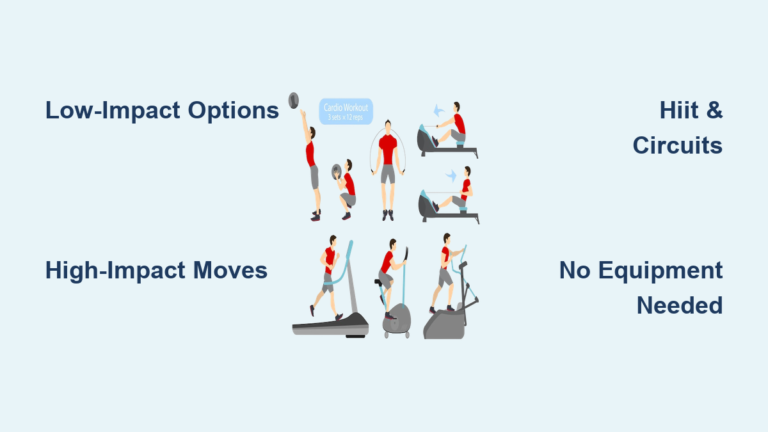
Running vs. Low-Impact Cardio
| Modality | Impact on Gains |
|---|---|
| Running | High eccentric load; delays leg recovery; increases injury risk |
| Cycling/Elliptical | Low joint stress; spares quads and hamstrings; better for lifters |
| Swimming/Rowing | Full-body, low-impact; great for active recovery |
Replace running with cycling or incline walking if leg strength or recovery is a priority.
Timing: When to Do Cardio for Maximum Gains
Weights Before Cardio: Always
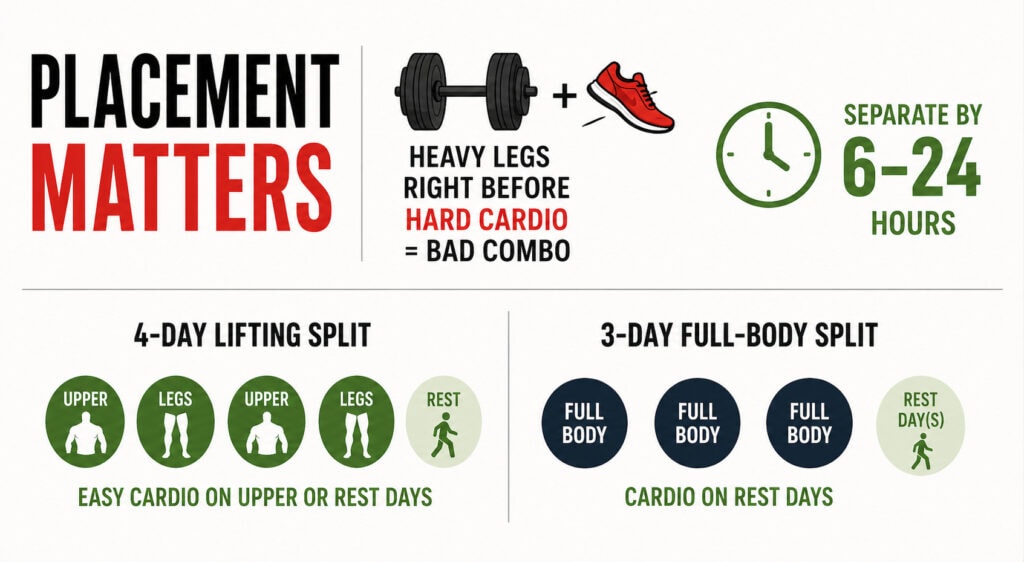
If you’re doing both in one session, lift first, cardio second.
Lifting requires peak CNS output and glycogen. Cardio first leads to fatigue, weaker lifts, less mechanical tension, and fewer gains. Even 10 minutes of intense cardio can reduce squat performance by 10–15%.
Exception: 5–10 min light cardio as a warm-up is fine and beneficial.
Separate Sessions by 6+ Hours
The best way to avoid interference is to space out your workouts.
- Minimum gap: 3–4 hours
- Ideal gap: 6+ hours (or 24 hours on alternate days)
Example schedules:
– AM cardio, PM lifting
– Lift Monday/Wednesday/Friday, cardio Tuesday/Thursday
– Full rest on weekends
This allows AMPK signaling to reset and glycogen to begin replenishing.
Avoid Cardio Before Leg Days
High-intensity or long-duration cardio the day before squats or deadlifts will deplete leg glycogen, increase muscle damage, and reduce performance. Do cardio after leg day as active recovery or on upper-body days.
How Much Cardio Is Too Much?
More isn’t always better. Here’s the sweet spot:
| Goal | Frequency | Duration | Intensity |
|---|---|---|---|
| Muscle Gain | 2–3x/week | 20–30 min | LISS (Zone 2) |
| Fat Loss | 3–4x/week | 30–45 min | Mix of LISS + 1 HIIT |
| Performance | 1–2x/week | ≤20 min | Low-impact, recovery-focused |
Red flags:
– More than 5 cardio sessions per week with heavy lifting
– More than 60 min high-intensity cardio 4+ days per week
– Strength plateaus or regression
– Chronic fatigue or poor sleep
If you’re doing marathon training and trying to bulk, something has to give. For most, 20–30 minutes of moderate cardio won’t touch your gains.
Nutrition: The Real Key to Avoiding Muscle Loss
Cardio only “kills gains” when nutrition is ignored. Here’s how to stay anabolic.
Eat Enough Calories
Cardio increases TDEE. If you don’t eat more, you’ll enter a deficit and muscle loss follows.
Rule: Maintain caloric maintenance or surplus when building muscle. Use cardio to increase TDEE, not slash calories.
Hit Your Protein Target
Protein is non-negotiable.
- Daily goal: 1.6–2.2g per kg (0.7–1g per lb) of body weight
- Per meal: ~0.4g/kg (e.g., 30g for a 150 lb person)
- Spread across 4–5 meals to maximize protein synthesis
Example: A 160 lb (72.5 kg) lifter needs 116–160g protein per day.
Fuel With Carbs
Carbs replenish glycogen used during lifting and cardio.
- Pre-workout: 30–50g carbs 1–2 hours before
- Post-workout: 3:1 carb-to-protein ratio (e.g., 60g carbs + 20g protein)
- During long cardio: 30–60g carbs per hour if over 60 min
Hydrate and Replace Electrolytes
Dehydration reduces strength, impairs recovery, and increases cortisol. Drink water throughout the day and add electrolytes during long or intense sessions.
Special Cases: Who Should Be Cautious?
Powerlifters and Sprinters
Your goal is maximal force and power. Interference risk is real.
Solutions:
– Limit cardio to 1–2x per week (LISS only)
– Keep sessions short (15–20 min)
– Separate from lower-body training by 24 hours
– Avoid HIIT and running
Older Lifters (50+)
Cardio is protective here. It fights sarcopenia, improves insulin sensitivity, enhances blood flow to muscles, and reduces inflammation.
Best: Zone 2 walking, cycling, or swimming 3x per week.
Women
Some evidence suggests women experience less interference than men, possibly due to hormonal profile and fiber type differences. Still, follow the same rules: prioritize lifting, manage volume, eat enough.
Debunking Common Myths
“Cardio Burns Muscle”
False, unless you’re in a severe deficit, doing excessive cardio, or not eating enough protein. In a fed state with adequate nutrition, cardio does not catabolize muscle.
“Fasted Cardio Kills Gains”
Myth. As long as total daily protein and calories are met, fasted cardio is safe. Performance may suffer, but gains won’t.
“You Must Choose Between Cardio and Gains”
Wrong. Hybrid athletes prove you can be strong and fit with strategic programming and nutrition.
“All Cardio Is Bad for Legs”
No. Low-impact LISS has zero negative impact and can speed recovery. Avoid only if it directly impairs performance.
Sample Weekly Protocols

Protocol 1: Muscle Gain (Hypertrophy Focus)
- Lifting: 4x per week (upper/lower split)
- Cardio: 2x per week, 20–30 min LISS (after lifting or on off days)
- Type: Incline treadmill, elliptical
- Nutrition: Caloric surplus, 1.8g/kg protein, carbs around workouts
Protocol 2: Fat Loss (Preserve Muscle)
- Lifting: 4–5x per week
- Cardio: 3–4x per week (2 LISS, 1 HIIT, 1 optional)
- Timing: Lift first; HIIT on upper-body days
- Nutrition: Slight deficit, 2.2g/kg protein, carb-cycling
Protocol 3: Strength Athlete (Powerlifter)
- Lifting: 4–5x per week, heavy compounds
- Cardio: 1–2x per week, 15–20 min LISS
- Timing: 24 hours from leg day, or post-upper-body
- Type: Cycling, swimming
- Nutrition: Maintenance or slight surplus, 1.6–2.0g/kg protein
Signs You’re Losing Gains to Cardio
Watch for these red flags:
-
Strength Stalls or Drops
Despite consistent training, you’re not progressing. -
Chronic Fatigue
Always tired, poor sleep, elevated resting heart rate. -
Prolonged Soreness
DOMS lasting 4+ days, especially in legs. -
Unintentional Weight Loss
Dropping body weight despite trying to maintain.
Fix it fast:
– Cut cardio volume by 50%
– Increase calories and carbs
– Separate lifting and cardio by 6+ hours
– Take a deload week
Frequently Asked Questions About Cardio and Muscle Gains
Does cardio actually kill gains?
No. For most people, cardio does not kill gains when programmed properly. The interference effect is real but mainly affects elite athletes or those doing excessive high-intensity cardio without recovery.
How much cardio is too much when trying to build muscle?
More than 5 cardio sessions per week combined with heavy lifting, or more than 60 minutes of high-intensity cardio 4+ days per week, can interfere with gains. For most lifters, 2–3 sessions of 20–30 minutes is the sweet spot.
Should I do cardio before or after weights?
Always lift first if doing both in the same session. Cardio first depletes glycogen and causes fatigue, reducing your strength performance and mechanical tension.
Is fasted cardio bad for muscle growth?
Not necessarily. As long as your total daily calories and protein are met, fasted cardio won’t kill gains. However, performance may suffer, so fed-state training is better for strength workouts.
What’s the best type of cardio for lifters?
Low-intensity steady state (Zone 2) cardio is the best choice. It includes incline walking, cycling, and swimming at 60–70% of max heart rate. It promotes recovery without depleting glycogen or causing CNS fatigue.
Can cardio help build muscle?
Yes. Cardio increases capillary density, boosts mitochondrial function, improves work capacity, and speeds recovery between sets. All of these support hypertrophy when combined with proper nutrition.
Key Takeaways: Cardio Doesn’t Kill Gains, Poor Programming Does
The idea that “cardio kills gains” is a relic of outdated science and gym lore. For 95% of lifters, cardio is a net positive, improving recovery, boosting work capacity, and supporting long-term health.
To keep building muscle:
– Do LISS or moderate cardio 2–4x per week
– Lift before cardio in the same session
– Separate workouts by 6+ hours when possible
– Eat enough protein and calories
– Avoid excessive HIIT or running before leg days
Cardio isn’t the enemy. Neglecting recovery and nutrition is. Start by adding two 20-minute Zone 2 sessions this week, keep your protein above 1.6g per kg, and watch your recovery and work capacity improve without sacrificing a single pound of muscle.