Legs and Cardio Workout: Quick Steps
You just finished squats, your quads are screaming, and your glutes feel like they’ve been through a war. Now you’re eyeing the treadmill, wondering if a quick run will help—or ruin—your gains. The truth is, a legs and cardio workout can either supercharge your results or sabotage them entirely. The difference comes down to timing, exercise selection, and intensity.
Most people either skip cardio on leg day out of fear or pile on endless jogging that wrecks recovery. But research-backed programming proves you can build muscle, torch fat, and boost endurance in the same session. In this guide, you’ll learn exactly how to structure your training, which exercises deliver dual benefits, and how to avoid the overtraining trap. Whether your goal is power, definition, or athletic performance, this plan shows you how to get there without compromise.
Sequence Your Training for Maximum Strength

Why Lifting Should Come First
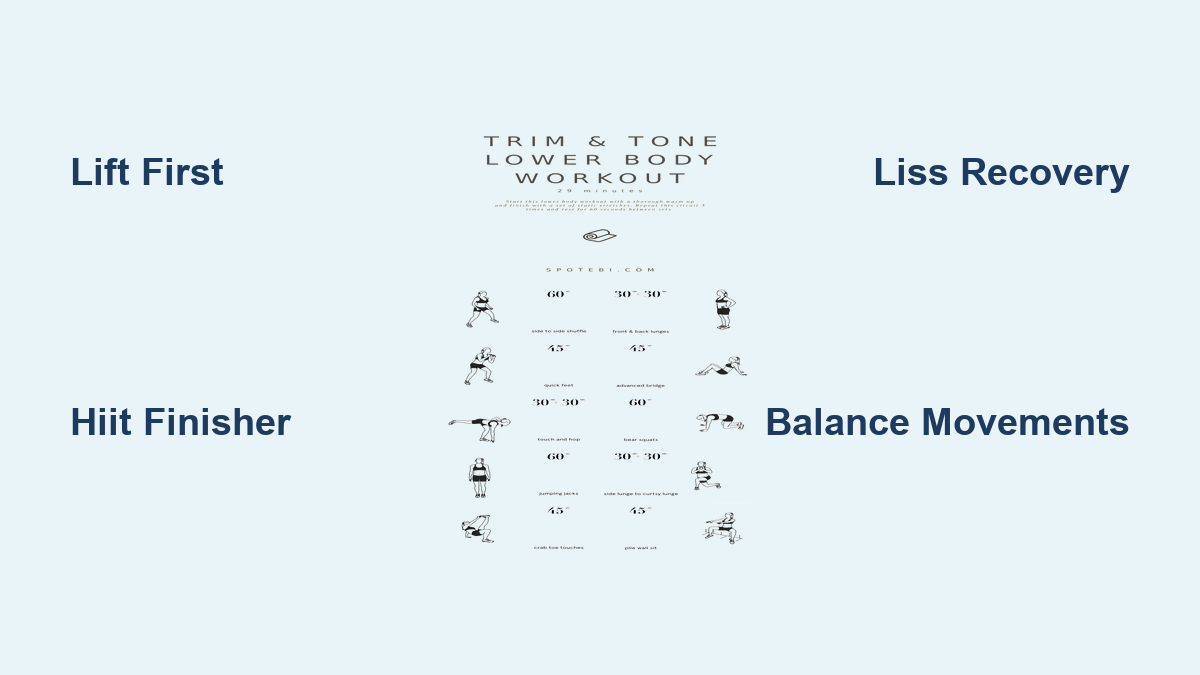
When your goal is muscle growth or strength, resistance training must precede cardio in the same session. Your muscles depend on glycogen for high-intensity effort. Performing squats, lunges, or deadlifts first lets you tap into fresh energy stores, maximizing power output, depth, and muscle recruitment.
Reverse the order, and you deplete glycogen before your heavy work begins. The consequences include reduced strength, compromised range of motion, poor squat depth, and a higher injury risk from fatigue-induced form breakdown. Research confirms that pre-exhausting the legs with cardio diminishes neuromuscular activation, especially in the fast-twitch fibers responsible for size and explosion.
✅ Pro Tip: If hypertrophy is your priority, never start leg day with lower-body cardio.
When Cardio Before Lifting Works
There’s one exception: endurance-focused athletes preparing for a 10K, half-marathon, or triathlon. Training under fatigue mimics race conditions and teaches your body to perform on depleted glycogen. However, this approach sacrifices peak strength output and muscle-building potential. For most lifters, strength-first sequencing is non-negotiable.
Select the Right Cardio Modality
HIIT: Cardio That Builds Muscle
Not all cardio is equal. High-Intensity Interval Training (HIIT) bridges the gap between endurance and hypertrophy by recruiting fast-twitch muscle fibers—the same ones activated during heavy lifting. Unlike steady jogging, HIIT alternates short bursts of max effort with brief recovery, spiking heart rate while stimulating growth.
Effective HIIT movements include:
– Sprint intervals (20 seconds sprint, 40 seconds walk)
– Kettlebell swings
– Jump squats
– Sled pushes
These work best as standalone leg workouts or finishers, not stacked after heavy compound lifts.
⚠️ Warning: Pairing intense HIIT with heavy squats in one session dramatically increases injury risk and delays recovery.
LISS: The Recovery Companion
Low-Intensity Steady State (LISS)—walking, light cycling, swimming—is ideal after leg day. It promotes blood flow without adding mechanical stress, helping clear metabolic waste and reduce soreness.
Key benefits:
– Accelerates recovery
– Supports fat oxidation
– Maintains mobility and circulation
Stick to 10–20 minutes at a conversational pace. If you’re gasping or limping, the intensity is too high.
Time Your Cardio for Optimal Results

The Post-Leg Day Window
After strength training, your muscles are primed for nutrient delivery. A brief cardio session amplifies this through Excess Post-exercise Oxygen Consumption (EPOC), commonly called the “afterburn.” Your body continues burning calories at an elevated rate for hours post-workout.
Recommended protocol:
– Duration: 10–20 minutes
– Intensity: Low to moderate (you can hold a conversation)
– Modality: Cycling, elliptical, brisk walking
This combination maximizes calorie burn without interfering with muscle repair.
❌ Avoid extending beyond 30 minutes or increasing intensity—this pushes the body toward catabolism, breaking down hard-earned muscle.
Split Sessions for Peak Performance
If you want both strength and cardio performance at their best, separate them into distinct sessions.
Two effective options:
– Same-day split: Lift in the morning, do cardio 6+ hours later
– Alternate-day split: Leg day Monday, cardio Tuesday
This allows full glycogen replenishment and prevents the interference effect. Studies show athletes who separate modalities gain more muscle and improve aerobic capacity faster than those who combine them daily.
Build Balanced Leg Development
Address Muscle Imbalances
Most cardio routines—running, cycling, elliptical—overwork the quads while neglecting the glutes, hamstrings, and adductors. Over time, this creates imbalances that increase injury risk and limit performance.
A complete legs and cardio workout must include movements across all planes of motion:
– Sagittal (forward/back): squats, lunges
– Frontal (side-to-side): lateral lunges, skater hops
– Transverse (rotational): crossover steps, curtsy lunges
Variety ensures balanced strength, joint stability, and full metabolic engagement.
Top 10 Legs and Cardio Exercises
1. Jump Squats
Targets: Quads, glutes, calves, explosive power
Execution:
– Lower into a bodyweight squat with hips back and chest up
– Explode upward into a jump
– Land softly with knees slightly bent and descend immediately into the next rep
Use as a finisher (3 sets of 10–15 reps) to exhaust fast-twitch fibers.
🔧 Modification: Remove the jump for beginners; add dumbbells for added resistance.
2. Alternating Jump Lunges
Targets: Quads, glutes, coordination, cardiovascular system
Execution:
– Start in a lunge position
– Push off both feet, switching legs mid-air
– Land with the opposite leg forward, sinking into a lunge
High-impact—only attempt after mastering static lunges.
⏱️ Duration: 30 seconds on, 30 seconds off for 3 rounds
3. Skater Hops
Targets: Glute medius, lateral stability, agility
Execution:
– Stand on right foot with left leg lifted behind
– Jump laterally to the left, landing on the left foot
– Swing arms opposite to legs for momentum
Perfect for frontal plane conditioning.
🔄 Progression: Increase speed or add a pause on landing for greater challenge.
4. Kettlebell Swings
Targets: Posterior chain, hip power, cardiovascular system
Execution:
– Hinge at hips and swing the kettlebell between your legs
– Drive hips forward explosively to swing the weight to chest height
– Let it fall back between your legs—no arm pull required
This is a hip hinge, not a squat. Power originates from the hips.
💡 Tip: Use for HIIT sets (30 seconds on, 30 seconds off)
5. Pulsing Bodyweight Squats
Targets: Time under tension, metabolic fatigue
Execution:
– Lower into a full squat
– Rise 4 inches, pause, then lower back down
– Repeat for 30–60 seconds
Creates a deep burn in quads and glutes—ideal as a finisher.
6. Sumo Squat Jumps
Targets: Adductors, glutes, inner thighs
Execution:
– Stand with feet wider than shoulders and toes pointed out
– Lower into a wide squat
– Jump explosively, spreading legs wider in mid-air
– Land back in the sumo stance
Activates often-neglected inner thigh muscles.
7. Wall Sits
Targets: Quadriceps endurance (isometric)
Execution:
– Keep your back flat against the wall and slide down until thighs are parallel to the floor
– Hold for 30–60 seconds
Simple but brutal. Excellent for building muscular stamina.
8. Running in Place with High Knees
Targets: Calves, hip flexors, cardiovascular system
Execution:
– Jog in place, gradually increasing pace
– Drive knees to hip level while pumping arms
– Stay on the balls of your feet
Can be intensified with a jump rope.
⏱️ Use: Warm-up or cardio burst (45-second intervals)
9. Single-Leg Deadlift
Targets: Hamstrings, glutes, balance
Execution:
– Hold dumbbells and shift weight to one leg
– Hinge at hips, lowering torso while extending the free leg behind you
– Keep your back flat and return to standing
Improves unilateral strength and stability.
🔄 Sets: 45 seconds per side for 3 rounds
10. Fast Feet
Targets: Calves, coordination, foot speed
Execution:
– Stand tall and rapidly alternate lifting feet off the ground
– Stay light on your toes and engage your core
Use to spike heart rate between strength sets.
Sample Workout Routines
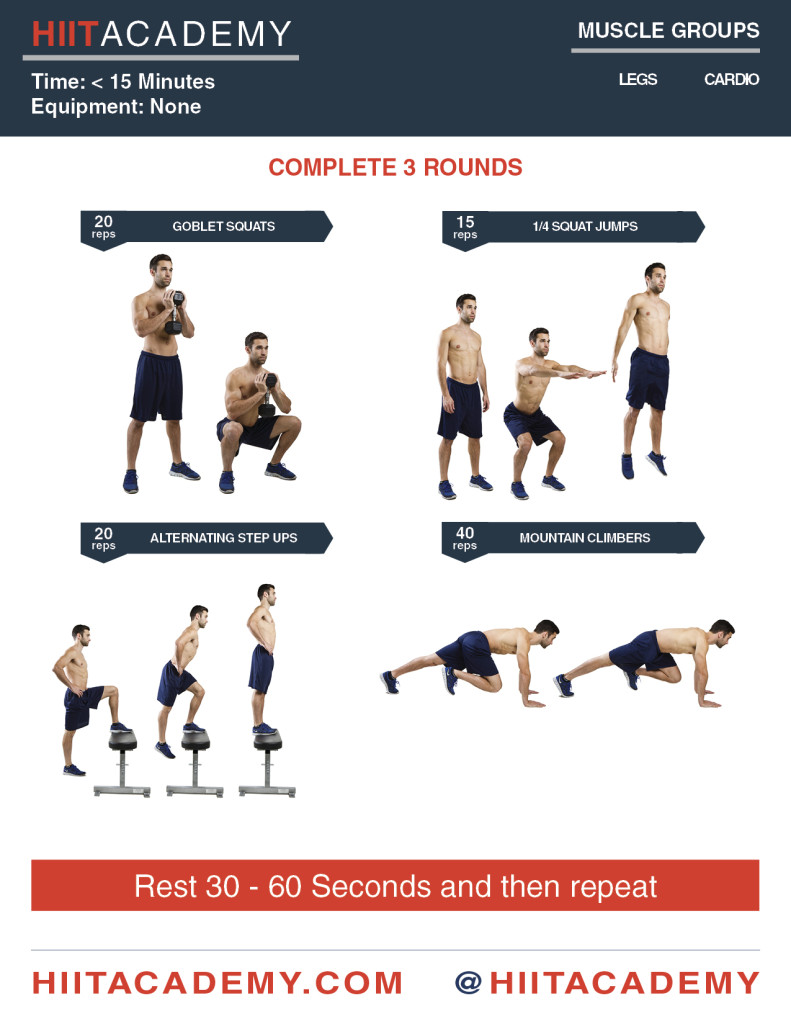
Routine A: HIIT Leg Blaster (Power & Endurance)
Goal: Build explosive strength and cardio capacity
Equipment: Bodyweight or light dumbbells
Format: Circuit (30–45 seconds work, 30 seconds rest)
| Exercise | Duration |
|---|---|
| Alternating Jump Lunges | 45 sec |
| Skater Hops | 45 sec |
| Jump Squats | 45 sec |
| Alternating Side Lunges | 45 sec |
Repeat 3–5 rounds. Rest 60 seconds between rounds.
✅ Best performed as a standalone workout, not after heavy lifting.
Routine B: Timed Progression Circuit (Conditioning)
Goal: Time-efficient full-leg conditioning
Equipment: Bodyweight or kettlebell
| Round | Work Time | Exercise Sequence |
|---|---|---|
| 1 | 45 sec | Squats, Plyo Lunges, KB Swings, KB RDLs, Fast Feet, Squat Jumps, Pulse Squats, Wall Sits |
| 2 | 60 sec | Same sequence |
| 3 | 75 sec | Same sequence |
Rest 60 seconds between rounds. No rest between exercises.
Total time: approximately 30 minutes including warm-up and cool-down.
Routine C: Strength & Cardio Hybrid (Supersets)
Goal: Combine stability with explosive power
Equipment: Dumbbells, bench
Superset 1 (3 rounds):
– Alternating Jump Lunge: 35 seconds
– Skater Hop: 35 seconds
– Rest 30 seconds
Superset 2 (3 rounds):
– Single-Leg Deadlift: 45 seconds per side
– Single-Leg Elevated Glute Bridge: 45 seconds per side
– Rest 30 seconds between rounds
Balances strength and cardiovascular demand effectively.
Prevent Overtraining and Injury
Recognize the Warning Signs
Combining legs and cardio increases total stress on the body. Watch for these red flags:
– Persistent fatigue or irritability
– Trouble sleeping
– Decreased performance week-over-week
– Loss of muscle definition
– Joint pain beyond normal soreness
These indicate overtraining—your body isn’t recovering adequately.
Recovery Strategies
If you spot warning signs:
– Reduce cardio volume: Drop to 10 minutes or skip cardio on leg days
– Switch to LISS: Replace running with cycling or swimming
– Separate training days: Do cardio on non-leg days
– Prioritize sleep and nutrition: Aim for 7–9 hours and adequate protein intake
💬 Rule of thumb: If your stride changes due to fatigue, stop immediately.
Master Form and Safety
Never Sacrifice Technique
Fatigue destroys form. During jump squats, you might see knees caving inward, landing with straight legs, or a rounded back during swings. These errors increase injury risk dramatically. Always prioritize control over rep count.
✅ Fix: Slow down, reduce impact, and master static versions before progressing.
Warm Up Properly
Dynamic warm-ups prepare muscles for explosive work. Include:
– Leg swings (front/side): 10 per leg
– Walking lunges: 10 steps
– High knees: 30 seconds
– Fast feet: 30 seconds
Skip static stretching before your workout—save it for cool-down.
Maximize Recovery After Cardio
Active Recovery Protocols
After leg day, use low-impact cardio to enhance recovery:
– Cycling: 15 minutes at light resistance
– Elliptical: 10–20 minutes with no incline
– Walking: 20 minutes on flat terrain
– Swimming: Full-body, zero impact
These modalities boost circulation, delivering nutrients while flushing waste products.
🧴 Bonus: Consume essential amino acids (EAAs) during or after your session to support muscle preservation.
Transition Smoothly
Allow 10–15 minutes between lifting and cardio:
– Stretch quads, hamstrings, and calves
– Hydrate with electrolytes
– Mentally reset before starting cardio
This prevents abrupt shifts and supports better performance in both modalities.
Frequently Asked Questions About Legs and Cardio Workouts
Can I do cardio on the same day as leg day without losing muscle?
Yes, but timing and intensity matter. Perform strength training first, then limit cardio to 10–20 minutes of low-to-moderate intensity. This approach supports recovery and fat loss without compromising muscle growth. Avoid high-intensity cardio after heavy lifting, as it interferes with the muscle remodeling process.
How long should I wait between leg day and cardio?
Ideally, separate them by at least 6 hours if doing both on the same day. A morning lifting session followed by an evening cardio session works well. This allows glycogen replenishment and partial recovery. Alternatively, alternate days entirely—leg day Monday, cardio Tuesday—to maximize performance in both.
Is HIIT or LISS better for leg muscle growth?
HIIT is superior for muscle growth because it recruits fast-twitch fibers similar to resistance training. However, HIIT should replace a leg workout rather than follow one. LISS is better suited for post-leg day recovery, as it promotes blood flow without adding mechanical stress that could impair muscle repair.
Will running make my legs smaller?
Long-duration steady-state running can interfere with hypertrophy if performed excessively. Running primarily targets slow-twitch fibers and may limit recovery from strength training. To preserve muscle size, keep running sessions short (under 20 minutes), use interval formats, or choose lower-impact options like cycling or swimming.
How do I know if I’m overtraining?
Watch for persistent fatigue, irritability, sleep disturbances, declining performance, prolonged soreness, and loss of muscle definition. If you notice these signs, reduce cardio volume immediately, switch to LISS modalities, ensure 7–9 hours of sleep, and consider separating leg and cardio sessions entirely until symptoms resolve.
What is the best cardio for leg definition without losing muscle?
Low-intensity steady-state cardio like walking, light cycling, or swimming performed for 15–20 minutes after strength training is ideal. These modalities increase blood flow and calorie burn without creating the mechanical stress that interferes with muscle growth. High-intensity intervals can also work when used as standalone sessions rather than add-ons.
Final Takeaways for Your Legs and Cardio Workout Strategy
The key to combining legs and cardio workout success lies in strategy, not volume. You don’t need hours in the gym—just smart programming.
Remember these core principles:
– Lift before cardio when muscle growth is the goal
– Use HIIT as a leg workout itself, not a finisher after heavy lifting
– Limit post-leg cardio to 10–20 minutes of LISS
– Include lateral and posterior chain movements for balanced development
– Listen to your body—overtraining stalls progress quickly
With the right balance, your legs will become stronger, more defined, and more enduring. Whether you’re chasing power, aesthetics, or athletic performance, this approach delivers results without the burnout.
Start by restructuring your next leg day: lift first, add 15 minutes of light cycling after, and track how your body responds. Adjust based on recovery and performance over the following weeks.