High Intensity Interval Cardio Exercises Guide
You’re short on time but want serious fitness results, including fat loss, better endurance, and a stronger heart, all from one workout. Enter high intensity interval cardio exercises, a training method that delivers more in less time than traditional steady-state cardio. Unlike jogging at a moderate pace for 45 minutes, these workouts push your body to its limits in short bursts, followed by brief recovery periods. This approach not only torches calories during the session but keeps your metabolism elevated for hours after, thanks to a phenomenon called Excess Post-Exercise Oxygen Consumption (EPOC), commonly known as the “afterburn effect.”
Backed by research and embraced by athletes and fitness enthusiasts alike, high intensity interval cardio exercises improve heart health, burn fat efficiently, and preserve muscle mass. Whether you use bodyweight moves, a treadmill, or dumbbells, the framework is flexible, scalable, and effective across fitness levels. In this guide, you’ll learn the science-backed protocols, top fat-burning exercises, sample workouts, and key safety tips to maximize results without injury or burnout.
How HIIT Cardio Works
Cardiovascular Stress vs. Steady-State
High intensity interval cardio exercises work by spiking your heart rate to 80–95% of its maximum during short, explosive efforts. This rapid elevation forces your cardiovascular system to adapt, improving oxygen delivery and heart efficiency over time. In contrast, steady-state cardio maintains a moderate pace (50–70% max heart rate) for extended periods, building endurance but offering minimal post-exercise calorie burn.
The key difference is that intensity drives metabolic disruption. When you push anaerobically during high intensity interval cardio exercises, your body accumulates an oxygen debt. After the workout, it burns extra calories to restore balance by repairing tissues, clearing lactate, and replenishing energy stores. This afterburn can last up to two hours, making HIIT far more effective for fat loss per minute than jogging.
Why Time Efficiency Matters
A typical HIIT session lasts between 4 and 30 minutes. You can achieve the same VO2 max improvements and fat loss in 20 minutes of HIIT as with 60 minutes of moderate cardio. For busy individuals, this time efficiency is transformative. Even a 5-minute high intensity interval cardio finisher at the end of a strength workout can boost metabolism and accelerate fat loss.
Optimal Work-to-Rest Ratios
Match Ratio to Your Goal
The effectiveness of high intensity interval cardio exercises depends on precise work-to-rest timing. These ratios determine whether you’re training aerobic capacity, anaerobic power, or general fitness.
- 1:1 Ratio (30s work / 30s rest): Ideal for improving aerobic fitness. Allows partial recovery while maintaining elevated heart rate over multiple rounds.
- 1:2 Ratio (20s work / 40s rest): Great for beginners or longer sessions. Provides enough recovery to sustain effort without burnout.
- 1:5 Ratio (15s work / 75s rest): Used for power and speed development. Ensures near-full recovery so each burst is performed at maximum output.
Beginners should start with longer rest periods to build tolerance. As fitness improves, reduce rest time to increase challenge.
Avoid Undertraining: Are You Going Hard Enough?
Many people mistake varied-paced workouts for true high intensity interval cardio exercises. If you’re not breathing hard, sweating heavily, or feeling muscle fatigue during the work phase, you’re likely not hitting the required 80%+ max heart rate. Use a heart rate monitor or the talk test. If you can speak in full sentences, push harder.
Top HIIT Cardio Exercises
Full-Body Fat Burners
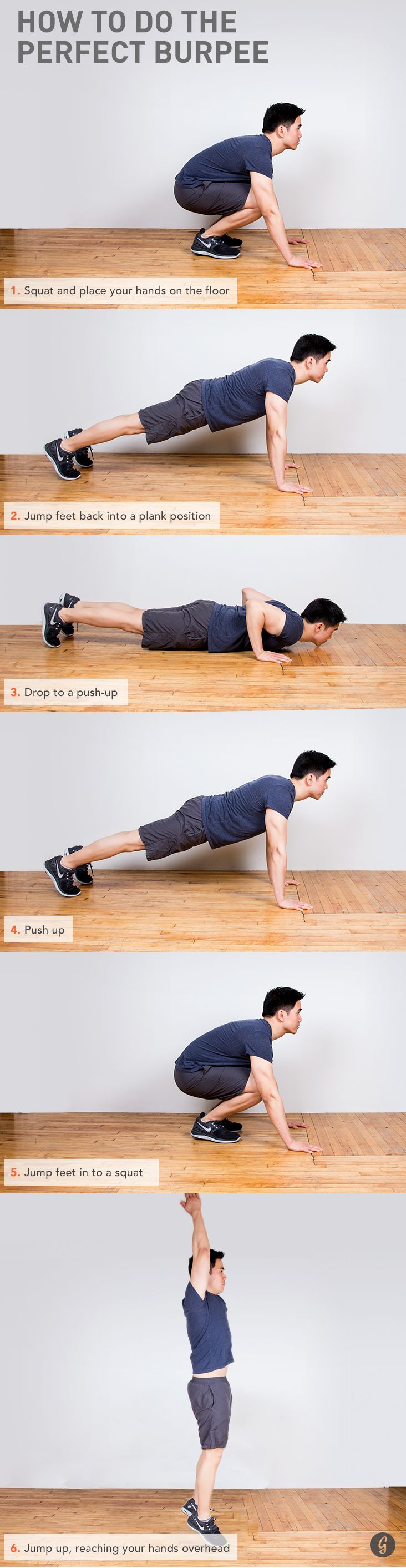
Burpees
No exercise combines strength, cardio, and coordination like the burpee. It engages the chest, legs, core, and shoulders in one explosive movement.
- Execution: Stand, squat, place hands on floor, kick back to plank, perform an optional push-up, jump feet forward, and leap up with arms overhead.
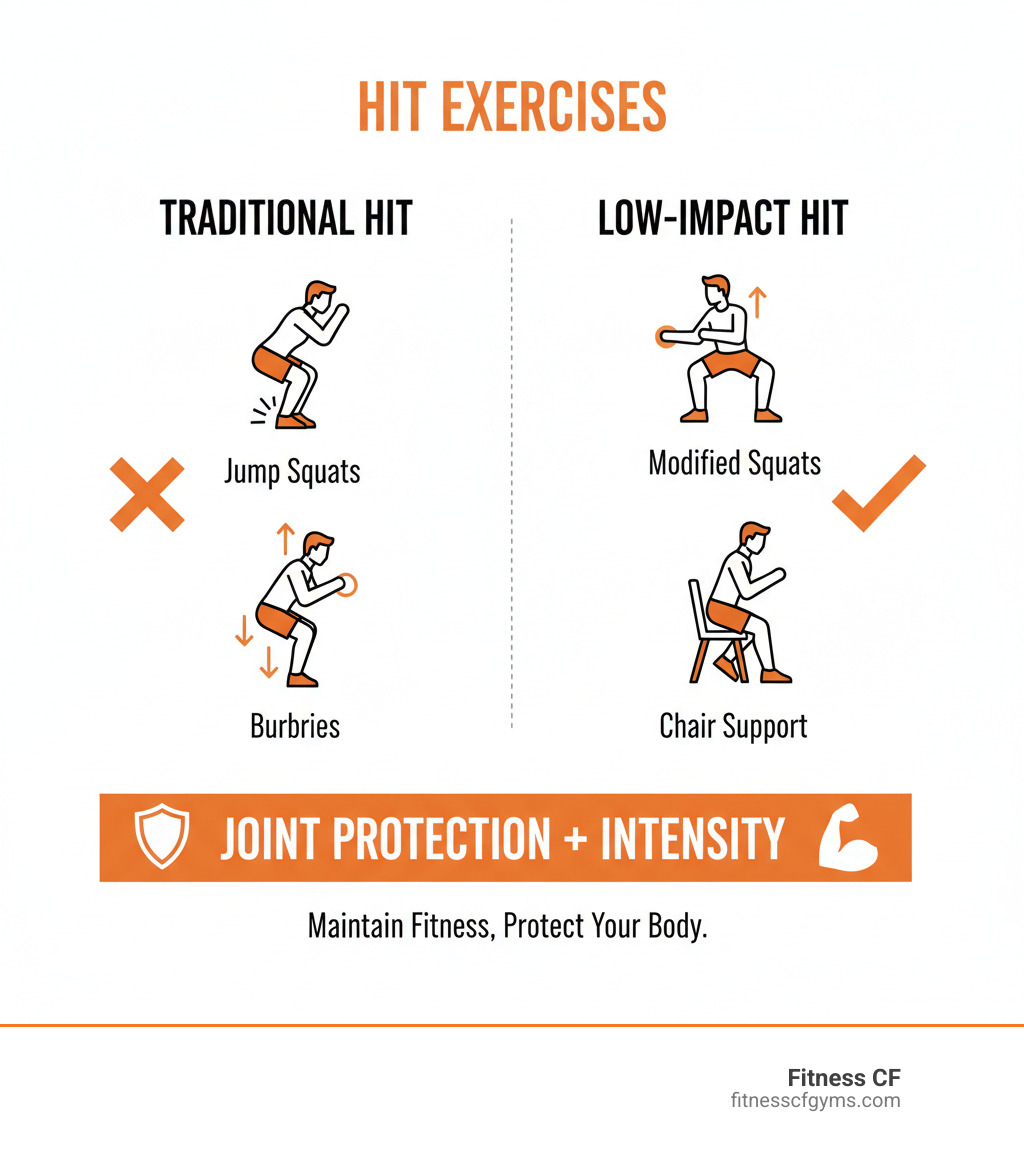
- Modification: Step back instead of jumping, skip the push-up, or omit the jump.
- Why It Works: Elevates heart rate instantly and builds functional strength.
Jump Squats
A lower-body powerhouse that also spikes cardiovascular demand.
- Execution: Lower into a squat with thighs parallel, explode upward into a jump, land softly, and immediately repeat.
- Modification: Perform regular squats or add a toe raise for intensity without impact.
- Visual Cue: Land with knees aligned over toes to protect joints.
Low-Impact Alternatives
Mountain Climbers
Fast-paced core and cardio hybrid that minimizes joint stress.
- Execution: In high plank, drive one knee toward chest, alternate quickly, keep hips level.
- Modification: Slow the pace or perform standing knee lifts.
- Pro Tip: Focus on speed and core engagement, not just leg movement.
High Knees
Mimics sprinting in place, ideal for warming up or max-effort intervals.
- Execution: Run in place, lifting knees to hip height, pumping arms aggressively.
- Modification: March with high knees or reduce speed.
- Time Estimate: 20–30 seconds per round.
Equipment-Based Variations
Treadmill Sprints
Precision-controlled and highly effective.
- Protocol: 30s sprint at 8–10 mph (or max safe speed), 60s walk, repeat 6–8 times.
- Safety Note: Use handrails only if balance is compromised; maintain natural running form.
Rowing Machine Intervals
Full-body, low-impact, and excellent for tracking power output.
- Protocol: 400m sprint, 1 min rest, repeat 5 rounds.
- Form Focus: Drive with legs first, then pull with arms; avoid rounding back.
Sample HIIT Cardio Workouts
5-Minute Bodyweight Blast
Perfect for a quick metabolic boost.
- Warm-up: 10s butt kickers (no rest)
- Circuit (2 rounds): 20s on / 10s off
- Air squats
- Alternating jump lunge
- Burpee with push-up
- Finisher: 30s max-effort jump squats (no rest)
Total Time: ~5 minutes | Difficulty: High
Expert Note: This workout fits between meetings or after a strength session. No equipment needed.
10-Minute AMRAP Challenge
Test endurance and pacing.
- Goal: Complete as many rounds as possible in 10 minutes.
- Round:
- 15 full-release push-ups
- 25 plank shoulder taps
- 30 touchdown jacks
Rest as needed within time limit.
Progression: Add 10 spiderman push-ups and 10 mountain climbers for an advanced version.
Tabata Sprint Protocol
Maximum intensity, minimal time.
- Format: 20s all-out effort / 10s rest × 8 rounds = 4 minutes
- Exercise Options:
- Squat jumps
- Treadmill sprint
- Rowing sprint
- Jumping jacks
Warning: Only attempt if you have a solid fitness base. This protocol is extremely demanding.
EMOM for Cardio Conditioning
Structured and sustainable.
- Format: Every minute on the minute for 10 minutes
- Odd Minutes: 5 push-ups, 10 shoulder taps, 10 touchdown jacks
- Even Minutes: 10 push-ups, 5 spiderman push-ups
Use leftover time in each minute to rest.
Benefit: Encourages consistency and pacing under fatigue.
Beginner HIIT Cardio Plan
Start safe and build stamina.
Starter Circuit (3 Rounds)
- Warm-up: 5 min light jog or march
- Work 20s / Rest 30s
- Jump squats (or regular squats)
- Push-ups (on knees if needed)
- Mountain climbers
- Burpees (modified)
- Cool-down: 5 min walk + stretch
Frequency: 1–2 times per week
Common Mistake: Going too hard on day one. Focus on form and consistency, not max effort.
Safety and Injury Prevention

Who Should Avoid HIIT?
High intensity interval cardio exercises are not for everyone. Consult a doctor before starting if you have:
- Heart disease or uncontrolled hypertension
- Joint pain (especially knees or hips)
- Recent injuries or surgeries
- Balance issues
Pregnant women should avoid high-impact variations unless cleared by a physician.
Form Over Speed
Fatigue leads to sloppy form, increasing injury risk. If your jump squats become shallow or your burpee landings are unstable, stop the set. It’s better to complete fewer quality reps than risk knee or back strain.
Red Flag Signs: Sharp pain, dizziness, chest tightness, or extreme shortness of breath. Stop immediately.
Recovery Is Part of the Program
HIIT causes significant physiological stress. Overtraining leads to burnout, fatigue, and injury. Follow these rules:
- Limit HIIT to 2–3 sessions per week
- Allow at least 48 hours between intense sessions
- Prioritize sleep and hydration
- Add light walking or stretching on rest days
Cool-Down Routines
Never skip recovery. Cooling down helps prevent dizziness and speeds muscle repair.
5-Minute Post-HIIT Stretch
Do this after every session:
- Inchworms (10 reps): Walk hands out to plank, perform an optional push-up, then walk feet to hands. Stretches hamstrings and shoulders.
- Downward Dog with Pedal (10 reps/side): In downward dog, pedal feet by bending one knee, then the other. Loosens calves and feet.
- World’s Greatest Stretch (10 reps/side): Lunge forward, place opposite hand on floor, rotate up toward ceiling. Opens hips and spine.
- Catcher’s Squat with Rotation (10 reps/side): Deep squat with feet flat, rotate torso side to side. Improves mobility in hips and mid-back.
Visual Cue: Keep heels down in stretches; use yoga blocks or lift heels if needed.
HIIT vs. Traditional Cardio: Which Wins?
| Factor | HIIT Cardio | Steady-State Cardio |
|---|---|---|
| Calorie Burn (Total) | High (during + after) | Moderate (mostly during) |
| Time Required | 4–30 min | 30–60+ min |
| Muscle Preservation | Yes (especially with resistance) | Risk of loss if prolonged |
| VO2 Max Improvement | Faster gains | Slower, linear gains |
| Beginner-Friendly | Moderate (with modifications) | High |
| Joint Impact | High (unless modified) | Low to moderate |
Bottom Line: HIIT wins for fat loss and time efficiency. Steady-state wins for endurance and accessibility.
Maximize Your HIIT Results
Track Your Progress
Use a simple log to monitor:
- Workouts completed
- Exercises and reps
- How you felt (energy, form, breath)
- Resting heart rate (should decrease over time)
Improvements in endurance and recovery happen within 2–4 weeks.
Mix It Up Weekly
Prevent plateaus by rotating:
- Exercises (swap jump squats for box jumps)
- Protocols (Tabata → EMOM → AMRAP)
- Equipment (bodyweight → dumbbells → rower)
Variety keeps motivation high and muscles adapting.
Fuel and Hydrate Smart
HIIT depletes glycogen stores fast. Support recovery with:
- 20–30g protein within 45 minutes post-workout
- Complex carbs (oats, sweet potato)
- At least 2 liters of water daily
Avoid training HIIT fasted unless experienced due to risk of dizziness or low energy.
Frequently Asked Questions About High Intensity Interval Cardio Exercises
How many times per week should I do HIIT?
Most people benefit from 2–3 HIIT sessions per week, with at least 48 hours between intense workouts. Beginners should start with 1–2 sessions weekly and increase gradually as fitness improves.
Is HIIT better than running for fat loss?
HIIT and running both burn fat, but HIIT offers superior time efficiency. You can achieve similar or better fat loss results in 20 minutes of HIIT compared to 60 minutes of moderate running, plus you continue burning calories after the workout due to EPOC.
Can beginners do high intensity interval cardio exercises?
Yes, beginners can do HIIT with modifications. Start with longer rest periods (1:2 ratio), shorter work intervals (15–20 seconds), and low-impact exercises like marching in place or step-ups instead of jumps.
What heart rate should I aim for during HIIT?
True HIIT requires working at 80–95% of your maximum heart rate during work intervals. If you can hold a full conversation, you’re likely not pushing hard enough. Use a heart rate monitor or the talk test to gauge intensity.
Does HIIT burn muscle?
HIIT actually helps preserve lean muscle mass, especially when combined with resistance exercises. Unlike prolonged steady-state cardio, which can lead to muscle loss, HIIT supports a leaner body composition.
How long until I see results from HIIT?
Most people notice improvements in endurance and recovery within 2–4 weeks of consistent training. Visible fat loss and body composition changes typically occur within 4–8 weeks when paired with proper nutrition.
Key Takeaways for High Intensity Interval Cardio Exercises
High intensity interval cardio exercises deliver maximum fitness results in minimum time by alternating explosive work periods with brief recovery. The science is clear: HIIT triggers EPOC, improves VO2 max rapidly, preserves muscle, and burns fat efficiently, all in sessions as short as 4–30 minutes.
Start with a beginner-friendly circuit, focus on proper form over speed, and progress gradually by adjusting work-to-rest ratios. Track your workouts, rotate protocols like Tabata and EMOM to prevent plateaus, and allow 48 hours between sessions for full recovery.
Your next step is simple: pick one workout from this guide, set a timer, and commit to three sessions this week. Consistency beats perfection, and your body will respond faster than you expect.