How to Do Cardio with a Broken Foot
You’re sidelined with a broken foot, stuck in a boot or on crutches, and your usual cardio routine feels impossible. The frustration is real: you don’t want to lose fitness, but you can’t run, jump, or even walk without pain. Here’s the good news: you can still do cardio with a broken foot safely and effectively by shifting focus to non-weight-bearing, upper-body, and aquatic methods that keep your heart rate up without risking re-injury.
This guide delivers a complete, medically informed plan for maintaining cardiovascular fitness while healing. You’ll learn which exercises are safe (and which to avoid), how to use equipment like arm bikes and battle ropes, and how to structure workouts that mimic running intensity, all without putting pressure on your injured foot. With the right approach, you can preserve endurance, stay mentally strong, and return to full activity faster.
Medical Clearance & Healing Phases
Before starting any workout, your top priority is healing. A broken foot requires structured recovery, and jumping into exercise too soon can delay healing or cause re-fracture.
Know Your Recovery Phase
Healing typically follows three stages:
– Phase 1 (0–6 weeks): Non-weight-bearing. Use crutches, a boot, or cast. No impact allowed.
– Phase 2 (6–8+ weeks): Partial weight-bearing. Cleared for light activity like stationary cycling.
– Phase 3 (8+ weeks): Full weight-bearing. Gradual return to walking, then jogging.
Never begin cardio without medical approval. Your doctor or physical therapist must confirm your fracture type and stability before any movement beyond daily mobility.
Pain Is Your Stop Signal
If you feel pain in the injured foot during any exercise, stop immediately. Discomfort isn’t “working through it.” It’s your body warning of potential damage. Cardio should elevate your heart rate, not your injury risk.
Safe Cardio Options: Zero Foot Impact
You don’t need legs to get your heart pumping. These proven, low-impact modalities deliver real cardiovascular benefits while protecting your healing foot.
Swim with a Pull Buoy
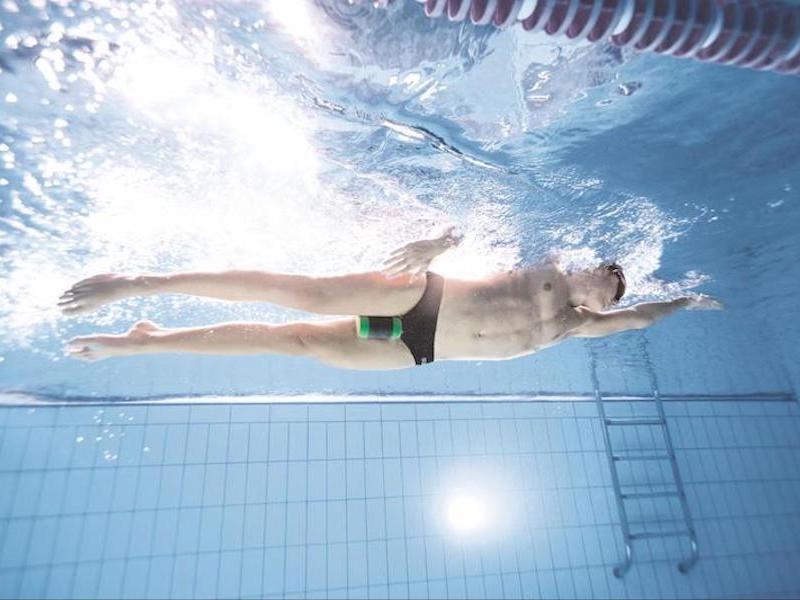
Swimming is one of the best cardio options for a broken foot when done correctly.
How to Do It Safely
- Use a pull buoy between your thighs to keep your legs floating.
- Keep legs still. No kicking. Even gentle flutter kicks can strain the foot.
- Propulsion comes from your arms only.
Best Strokes
- Freestyle (arm-only): High-intensity, full upper-body engagement.
- Backstroke: Gentle on shoulders, excellent for endurance.
- Breaststroke (modified): Only if you can avoid pushing off the wall with your feet.
Pro Tip: Aim for 20–30 minutes of continuous swimming, 3–4 times per week. Start slow if you’re new to swim cardio.
Try Aqua Jogging
Aqua jogging mimics running motion in deep water for zero impact and full cardiovascular benefit.
What You Need
- Aqua Jogger belt (buoyancy belt)
- Pool deep enough that feet don’t touch bottom
- Optional: aqua ankle weights for resistance
How to Do It
- Strap on the buoyancy belt.
- Run in place in chest- to shoulder-deep water.
- Maintain upright posture, drive elbows, and simulate running form.
Why It Works: Aqua jogging maintains VO2 max and running economy in injured athletes. It’s the gold standard for runners with lower-body injuries.
Workout Suggestion:
– Warm-up: 5 min easy jog
– Intervals: 1 min hard / 2 min easy x 6 rounds
– Cool-down: 5 min easy
Use an Arm Bike (Upper Body Ergometer)

An arm bike, also called an upper body ergometer, is a stationary bike for your arms. It delivers aerobic intensity comparable to running.
How to Use It
- Sit upright with back supported.
- Pedal forward for triceps and chest focus.
- Pedal backward for biceps and back engagement.
- Adjust resistance to reach target heart rate.
Workout Example (HIIT)
- 30 sec max effort
- 90 sec recovery
- Repeat 8–10 rounds
Calorie Burn: Up to 400–600 kcal/hour at high intensity, similar to running.
Equipment Note: If you don’t have access to a gym, portable arm bikes are available for home use.
Battle Rope HIIT (Seated)
Battle ropes are a dynamic, high-intensity tool that requires zero foot movement, perfect for broken foot recovery.
How to Do It Seated
- Sit in a sturdy chair or on the floor.
- Anchor the rope to a pole or use a weighted rope (no anchor needed).
- Perform:
- Alternating waves (30 sec)
- Double waves (30 sec)
- Slams (30 sec)
- Rest 60 sec
- Repeat 3–5 rounds
Why Seated? This position eliminates balance issues caused by a walking boot. It’s also safer if you’re on crutches.
Cardio Benefit: Rapid heart rate elevation, excellent for fat burn and endurance.
Pro Tip: Use a Heavywear battle rope with a weighted center for indoor, anchor-free workouts.
Stationary Bike (Conditional)
Cycling may be safe, but only with clearance and proper setup.
When It’s Allowed
- If your fracture is stable
- If you’re in a walking boot or partial weight-bearing phase
- If pedaling causes no pain
How to Modify
- Raise the seat so your knee is slightly bent at the bottom of the stroke.
- Avoid clip-in pedals. Use flat pedals or remove pedals entirely on an air bike.
- Use arms-only mode on an Assault AirBike Classic (pedals removed, focus on handles).
Risk Alert: Pedaling can transfer force through the foot. If in doubt, skip it.
Try the ElliptiGO
For outdoor cardio lovers, the ElliptiGO is a game-changer.
What It Is
- A hybrid between a bike, elliptical, and runner’s motion.
- Provides smooth, low-impact forward movement.
Why It’s Ideal
- No pounding on joints.
- Engages core and legs gently.
- Lets you “run” outdoors without impact.
Best For: Runners in later recovery phases (partial weight-bearing) who miss outdoor training.
Strength & Core: Maintain Fitness Without Foot Stress
Cardio isn’t the only goal. Preserving muscle mass and core strength prevents setbacks when you return to full activity.
Upper Body Strength (Seated)
Focus on chest, back, shoulders, and arms using minimal equipment.
Key Exercises
- Seated dumbbell press (shoulders)
- Bicep curls
- Lateral raises
- Seated rows (with band or machine)
- Push-ups (modified):
- Wall push-ups
- Kneeling push-ups
- Feet-on-chair push-ups (if balance allows)
Workout Format: 3 sets of 10–12 reps per exercise.
Core Work (Supine Only)
Lie on your back for zero foot pressure.
Safe Core Exercises
- Abdominal draw-in: Tighten abs, pull belly to spine.
- Bicycle crunches: Lie flat, alternate elbow-to-knee.
- Leg lifts: Straight legs up and down (keep lower back flat).
- Dead bugs: Arms and opposite leg extend slowly.
- Hollow hold: Advanced core stability.
Avoid: Planks, mountain climbers, or any move requiring toe pressure.
Uninjured Leg & Hip Work
Use the cross-education effect. Training one leg can help preserve strength in the injured one.
Safe Exercises
- Seated leg extension machine (quad focus)
- Seated hamstring curl machine
- Four-way hip exercises (lying down):
- Flexion: Lift straight leg while lying on back
- Abduction: Lie on side, lift top leg
- Extension: Lie on stomach, lift leg (glutes)
- Adduction: Lie on side, lift bottom leg
Add ankle weights only if pain-free.
Build a Weekly Cardio Routine
/1752685068789_Screenshot%202025-07-16%20at%2011.57.18%E2%80%AFAM-comp.png)
Structure your workouts for consistency and results.
Sample Weekly Plan (Phase 1: Non-Weight-Bearing)
| Day | Workout |
|---|---|
| Mon | Arm bike HIIT (20 min) + core |
| Tue | Aqua jogging (30 min) |
| Wed | Seated battle ropes (3 rounds) + upper body strength |
| Thu | Swim with pull buoy (25 min) |
| Fri | Arm bike endurance (40 min, steady pace) |
| Sat | ElliptiGO or pool walk (if cleared) |
| Sun | Rest |
Adjust intensity based on energy and healing progress.
Modified HIIT & CrossFit Workouts
You can still do high-intensity training. Just adapt it.
Tabata-Style HIIT (No Legs)
- 20 sec work / 10 sec rest x 8 rounds
- Exercises:
- Battle rope waves
- Seated dumbbell presses
- Bicycle crunches
- Arm bike sprints
Modify “Cindy” (CrossFit WOD)
Original: 5 pull-ups, 10 push-ups, 15 squats (20-min AMRAP)
Modified:
– 5 pull-ups
– 10 push-ups (knees or wall)
– 15 seated leg lifts or bicycle crunches
Result: Same metabolic demand, zero foot stress.
Recommended Video Workouts
No gym? No problem. These guided routines are perfect for recovery.
Top YouTube Options
- Fitness Blender – Total Body Chair Workout
Full-body, no standing required. - Caroline Jordan – Hurt Foot Workout
Short, gentle, crutch-friendly. - Heather Frey – FOOTLESS Workout
Advanced, high-energy, non-weight-bearing. - Bob Harper – Pure Burn (Core & Upper Body)
Skip lunges; focus on arms and abs.
Search Terms:
– “40-minute seated workout”
– “non-weight-bearing cardio”
– “broken foot exercise”
Equipment You Need
You don’t need much, just a few key tools.
| Equipment | Why It’s Useful |
|---|---|
| Pull buoy | Enables pain-free swimming |
| Arm bike | Full cardio without legs |
| Battle rope (weighted) | HIIT from a chair |
| Resistance bands | Portable strength training |
| Dumbbells | Upper body work at home |
| Aqua Jogger belt | Deep-water running |
| Assault AirBike (arms-only) | Full-body cardio, no pedals |
Mindset & Motivation
Injury can feel isolating. But this time isn’t lost. It’s a chance to build weakness into strength.
- Shift focus: Use this period to strengthen your upper body and core, areas many runners neglect.
- Track effort, not pace: Your heart rate and sweat matter more than speed.
- Celebrate adaptation: You’re not “broken.” You’re problem-solving.
Pro Tip: Record workouts. Seeing progress, even in arm strength or swim duration, boosts morale.
What NOT to Do
Avoid these common mistakes:
Running or Jumping
Even light jogging can re-fracture healing bone. Wait for full clearance.
Planks and Push-Up Variations That Stress Toes
Any exercise requiring foot flexion or pressure is off-limits.
High-Impact Elliptical Use
Standard ellipticals can still transmit force through the foot. Use only if cleared.
Ignoring Pain
No “pushing through.” Pain means stop.
Recovery Timeline & Return to Running
Healing takes 6–12 weeks, depending on fracture type.
Phased Return to Activity
- Weeks 0–6: Non-weight-bearing. Focus on arms, core, pool.
- Weeks 6–8: Partial weight-bearing. Add cycling (if cleared).
- Weeks 8–12: Full weight-bearing. Start walking, then walk/run intervals.
- After 12 weeks: Gradual return to running, only with medical approval.
Never rush it. Re-injury can double recovery time.
Frequently Asked Questions About Cardio with a Broken Foot
Can I do cardio with a broken foot?
Yes, you can do cardio with a broken foot using non-weight-bearing methods like swimming with a pull buoy, arm biking, aqua jogging, and seated battle ropes. These keep your heart rate up without stressing the fracture site.
Is swimming safe when you have a broken foot?
Swimming is safe if you use a pull buoy between your thighs and avoid kicking. Propulsion should come from your arms only. Even gentle kicking can disrupt healing.
When can I return to running after a broken foot?
Most foot fractures require 6–12 weeks of healing before a return to running. You need full medical clearance and should progress gradually from walking to walk/run intervals before resuming normal runs.
What machines can I use at the gym with a broken foot?
You can safely use an arm bike (upper body ergometer), seated battle ropes, and resistance machines for upper body work. Stationary bikes and ellipticals require medical clearance and may carry risk depending on fracture location.
Does training one leg help the injured leg?
Yes. Research on the cross-education effect shows that training your uninjured leg can help preserve strength and reduce muscle loss in the immobilized limb through neural stimulation.
What should I eat to help my broken foot heal?
A diet rich in calcium and vitamin D supports bone healing and density. These nutrients are essential for fracture recovery and long-term bone health.
Final Tips for Cardio with a Broken Foot
- Wear proper shoes post-recovery to prevent stress fractures.
- Boost calcium and vitamin D intake for bone healing.
- Progress slowly. Don’t jump from zero to 5K.
- Listen to your body and rest when needed.
You don’t have to lose fitness because of a broken foot. With smart substitutions and consistent effort, you can maintain cardiovascular health, build strength elsewhere, and return stronger than before.
Your injury isn’t the end of your fitness. It’s a detour. Use it wisely.