How to Build Cardio Endurance: Quick Steps
You start running and within minutes, your breath hitches, your legs burn, and you’re forced to stop. That frustrating moment is your body signaling low cardiovascular endurance. The encouraging truth is that cardio endurance is highly trainable. Whether you’re a beginner struggling with stairs or an athlete aiming to crush a 10K, building stamina is a systematic process rooted in consistency, smart progression, and recovery.
Cardiovascular endurance measures how efficiently your heart, lungs, and blood vessels deliver oxygen to working muscles during sustained activity. The stronger this system, the longer you can move without fatigue. The gold-standard metric is VO2 max, your body’s maximum oxygen uptake. While elite athletes hit 70+ ml/kg/min, most adults hover around 35–50. The key is that you can boost yours significantly with the right training.
In this guide, you’ll learn how to build cardio endurance using proven methods: heart rate zones, interval training, progression strategies, and lifestyle integration. No fluff. Just actionable steps that work, whether you have 10 minutes a day or 5 hours a week.
Start with Your Baseline
Know Your VO2 Max Potential
VO2 max is the best indicator of cardiovascular fitness. Lab testing is most accurate, but field tests like a 1.5-mile run or shuttle run can estimate it. For most adults, a score between 35–50 ml/kg/min is considered active. Endurance athletes often exceed 70 ml/kg/min. Post-stroke or sedentary individuals may start as low as 8–23, but even modest improvements of 10–15% yield major health gains.
You don’t need an exact number to begin, but understanding your starting point helps track progress. Use fitness trackers that estimate VO2 max, or simply note how far you can go before fatigue hits.
Assess Your Current Fitness Level
Before jumping into training, ask yourself a few honest questions:
– Can you walk for 15 minutes without stopping?
– Do you get winded climbing a flight of stairs?
– How many days per week are you currently active?
If you answered “no” to the first two, start with low-intensity steady-state workouts like walking. If you can sustain 20+ minutes of moderate activity, you’re ready to build structure and intensity.
Apply the FIIT Framework

Frequency: How Often to Train
Aim for 3–6 days per week of cardio. Beginners should start with 3–4 days, gradually increasing as stamina improves.
- Moderate intensity: 150+ minutes per week (e.g., brisk walking).
- Vigorous intensity: 75+ minutes per week (e.g., running, cycling hard).
Spread sessions throughout the week to avoid burnout. Two 25-minute walks are better than one 50-minute walk if it keeps you consistent.
Intensity: Train in Heart Rate Zones
Your effort level determines adaptation. Use Maximum Heart Rate (MHR), estimated as 220 minus your age, to guide intensity.
| Zone | % MHR | Purpose | Example |
|---|---|---|---|
| Zone 1 | 50–60% | Recovery, fat burning | Nature walk |
| Zone 2 | 60–70% | Aerobic base building | 30–60 min jog |
| Zone 3 | 70–80% | Lactate threshold | Tempo run |
| Zone 4 | 80–90% | Anaerobic power | Hill sprints |
| Zone 5 | 90–100% | Max effort | 30-sec all-out sprint |
Spend 70–80% of weekly cardio in Zone 2. This builds your aerobic engine, the foundation of all endurance.
Time: Duration That Works
Start with 10–15 minutes if you’re new. Add 5 minutes weekly until you reach 30+ minutes.
- LISS: 40–90 minutes at Zone 1–2.
- HIIT: 15–25 minutes including warm-up and recovery.
- Long runs: Add 10% weekly to prevent injury.
Even short bursts help. Three 10-minute walks equal 30 minutes of daily activity.
Type: Choose Your Cardio Modality
Pick activities you enjoy. Variety prevents burnout and overuse injuries.
- Walking: Lowest injury risk. Great for beginners.
- Running: High calorie burn. Start with walk/jog intervals.
- Cycling: Low-impact, joint-friendly. Indoor or outdoor.
- Swimming: Full-body, therapeutic. Builds strength plus endurance.
- Jump rope, burpees, stairs: No-equipment options.
Rotate 2–3 types weekly for balanced development.
Use Proven Training Methods
Build Your Aerobic Base
Your aerobic system fuels long-duration efforts. Strengthen it with Zone 2 training.
- Jog, bike, or row at a conversational pace, where you can speak in full sentences.
- Aim for 30–60 minutes, 3–4 times per week.
- Track progress: Can you go farther at the same pace?
This zone improves oxygen efficiency, fat metabolism, and heart strength. It is the bedrock of endurance.
Add Interval Training
Intervals boost VO2 max faster than steady-state work alone.
HIIT: High-Intensity Interval Training
- Work: 1–4 minutes at Zone 4–5.
- Recovery: 2–3 minutes at Zone 1–2.
- Repeat: 4–6 rounds.
- Example: 3-minute hard jog, then 3-minute walk, repeat 5x.
Do 1–2 HIIT sessions per week. Studies show 38–79% VO2 max improvement with consistent use.
SIT: Sprint Interval Training
Shorter, more intense bursts:
– Sprint: 10–30 seconds at max effort.
– Recover: 2–5 minutes easy.
– Repeat: 3–7 times.
Three SIT sessions per week for 2–8 weeks can improve endurance by 4–13.5%.
Fartlek: Speed Play
Unstructured intervals are ideal for runners.
– During a run, sprint to a tree, then recover.
– Pick up pace during a song chorus.
– No strict timing. Just mix effort levels.
Fartlek keeps training fun and unpredictable.
Progress Without Injury
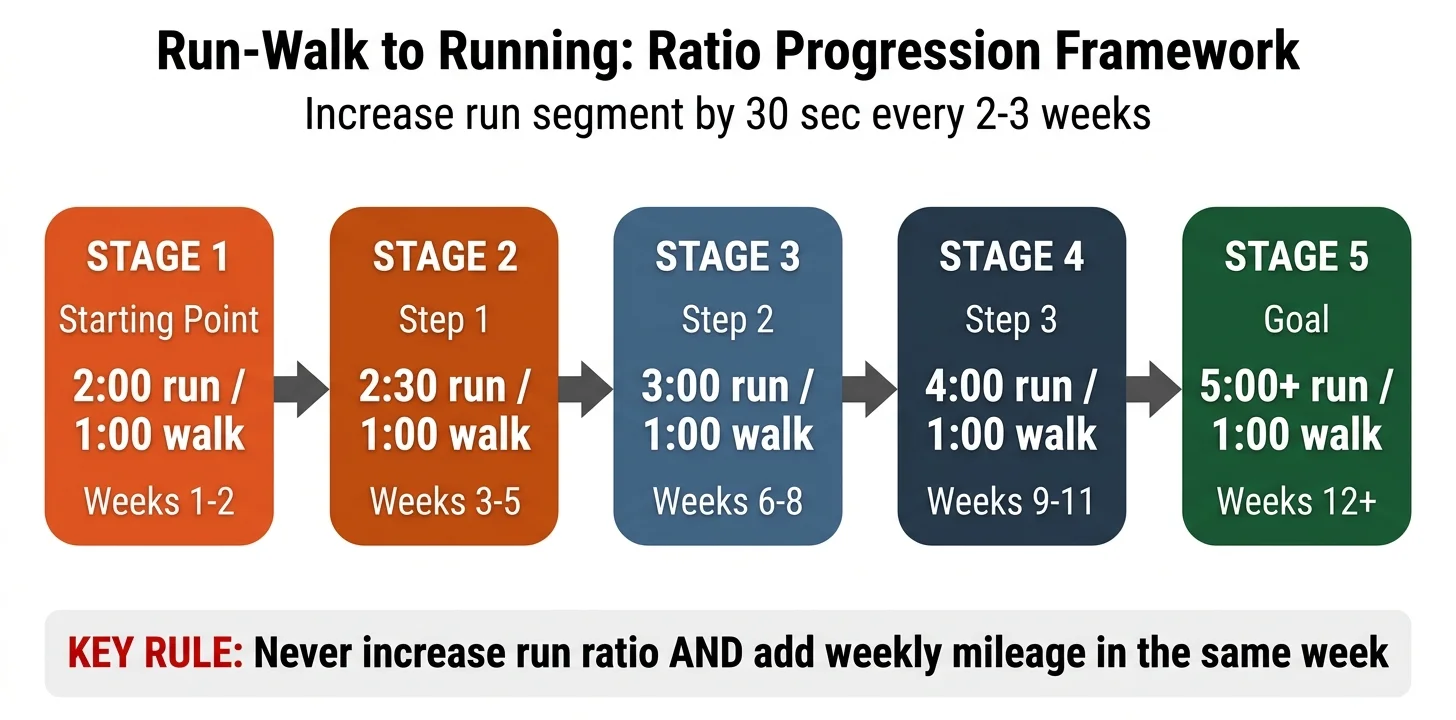
Follow the Add/Subtract Method
Avoid sudden jumps in volume. Use a progressive overload cycle:
| Week | Run/Walk Ratio | Duration | Purpose |
|---|---|---|---|
| 1 | 1 min run / 2 min walk | 20 min | Start |
| 2 | 2 min run / 2 min walk | 20 min | Increase effort |
| 3 | 2 min run / 2 min walk | 15 min | Recovery |
| 4 | 3 min run / 2 min walk | 25 min | Progress |
Every 3–4 weeks, increase volume or intensity, then step back to let your body adapt.
Prevent Overtraining
Signs you’re doing too much:
– Persistent fatigue
– Elevated resting heart rate
– Poor sleep
– Irritability
If you see these, take 2–3 days off or switch to Zone 1. Recovery is when adaptation actually happens.
Cross-Train for Resilience
Mix cardio with strength and flexibility:
– Strength training: 2x per week. Builds muscle to support joints.
– Yoga or stretching: Prevents stiffness, especially after cycling or running.
Cross-training reduces injury risk and improves overall performance.
Optimize for Results
Fuel with the Right Nutrition
Your body needs energy to sustain effort.
– Pre-workout: Light carb plus protein (banana with peanut butter).
– Post-workout: Protein plus carbs (chicken with rice, or a smoothie).
– Daily diet: Focus on whole grains, lean proteins, fruits, and vegetables.
Avoid heavy meals before cardio. Stay away from sugary snacks that cause energy crashes.
Hydrate Before, During, After
Dehydration reduces blood volume, forcing your heart to work harder.
– Before: 16–20 oz water 2 hours pre-workout.
– During: 7–10 oz every 10–20 minutes if exercising more than 45 minutes.
– After: Replace 1.5x lost fluids by weighing yourself pre and post.
Sweat rate varies, so adjust based on climate and intensity.
Listen to Your Body
Pain is a stop sign. Discomfort is normal; sharp or persistent pain is not.
– Joint pain: Stop and assess form or footwear.
– Chest tightness or dizziness: Seek medical advice immediately.
– Muscle soreness: Expected. Rest or do light activity.
Beginners should start slow. Even 10 minutes a day builds momentum.
Special Considerations

For Beginners and Sedentary Adults
You don’t need to run to build endurance.
– Start with brisk walking 10–15 minutes per day.
– Add 5 minutes weekly.
– Use a step counter and aim for 5,000 to 10,000 steps per day.
Consistency beats intensity. Showing up matters more than speed.
For Post-Cardiac or Stroke Survivors
Exercise is medicine, but get clearance first.
– Doctor-prescribed program: Essential.
– Start low: Zone 1–2 for 10–15 minutes.
– Goal: 150 minutes per week of moderate activity.
Even small improvements of 10–15% enhance walking ability and reduce recurrence risk.
For Children
More movement equals better endurance.
– Increase PE frequency: From 2x to 4x per week.
– Active play: Tag, jump rope, bike rides.
– Limit screen time.
Early habits shape lifelong health.
Weekly Cardio Plan Template

Use this structure to build endurance safely:
| Day | Workout | Duration | Intensity |
|---|---|---|---|
| Mon | Brisk walk or jog | 30 min | Zone 2 |
| Tue | HIIT (e.g., sprint intervals) | 20 min | Zone 4–5 |
| Wed | Rest or yoga | — | Recovery |
| Thu | Cycling or swim | 45 min | Zone 2 |
| Fri | Fartlek run | 25 min | Mixed zones |
| Sat | Long walk or hike | 60 min | Zone 1–2 |
| Sun | Rest | — | — |
Adjust based on fitness level:
– Beginner: Replace HIIT with walk intervals.
– Advanced: Add a second Zone 2 session or extend the long run.
Make It Last
Build Mental Resilience
Endurance is as mental as it is physical.
– Reframe hard efforts as fun challenges.
– Use music or podcasts to distract during long sessions.
– Set small, achievable goals like “This week, I’ll add 5 minutes.”
Motivation fades, but systems don’t. Schedule workouts like appointments.
Integrate Movement Daily
Don’t rely only on workouts.
– Take stairs.
– Park farther away.
– Dance while cooking.
– Walk during calls.
These micro-movements add up to your 150-minute weekly goal.
Track Progress
Use simple metrics:
– Distance: Can you run 2km without stopping?
– Time: Is your 5K time dropping?
– Perceived effort: Is the same pace easier?
– Resting heart rate: Lower over time means a stronger heart.
Celebrate small wins. They compound.
Frequently Asked Questions About Building Cardio Endurance
How long does it take to build cardio endurance?
Most beginners notice meaningful improvements within 8–12 weeks of consistent training. VO2 max can increase by 10–15% in previously sedentary individuals within that timeframe.
What is the best exercise for building cardio endurance?
There is no single best option. Walking, running, cycling, and swimming all build endurance effectively. The best exercise is one you enjoy and can perform consistently.
How often should I do cardio to build endurance?
Aim for 3–6 days per week. Beginners should start with 3–4 days and gradually increase. Most adults need at least 150 minutes of moderate or 75 minutes of vigorous activity weekly.
Should I do HIIT or steady-state cardio for endurance?
Both work. Steady-state Zone 2 training builds your aerobic base, while HIIT boosts VO2 max faster. A balanced plan uses 70–80% steady-state and 1–2 HIIT sessions per week.
Can I build cardio endurance without running?
Absolutely. Walking, cycling, swimming, rowing, and even jump rope build endurance effectively. Running is just one option among many.
Is it normal to feel out of breath when starting cardio?
Yes. Getting winded initially is expected. As your heart and lungs adapt, breathing becomes easier at the same effort level. Start slow and progress gradually.
Key Takeaways for Building Lasting Cardio Endurance
Building cardio endurance is not about pushing harder every day. It is about training smarter, recovering well, and staying consistent. Start where you are, use the FIIT framework, and prioritize Zone 2 work. Add intervals wisely, recover fully, and cross-train to prevent injury.
In 8–12 weeks, you’ll climb hills without gasping, play with kids without collapsing, and feel stronger in every part of life. The heart is a muscle. Train it, and it will carry you farther than you ever thought possible. Your first step begins today.