Types of Heart Rate Monitors: A Complete Guide
Heart rate monitors have become everyday tools, yet confusion persists about which type actually delivers reliable data. Some users need clinical-grade accuracy to diagnose arrhythmias, while others simply want to track workouts or sleep quality. The types of heart rate monitors available today vary dramatically in technology, precision, and intended use.
The fundamental divide comes down to how a device measures your pulse. Medical-grade monitors use electrocardiography (ECG) to read electrical signals directly from your heart, delivering diagnostic precision. Fitness devices typically rely on photoplethysmography (PPG), which uses light to detect blood flow changes beneath your skin. Both approaches have strengths and limitations worth understanding.
This guide walks you through every major category of heart rate monitor, from short-term Holter devices to implantable loop recorders and wrist-worn smartwatches. You’ll discover which option matches your specific situation, whether you’re chasing a diagnosis, training for competition, or monitoring daily wellness.
Medical-Grade Heart Monitors for Diagnosis

Prescribed by physicians, these devices diagnose arrhythmias, correlate symptoms with heart activity, and enable real-time clinical intervention. They differ from consumer products in precision, data transmission, and monitoring duration.
Holter Monitor: Short-Term Continuous Recording
A Holter monitor records continuous ECG data for 1–3 days, with newer models extending up to 2 weeks. Doctors typically prescribe this device when patients experience symptoms like palpitations or dizziness on a daily basis.
- How it works: Sticky electrodes attach to your chest and connect via wires to a recording unit roughly the size of a deck of cards. You wear this unit on a neck strap or clip it to your clothing.
- What to expect: Showering is prohibited unless your provider supplies a waterproof cover. All recorded data gets analyzed after the monitoring period ends.
- Best for: Patients with frequent symptoms requiring short-term rhythm correlation.
Pro tip: Maintain a symptom diary throughout the monitoring period. Write down exact times when you feel dizzy or notice heart racing so your doctor can match those moments to your ECG trace.
Patch Recorders: Wireless ECG for Extended Wear
Patch recorders are slim, adhesive devices applied directly to your chest skin. They eliminate wires, remain discreet under clothing, and are typically waterproof once applied.
- Duration: Up to 14 days for standard models.
- Functionality: Continuous rhythm recording with automatic saving when abnormal patterns appear. Some models also allow manual triggering during symptoms.
- Lifestyle impact: Shower-safe after application, comfortable during sleep and physical activity.
- Best for: Patients with infrequent symptoms like occasional palpitations or unexplained fatigue.
Compared to Holter monitors, patches offer superior comfort and compliance because there are no wires to manage.
External Event Monitors: Manual Capture for Rare Symptoms
These devices pair chest sensors with a handheld recorder you carry in your pocket or on a belt. When symptoms strike, you press a button to capture heart activity surrounding that moment.
- Wear time: 2–6 weeks depending on the specific model.
- Setup: Electrodes adhere to your chest with wires running to the portable monitor.
- Activation: Either user-triggered or automatic detection, depending on the device.
- Data flow: Some models transmit readings in real time to a monitoring center, while others store data for later physician review.
Common mistake: Forgetting to press the activation button during symptoms. If your device requires manual triggering, act quickly. The buffer only retains approximately 45 seconds of data before the event.
MCOT: Real-Time Telemetry for 30 Days
Mobile Cardiac Outpatient Telemetry (MCOT) provides continuous, real-time ECG transmission to a dedicated monitoring team. This system suits high-risk patients who need immediate detection of dangerous rhythms.
- Placement: A patch adheres firmly to your chest with no wires involved.
- Connectivity: Requires stable internet and a base station within 30 feet. Data streams 24/7 to technicians who alert your physician if concerning rhythms emerge.
- Patch replacement: Change every 5 days to maintain skin adhesion and hygiene.
- Best for: Patients with intermittent symptoms requiring active oversight and rapid response.
MCOT fills the gap between short-term Holter monitoring and long-term implantable solutions.
Implantable Loop Recorder: Multi-Year Internal Monitoring
An Implantable Loop Recorder (ILR) is a tiny device about the size of a large paperclip, inserted just beneath the skin near your chest.
- Battery life: Up to 4 years of continuous monitoring.
- Procedure: Performed in-office under local anesthesia without sedation. Most patients drive themselves home afterward.
- Functionality: Records continuously and transmits data nightly through a home transmitter to a secure monitoring website.
- Removal: Straightforward outpatient procedure when monitoring is complete.
Doctors recommend ILRs when other monitors fail to capture elusive events like unexplained fainting or silent arrhythmias.
Expert note: ILRs prove especially valuable for cryptogenic stroke patients whose strokes have no identified cause. Detecting undiagnosed atrial fibrillation through long-term monitoring can prevent future cardiovascular events.
Fitness and Consumer Heart Rate Monitors
Designed for athletes and health-conscious users, these devices emphasize convenience, real-time feedback, and seamless integration with apps like Strava, Apple Health, and Garmin Connect.
Chest Strap Monitors: The Accuracy Gold Standard

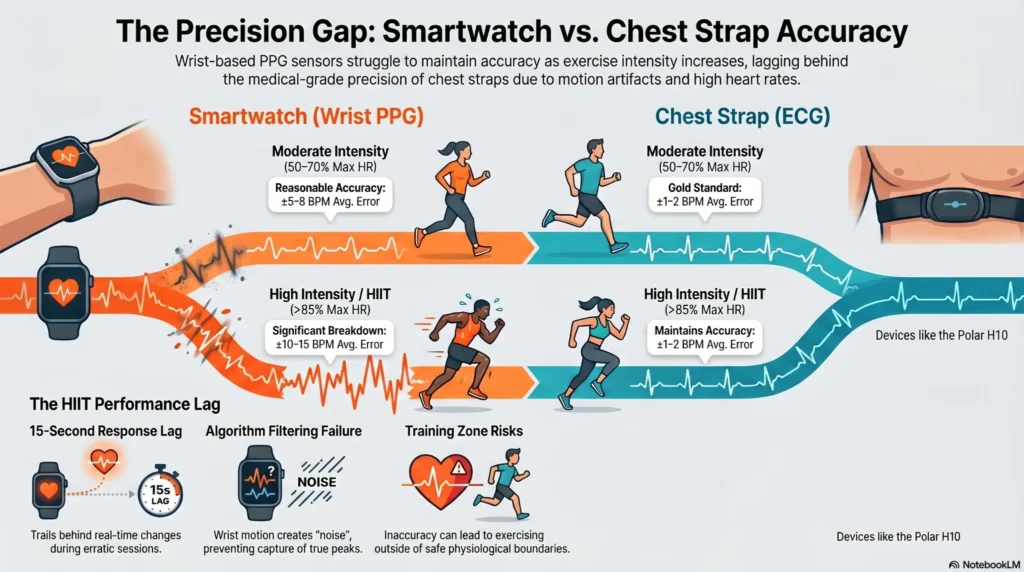
Chest straps use ECG technology to detect electrical impulses directly from your heart, making them the most accurate consumer option available.
- How it works: A conductive strap wraps snugly around your chest just below the pectorals. Built-in sensors pick up heart signals and transmit them wirelessly via Bluetooth or ANT+ to your watch, phone, or bike computer.
- Accuracy: Unmatched during high-intensity intervals, sprints, and rapid heart rate transitions.
- Battery: Replaceable coin-cell batteries typically last 1–3 years.
- Best for: Serious athletes, HIIT sessions, endurance sports including running, cycling, and triathlon.
Pro tip: Wet the electrode areas before each use. Dry sensors reduce signal quality and produce erratic readings.
Despite their precision, some users find chest straps uncomfortable for all-day wear, particularly during sleep or extended rest periods.
Arm Strap Monitors: Balanced Accuracy and Comfort

Arm straps house PPG sensors on your upper or lower arm, avoiding the motion artifacts that plague wrist-based devices.
- Technology: Photoplethysmography using light-based measurement, but more stable than wrist devices because there’s less muscle movement at the arm.
- Placement: Worn on the forearm or bicep, making them ideal during weightlifting, tennis, or boxing where wrist motion interferes with optical readings.
- Accuracy: Closer to chest strap performance than wrist devices, especially during dynamic workouts.
- Best for: Athletes who dislike chest straps but demand better-than-wrist accuracy.
Brands like Scosche and WHOOP produce arm-worn models trusted by professional athletes.
Wrist-Based Monitors: Everyday Convenience
Smartwatches and fitness bands from Apple, Fitbit, Garmin, and Samsung use PPG sensors positioned on the underside of the device.
- How it works: Green LED lights shine into your wrist tissue while a photodetector measures blood volume changes with each heartbeat.
- Convenience: Seamless 24/7 wear for step counting, sleep tracking, and moderate exercise sessions.
- Limitations:
- Reduced accuracy during rapid heart rate shifts
- Motion artifacts from running or lifting distort readings
- Skin tone, tattoos, and strap tightness all affect measurement quality
Real-world test: Compare your smartwatch reading to a chest strap during sprint intervals. You will likely notice a lag or spike discrepancy between the two.
For resting heart rate, sleep trends, and moderate cardio, wrist devices deliver valuable insights without any discomfort.
Choosing the Right Heart Rate Monitor
The best device depends entirely on your primary objective: medical diagnosis, athletic performance, or lifestyle tracking.
Match Your Monitor to Your Goal
| Goal | Recommended Type |
|---|---|
| Diagnose arrhythmia or fainting | Holter, Patch, MCOT, ILR |
| Train with precise heart rate zones | Chest strap |
| Track general fitness with minimal hassle | Wrist-based smartwatch |
| Lift weights or play racket sports | Arm strap |
| Monitor long-term heart trends | Implantable Loop Recorder or HRV-capable wearable |
Weigh Accuracy Against Comfort
- Highest accuracy: Chest strap using ECG technology
- Best balance: Arm strap using PPG with reduced motion noise
- Most convenient: Wrist-based PPG, though prone to motion errors
Warning: Never rely on wrist-based devices for medical decisions. They function as wellness tools, not diagnostic instruments.
Verify Compatibility and Battery Requirements
- Fitness users: Confirm your chest strap pairs with your preferred watch or app through ANT+ or Bluetooth support.
- Medical users: Check internet requirements for MCOT or base station needs for telemetry systems.
- Battery expectations:
- Chest straps: Years of use with replaceable batteries
- Wrist devices: Daily to weekly charging required
- Patches: Non-replaceable, lasting the full wear cycle
Essential Maintenance for Reliable Readings
Proper care extends device lifespan and ensures accurate data collection.
Prepare Your Skin for Medical Sensors
- Clean the chest area with alcohol wipes before applying electrodes or patches.
- For men: Shave chest hair where sensors will sit. Hair prevents proper adhesion and creates signal gaps.
- Avoid lotions or oils on application areas since they interfere with electrical conductivity.
Keep Optical Sensors Clean
- Wipe the back of wrist or arm devices regularly with a dry cloth.
- Accumulated sweat, dirt, and dead skin block light transmission and cause inaccurate PPG readings.
Replace Patches and Electrodes on Schedule
- MCOT patches: Replace every 5 days
- Holter electrodes: Replace if loose or peeling
- Disposable patches: Single use only, discard after removal
Medical vs. Fitness Monitors: Final Comparison
| Feature | Medical Monitors | Fitness Monitors |
|---|---|---|
| Purpose | Diagnose arrhythmias | Optimize workouts, track health |
| Technology | ECG across all types | ECG (chest), PPG (wrist/arm) |
| Prescription Required | Yes | No |
| Data Transmission | Stored or real-time telemetry | Bluetooth to phone or watch |
| Wear Duration | 1 day to 4 years | Continuous based on user preference |
| User Action Needed | Log symptoms, press button | Minimal automatic tracking |
| Water Resistance | Varies, patches often shower-safe | Most models swim-proof |
| Cost | Typically insurance-covered | Out-of-pocket ranging $50–$500 |
Frequently Asked Questions About Heart Rate Monitors
What is the most accurate type of heart rate monitor?
Chest strap monitors using ECG technology deliver the highest accuracy among consumer options. They detect electrical signals directly from your heart, making them reliable even during intense movement and rapid heart rate changes.
Can a smartwatch detect heart problems?
Smartwatches can identify irregular rhythm patterns and alert you to potential issues, but they cannot diagnose conditions. If your device flags an irregularity, consult a physician for proper evaluation using medical-grade equipment.
How long should you wear a heart rate monitor for diagnosis?
Duration depends on symptom frequency. Holter monitors work for 1–3 days when symptoms occur daily. Patch recorders and external event monitors span 2–6 weeks for infrequent symptoms. MCOT extends to 30 days, while implantable loop recorders can monitor for up to 4 years.
Do wrist heart rate monitors work during exercise?
Wrist monitors provide reasonable accuracy during steady-state cardio but struggle during high-intensity intervals or activities involving significant wrist motion. For precise training data, chest straps or arm straps perform better.
What is the difference between ECG and PPG heart rate monitors?
ECG monitors measure electrical impulses generated by your heart, offering clinical precision. PPG monitors use light to detect blood flow changes beneath your skin, providing convenience but with reduced accuracy during movement.
Are fitness heart rate monitors waterproof?
Most modern wrist-based fitness trackers tolerate swimming and showering. Medical devices vary: patches are typically shower-safe once applied, while Holter monitors usually require you to avoid water entirely.
Key Takeaways for Selecting Your Heart Rate Monitor
Three core categories define the types of heart rate monitors available today. Diagnostic medical monitors including Holter, patch, MCOT, and ILR devices help physicians catch arrhythmias through varying wear times and transmission methods. Performance athletic monitors like chest straps and arm straps deliver high accuracy for serious training. Lifestyle health monitors built into smartwatches prioritize 24/7 wearability for general wellness tracking.
Your next step depends on your situation. If you experience heart symptoms like dizziness, palpitations, or fainting, schedule a medical evaluation rather than attempting self-diagnosis with consumer devices. If you train intensely and need precise zone data, invest in a quality chest strap. For everyday wellness and moderate exercise, a wrist-based smartwatch provides sufficient insight without discomfort.
Understanding these distinctions empowers you to choose equipment that matches your actual needs, whether your priority is health protection, athletic performance, or simple awareness of how your body responds to daily life.