Kettlebell Cardio Exercises: Quick Steps
You don’t need a treadmill, spin bike, or expensive gym membership to torch calories and build serious endurance. With just one kettlebell, you can spike your heart rate, strengthen every major muscle group, and burn fat for hours after your workout ends. Kettlebell cardio exercises combine strength, power, and heart-pumping intensity into fluid, full-body movements that deliver results in under 30 minutes.
Unlike running or cycling, which often beat up your joints and isolate the lower body, kettlebell training is low-impact but high-intensity. The dynamic swings, cleans, and snatches engage your glutes, hamstrings, core, shoulders, and grip, elevating your heart rate without the pounding of pavement. Thanks to the kettlebell’s offset center of mass, every rep demands stability, turning each movement into a core and balance challenge.
In this guide, you’ll discover how to choose the right weight, master the foundational movements, and apply proven training protocols like Tabata, EMOM, and AMRAP. Whether you’re short on time, recovering from injury, or simply bored of traditional cardio, these kettlebell cardio exercises will transform your conditioning, strength, and body composition.
Choose the Right Kettlebell Weight for Cardio
Go Lighter Than Your Strength Weight
For cardio, your goal isn’t maximal muscle failure; it’s sustained effort over time. If your arms burn out before your breathing gets heavy, the weight is too much. Pick a bell light enough to maintain clean form for 20 to 60 seconds during high-rep sets, but heavy enough to challenge your endurance.
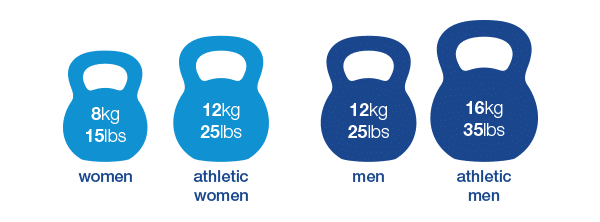
- Men: Start with 16 to 24 kg (35 to 53 lbs)
- Women: Start with 8 to 16 kg (18 to 35 lbs)
- Adjustable kettlebells let you fine-tune resistance as fatigue builds
Stick with one bell for most circuits to minimize transitions and keep your heart rate elevated.
Avoid Early Muscular Failure
Cardio effectiveness depends on cardiovascular fatigue, not local muscle exhaustion. If your quads give out during swings before your breathing spikes, scale down the weight. This extends your work intervals and increases total calorie burn across the session.
Master the Core Kettlebell Cardio Moves
Kettlebell Swings: The #1 Cardio Builder
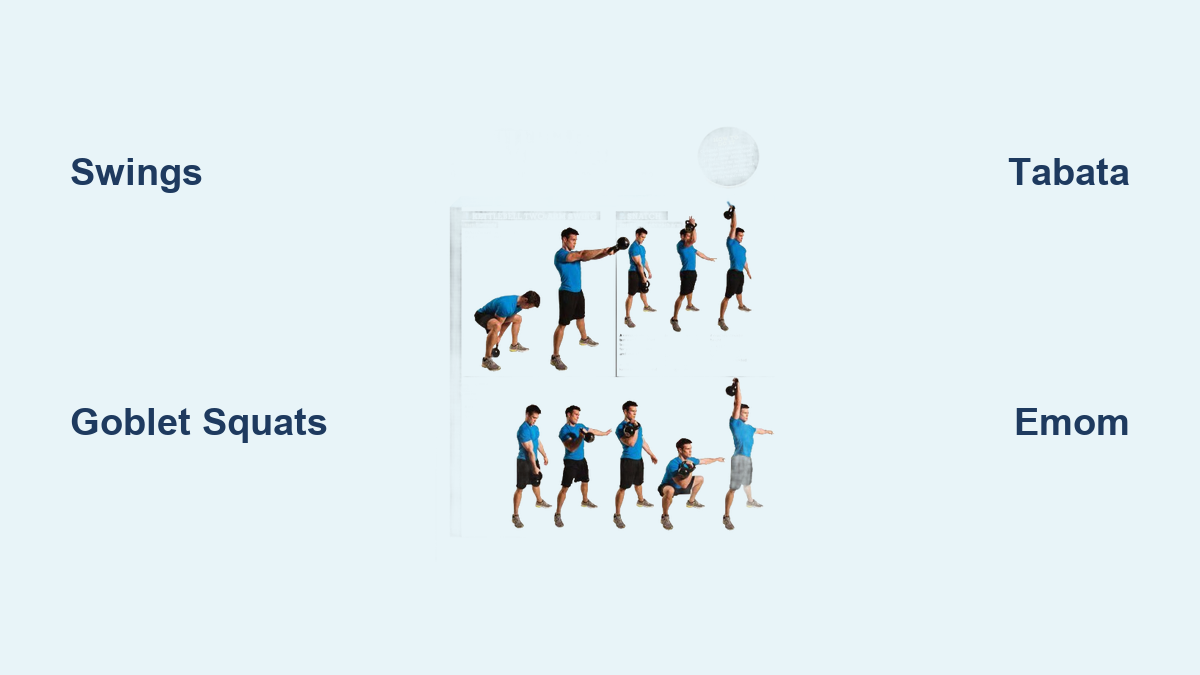
Swings are the cornerstone of kettlebell conditioning. They train explosive hip drive, hammer the posterior chain, and spike your heart rate faster than almost any other movement.
How to do it:
1. Stand with feet wider than shoulder-width apart, kettlebell on the floor.
2. Hinge at the hips, grab the bell with both hands.
3. Hike it back between your legs like a football snap.
4. Drive through your heels, extend your hips, and swing the bell to chest height.
5. Let it fall back down by hinging at the hips. Don’t squat or pull with your arms.
Keep your arms long, back flat, and power coming from the hips. The swing stops naturally when momentum dies; do not press it overhead.
Pro tip: Squeeze your glutes hard at the top. This protects your lower back and maximizes power output.
Goblet Squats: Full-Body Burner
Holding the kettlebell at chest level forces your core to fight forward lean, making this squat variation ideal for high-rep cardio sets.
Execution:
1. Hold the bell by the horns, close to your chest.
2. Sit your hips back and down, keeping your chest up.
3. Descend until your thighs pass parallel to the floor.
4. Drive through your heels to stand tall.
The anterior load increases core activation and allows deeper, safer squats than barbell versions, perfect for repeated rounds.
Alternating Lunges (Goblet Style)
Lunges build unilateral leg strength and stability while spiking heart rate when done continuously.
Steps:
1. Hold the kettlebell in goblet position.
2. Step one leg back into a reverse lunge.
3. Lower until your front knee reaches about 90 degrees.
4. Push back to start, then alternate legs.
Keep your torso upright. Do not let the weight pull you forward.
Romanian Deadlift (RDL)
This movement targets the hamstrings and glutes while reinforcing proper hip hinge mechanics essential for safe swings.
How to:
1. Hold the bell with both hands in front of your thighs.
2. Push your hips back with a slight knee bend, lowering the bell down your shins.
3. Feel a stretch in your hamstrings, then squeeze your glutes to return to standing.
Keep the bell close to your legs throughout. Light contact guides the path and protects your back.
Kettlebell High Pull
A ballistic upper-body move that uses triple extension (hips, knees, ankles) to generate explosive power.
Technique:
1. Start with the bell in one hand, hanging in front of you.
2. Dip slightly, then explode upward using your hips.
3. Pull the bell to shoulder height with a powerful shrug.
4. Let momentum stop the movement. Do not “catch” it overhead.
Switch arms each set to balance workload and prevent overuse.
Clean and Press
This move combines a swing, high pull, and overhead press into one seamless, metabolically demanding sequence.
Two-phase breakdown:
– Clean: Swing the bell up, flip it onto your forearm into the rack position (elbow tucked to ribs).
– Press: Use a slight leg dip to drive the press overhead.
Control the descent. Do not drop the bell. This movement builds coordination, shoulder stamina, and full-body power.
Squat Clean + Squat Jack
A dynamic combo that blends strength, rhythm, and cardio intensity.
Flow:
1. Start with the bell at your chest, feet wide.
2. Lower into a squat, optionally tapping the bell to the floor.
3. Stand while jacking your feet together.
4. As you rise, clean the bell back to your chest.
5. Step or jump your feet wide again and repeat.
Modification: Step instead of jump to reduce impact on your joints.
Burpee + Pickup + Press
This full-body HIIT killer integrates ground transitions, explosive power, and overhead pressing.
Sequence:
1. Stand over the kettlebell.
2. Squat, place your hands, jump your feet back to plank.
3. Jump your feet back in, grab the bell.
4. Clean to chest, then press overhead.
5. Lower with control and repeat.
Scaling options: Step back instead of jumping, or skip the press for beginners.
Tap Back + High Pull
Also known as a staggered deadlift, this one-sided hinge isolates posterior chain strength.
How to:
1. Step one foot slightly forward, heel lifted.
2. Hinge back, sliding the bell down your front leg.
3. Drive through your front heel, pulling your back leg forward.
4. Use momentum to high pull the bell.
Keep 80% of your weight on the front foot for proper loading and balance.
Lateral Lunge + Narrow Squat
Adds side-to-side movement to combat the linear patterns of standard cardio.
Execution:
1. Step your right leg out, lunge sideways, left leg straight.
2. Push back to center.
3. Immediately drop into a narrow squat.
4. Stand and repeat on the left side.
This targets the adductors and glutes, often neglected in traditional cardio routines.
Build Cardio With Proven Protocols

Tabata Swings: 4 Minutes to Maximum Output
Tabata delivers extreme density: 20 seconds all-out, 10 seconds rest, 8 rounds totaling just 4 minutes.
Best exercises for Tabata:
– Two-handed swings
– Goblet squats
Fixed rest forces relentless pace. Even elite athletes struggle to maintain rep counts across all rounds.
Pro tip: Use Tabata when your energy is high. Do not perform it first thing after heavy lifting.
EMOM: Every Minute on the Minute
Each minute, complete a set task and rest for the remainder. This format is self-regulating and infinitely scalable.
Example (12-Minute EMOM):
– Min 1: 10 burpees, 20 swings, 10 push presses, 5 plank up-downs
– Rest 15 to 30 seconds
– Repeat for 12 minutes
If no rest remains, reduce reps or weight on the next round.
AMRAP: As Many Rounds As Possible
Set a time cap (10 to 20 minutes) and complete as many rounds as possible.
20-Minute Fat-Burning AMRAP:
– 40 swings
– 30 tap back + high pulls
– 20 lateral lunge + narrow squats
– 10 squat clean + squat jacks
– 5 burpee pickup + press
Track your rounds each session. More rounds equal improved work capacity.
Tri-Sets: Zero-Drop Conditioning
Keep the kettlebell in your hand the entire set. No putting it down.
Sample Tri-Set (3 to 5 rounds):
1. 5 single-arm snatches (each side)
2. 10 two-handed swings
3. 10 goblet squats
Rest 60 seconds between rounds. Minimal downtime equals constant metabolic demand.
Swings + Push-Ups EMOM
Simple, brutal, and brutally effective.
Standard method:
– Min 1: 10 swings + 6 push-ups
– Rest the remainder of the minute
– Repeat for 10 to 20 minutes
Descending pyramid: Start with 10 push-ups, reduce by 1 each minute until you reach zero.
Ground transitions spike heart rate, and push-up fatigue forces core engagement throughout.
Double Reverse Tabata: 24-Minute Grinder
Four rounds of six exercises, 20 seconds each, with minimal rest.
Per round:
– 20 sec swings
– 20 sec alternating lunges
– 20 sec RDLs
– 20 sec goblet squats
– 20 sec high pulls (each arm)
– 20 sec clean and press (each arm)
Total time is roughly 24 minutes with brief rest between rounds.
Progression rule: Only increase work time when Round 4 reps equal Round 1 reps. This proves true adaptation.
Optimize Programming for Real Results
Weekly Integration Plan
Balance kettlebell cardio with other training to avoid overuse and maintain joint health.
Sample week:
– Monday: Strength-Endurance Circuit (goblet squats, lunges, planks)
– Tuesday: Interval running (track or treadmill)
– Wednesday: Dual Circuit (snatches + Russian twists, deadlifts + lunges)
– Thursday: Hill sprints (8 x 20 sec)
– Friday: EMOM Challenge
– Saturday/Sunday: Active recovery or rest
Alternating modalities prevents monotony and keeps your body adapting.
Adjust Intensity Smartly
Do not just add weight. Use multiple levers to scale difficulty.
Increase intensity by:
– Adding reps (especially push-ups or burpees)
– Reducing rest periods
– Using a heavier bell
– Extending workout time
Decrease intensity by:
– Using a lighter weight
– Stepping instead of jumping
– Shortening work intervals
If your form breaks down, scale back immediately.
Why Kettlebells Beat Traditional Cardio
Low Impact, High Return
Running and jumping put repetitive stress on knees and hips. Kettlebell cardio uses ballistic, weight-bearing movements with minimal eccentric loading, meaning less muscle damage and soreness. This allows you to train more often without burnout.
Ideal for:
– Joint-sensitive individuals
– Lifters on recovery days
– Runners needing cross-training
Builds Strength + Stamina Simultaneously
Treadmills only build endurance. Kettlebells build functional strength, grip power, core stability, and cardiovascular fitness in a single session.
You gain:
– Stronger glutes and hamstrings
– Better posture and hip mobility
– Iron grip and shoulder resilience
– Elevated VO₂ max
Minimal Equipment, Maximum Results
With one or two kettlebells, you can replicate gym-grade cardio anywhere. No cords, no setup, no noise.
Perfect for:
– Home gyms
– Apartment workouts
– Travel training
Forces Focus and Rhythm
Unlike “zombie” treadmill runs, kettlebell cardio demands mental engagement. You must coordinate breathing, timing, and technique, making it meditative in motion.
No autopilot allowed here.
Avoid Common Mistakes

Overloading for Cardio
Using a strength-training weight kills endurance. Cardio requires sustainability. If you cannot complete 15 or more clean swings in 20 seconds, the bell is too heavy.
Sacrificing Form for Speed
Fast does not mean sloppy. Hips, not arms, drive the swing. Rounded back? Stop. Shoulder pain? Scale back.
Injury risk skyrockets when fatigue overrides technique.
Skipping the Hip Hinge
Many people squat instead of hinge. The RDL and swing rely on hip movement, not knee bend. Practice the hinge pattern first before adding load.
Ignoring Recovery Cues
Even low-eccentric training requires rest. If you feel constantly fatigued or sore, scale frequency to 3 to 4 sessions per week.
Maintain Equipment and Performance
Care for Your Kettlebell
- Store dry to prevent rust (unless coated)
- Use on rubber mats to protect floors and reduce bounce
- Check for chips if using competition-style bells
Build Long-Term Durability
The low-DOMS nature of swings allows near-daily training, but balance with mobility work.
Add in:
– Hip openers
– Thoracic spine drills
– Shoulder stability exercises
Frequently Asked Questions About Kettlebell Cardio Exercises
How often should I do kettlebell cardio exercises per week?
Three to five sessions per week is ideal for most people. The low-eccentric nature of ballistic kettlebell movements reduces muscle damage, allowing more frequent training than traditional cardio or heavy lifting.
Can kettlebell cardio exercises replace running?
Yes, for many people. Kettlebell cardio builds endurance, strength, and power simultaneously without the joint impact of running. However, runners may still benefit from occasional mileage for sport-specific adaptation.
What weight kettlebell should I start with for cardio?
Men typically start with 16 to 24 kg, women with 8 to 16 kg. The right weight lets you maintain clean form for 20 to 60 seconds without local muscle failure before your heart rate climbs.
Are kettlebell cardio exercises good for fat loss?
Absolutely. The high-intensity, full-body nature of kettlebell cardio creates a massive caloric burn during the workout and elevates metabolism for hours afterward, a phenomenon known as excess post-exercise oxygen consumption (EPOC).
How long should a kettlebell cardio workout last?
Most effective sessions run 15 to 30 minutes. Protocols like Tabata finish in 4 minutes, while AMRAP and EMOM workouts typically cap at 20 minutes. Quality of intensity matters more than duration.
Do I need multiple kettlebells for cardio workouts?
No. Most cardio protocols work best with a single kettlebell to minimize transitions and keep your heart rate elevated. Adjustable kettlebells offer flexibility if you want to scale resistance.
Final Thoughts on Building Cardio With Kettlebells
Kettlebell cardio exercises deliver unmatched metabolic conditioning with minimal equipment. From the foundational swing to advanced EMOM and AMRAP protocols, they blend efficiency, effectiveness, and adaptability into every session.
Start with one protocol, such as the 20-minute AMRAP or a simple swings-and-push-ups EMOM, and build consistency. Focus on form, choose the right weight, and let the intensity come from pacing, not ego. Over time, you will burn more calories, move better, stand taller, and feel stronger in everything you do.
The kettlebell is not just a tool. It is a training revolution packed into one compact, iron package. Grab one, pick a protocol, and get started today.