Jumping Jacks Cardio Workout: Quick Steps
You’ve likely done jumping jacks since childhood, whether in gym class, warm-ups, or quick energy boosters. But don’t underestimate this classic move. A jumping jacks cardio workout isn’t just nostalgia. It’s a powerful, science-backed way to torch calories, strengthen bones, and elevate heart health, all with zero equipment and minimal space. Whether you’re pressed for time, working out at home, or prepping for a high-intensity session, jumping jacks deliver maximum return on effort.
Performed correctly, jumping jacks spike your heart rate fast, engaging your glutes, quads, shoulders, and core in a full-body rhythm. They’re scalable, with step jacks for low impact and power jacks for explosion, and perfect for HIIT, circuits, or warm-ups. Research shows they improve bone density, reduce disease risk, and burn nearly 100 calories in just 10 minutes for a 150-pound person. In this guide, you’ll learn proper form, advanced variations, safety tips, and how to integrate them into routines that deliver real results.
Decode the Jumping Jack Movement
Jumping jacks are more than just hop-and-spread. They combine plyometric power with aerobic endurance. Understanding the mechanics helps maximize effectiveness and prevent injury.
Why It’s a Total-Body Cardio Tool
Unlike treadmill running, which moves you in the sagittal plane only, jumping jacks move you frontally (side to side) and vertically, challenging balance, coordination, and lateral strength. This multiplanar motion activates the glutes and hip abductors more than linear exercises, improving functional fitness for real-world movement.
The rapid stretch-shortening cycle classifies it as plyometric. This builds explosive power, enhances neuromuscular response, and increases calorie burn per rep. Because arms and legs move simultaneously, cardiac demand rises quickly, making it ideal for cardiovascular conditioning.
Muscles Activated in Every Rep
Each jump recruits a chain of muscles working in sync:
- Glutes & Quads: Drive the upward explosion and absorb landing impact.
- Hip Flexors: Lift legs during abduction and stabilize core-to-limb connection.
- Deltoids & Shoulders: Raise arms overhead with control, engaging front and rear delts.
- Core & Abs: Maintain upright posture and prevent back arching.
- Hamstrings & Calves: Assist in propulsion and joint stabilization.
Secondary engagement includes obliques (in rotational versions) and upper back (especially in Seal Jacks). The result is a true full-body metabolic trigger.
Master Proper Jumping Jack Form
Poor technique turns an efficient exercise into a joint-stressing hazard. Nail the basics before adding speed or complexity.
Step-by-Step Execution Guide
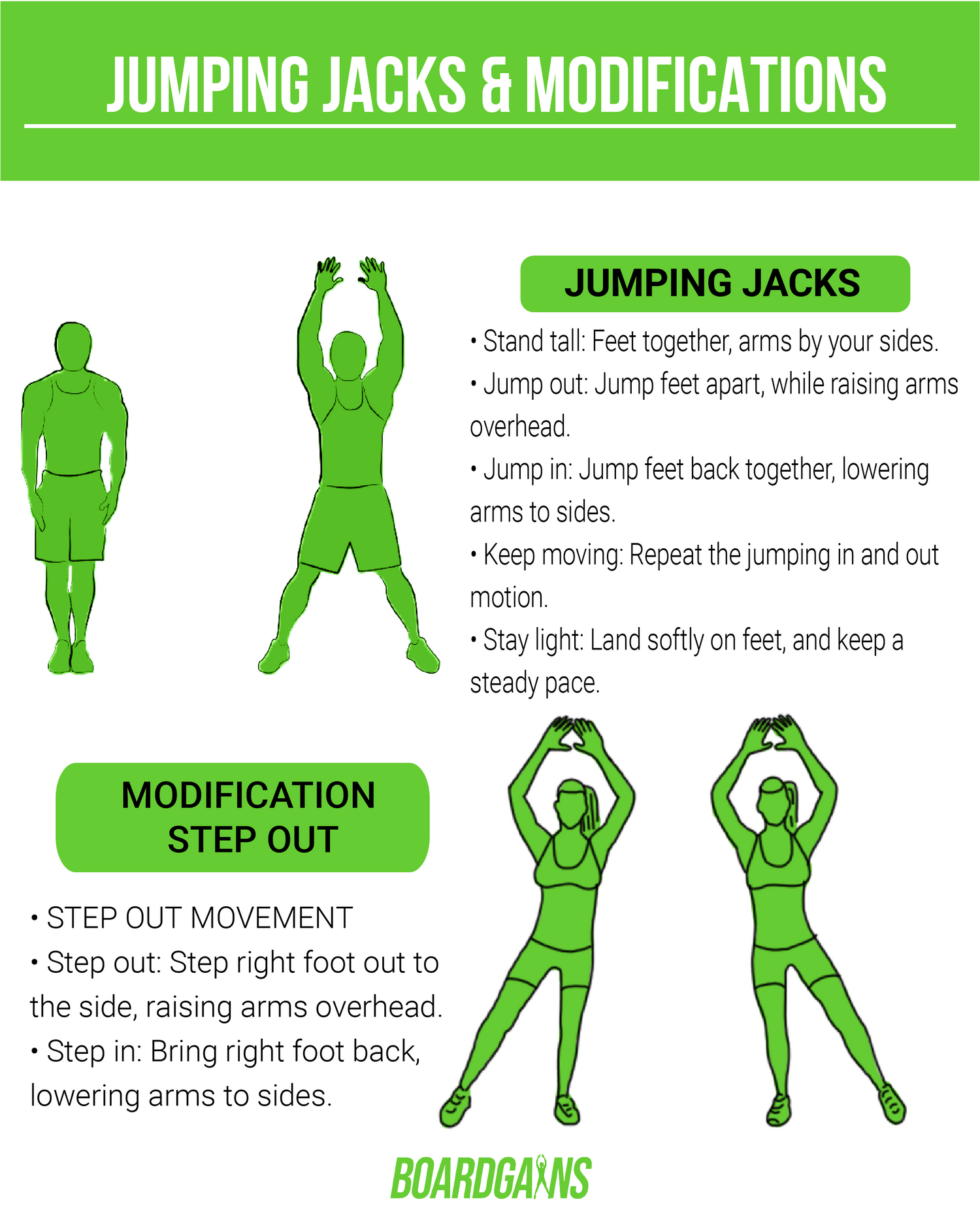
- Start Tall: Stand feet together, arms at sides, spine neutral, shoulders back.
- Jump & Spread: Slightly bend knees, jump up while spreading feet wider than shoulders and raising arms overhead with hands nearly touching.
- Land Softly: Return feet to center and lower arms, landing with knees bent to absorb impact.
- Stay Synced: Ensure arm and leg movements happen simultaneously with no lag.
- Repeat Smoothly: Maintain rhythm without pausing between reps.
Visual Cue: Imagine drawing a star with your body, with arms and legs extending fully at the peak.
Common Form Mistakes to Avoid
- Locking Knees: Increases joint stress. Always keep a micro-bend.
- Flat-Footed Landing: Causes shock to ankles and knees. Land on the balls of your feet first.
- Flared Toes: Letting feet turn outward can strain knees. Keep toes forward.
- Rounded Back: Especially when fatigued. Engage core to stay upright.
- Shrugging Shoulders: Tension in neck? Keep shoulders down and back.
Pro Tip: Record yourself. Many people unknowingly let their hips shift or land too hard.
Modify for Low Impact with Step Jacks
Not everyone can or should jump. Step jacks preserve benefits without joint strain.
Who Should Use Step Jacks?
Step jacks are ideal for:
- Knee or ankle pain
- Beginners building stamina
- Older adults
- Pregnant individuals (especially second/third trimester)
- Recovery-phase athletes
How to Perform Step Jacks Correctly
- Step one foot out to the side while raising both arms overhead.
- Step the same foot back in, lowering arms.
- Immediately step the opposite foot out, raising arms again.
- Continue in fluid motion without jumping.
Variation: Alternate stepping out with opposite arm raise (e.g., step right, raise left arm) for added coordination.
Time-Saving Shortcut: Use step jacks as a warm-up for 60–90 seconds to prime joints and elevate heart rate safely.
Boost Intensity with Advanced Variations
Once basic form is solid, level up with variations that target specific goals: fat burn, power, or core strength.
Power and Plyometric Upgrades
Plyo Jack: Max Height, Max Burn
Explode upward as high as possible while spreading legs and arms. Land softly in a slight squat, then immediately rebound.
Best for: Power development and calorie spike.
Low Jack: Constant Tension Builder
Stay in a deep squat throughout. Jump feet out and in without standing up.
Best for: Quad and glute endurance.
Power Jack: Squat + Jump Combo
After landing, sink into a half-squat before jumping again. Adds resistance-like load.
Best for: Lower-body strength and metabolic conditioning.
Core and Coordination Challenges
Oblique Jack: Twisting Core Burner
Jump while bringing one knee up and out, meeting it with the opposite elbow. Alternate sides.
Best for: Oblique activation and rotational stability.
Rotational Jack: Full-Body Twist
Land in a wide squat, then rotate torso to one side, reaching one hand down and the other up. Jump back to center and switch.
Best for: Spinal mobility and athletic agility.
Skier Jack: Sagittal Plane Mimic
Jump into a split stance (front and back) while swinging opposite arms forward. Alternate quickly.
Best for: Mimicking skiing or sprint mechanics.
Equipment-Enhanced Versions
Press Jack: Add Resistance
Hold a dumbbell, kettlebell, or medicine ball at chest level. Press overhead as you jump legs out.
Best for: Upper-body strength and power.
Battle Rope Jack: Cardio + Grip
Raise ropes overhead as feet jump wide; slam down as feet come together.
Best for: Anaerobic endurance and grip strength.
Slider Jack: Glute Focus
In plank, place sliders under feet. Slide legs out wide, then pull back using inner thighs and glutes.
Best for: Adductor and core control.
Integrate Into HIIT and Tabata
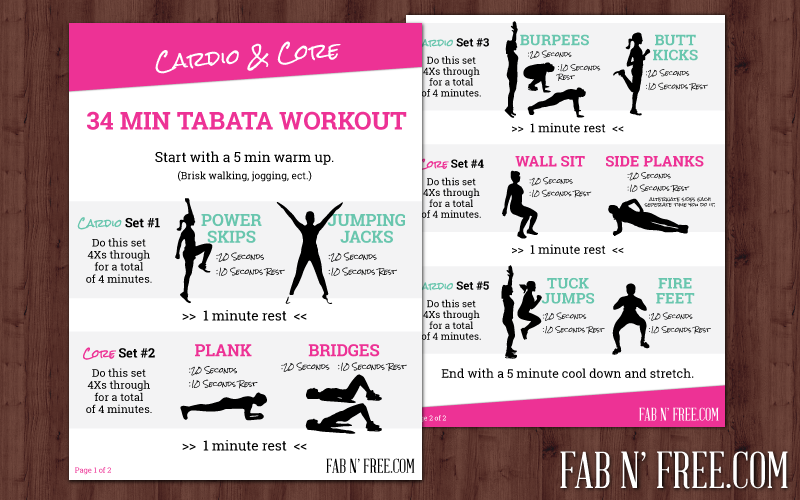
Jumping jacks shine in interval training, where short bursts create long-term metabolic effects.
Tabata-Style Jumping Jacks (4-Minute Blast)
- 20 seconds: Max-effort jumping jacks
- 10 seconds: Rest or march in place
- Repeat for 8 rounds
Expected Outcome: Heart rate hits 80–90% max, boosting VO₂ max and afterburn effect (EPOC).
Beginner Adjustment: Swap 20 seconds of jacks with step jacks or reduce to 15 seconds.
HIIT Circuit Example (15 Minutes)
- 45 sec – Jumping jacks (Plyo or standard)
- 45 sec – Bodyweight squats
- 45 sec – Push-ups
- 45 sec – Plank
- 30 sec rest
- Repeat for 3 rounds
Why It Works: Jacks serve as the cardio engine, elevating heart rate between strength moves.
Expert Note: Use jacks as active recovery, such as 30 seconds of step jacks between heavy deadlift sets, to maintain circulation without full rest.
Use in Warm-Ups and Cool-Downs
Don’t relegate jumping jacks to finishers. They’re ideal prep tools.
Dynamic Warm-Up Role
Perform 1–2 minutes of jumping jacks before workouts to:
- Increase blood flow to muscles
- Activate neuromuscular pathways
- Improve joint range of motion
- Prime frontal plane movement (critical for sports)
Bonus: The lateral leg movement preps hips for lateral lunges, agility drills, or plyo circuits.
Active Cool-Down Option
After heavy lifting or running, use 60 seconds of slow step jacks to:
- Gradually lower heart rate
- Promote circulation for recovery
- Maintain mobility
Pair with deep breathing to transition into stretching.
Burn Calories and Target Belly Fat
Can jumping jacks reduce belly fat? Not directly, but they’re a key piece of the puzzle.
Calorie Burn Estimates
For a 150-pound person:
- 2 minutes (~100 reps): ~19 calories
- 10 minutes cumulative: ~94 calories
Real-World Application: Three 3-minute sessions spread through the day equal ~85 calories burned, which is effortless fat-loss support.
Visceral Fat Reduction Strategy
While spot reduction is a myth, high-intensity cardio like jumping jacks helps burn visceral (deep abdominal) fat when combined with:
- Calorie-conscious eating
- Strength training
- Sleep and stress management
Study Insight: Regular aerobic activity reduces liver and abdominal fat, lowering metabolic syndrome risk.
Pro Tip: Pair 5 minutes of power jacks with a morning walk to kickstart metabolism.
Build Bone Density and Prevent Osteoporosis
Jumping jacks are weight-bearing and impact-loaded, two keys to bone health.
How Impact Strengthens Bones
Mechanical stress from jumping causes micro-strains in bone tissue, triggering osteoblasts (bone-building cells) to reinforce structure. This osteogenic response increases density over time.
Animal Study Evidence: Rats doing 200 jumps per week for 8 weeks showed significant bone density gains, which were maintained even with reduced training.
Human Data: A 2018 study in Archives of Osteoporosis found male adolescent athletes improved bone mass and stiffness after a 9-month jump program.
Practical Application for Adults
- Ages 50+: 2–3 sets of 3–10 explosive jumps, 2–3x per week
- Daily Habit: 10–20 reps every morning
- Focus: Quality over quantity, with soft landings and full control
Caution: Those with osteoporosis should consult a doctor, as low-impact alternatives may be safer.
Stay Safe: Avoid Injuries and Know Limits
Even simple moves carry risk if done wrong or too soon.
Joint Stress and Landing Risks
Ankle, knee, and foot joints absorb 2–3x body weight during landing. Poor form or fatigue increases injury risk.
Prevention Tips:
- Warm up first (e.g., marching, ankle rolls)
- Land softly and think “quiet feet”
- Avoid hard surfaces like concrete; use mats or sprung floors
- Stop if you feel sharp pain
Who Should Avoid Standard Jacks?
Standard jacks are contraindicated or require modification for:
- Severe knee or ankle injuries
- Uncontrolled hypertension
- Advanced pregnancy (use step jacks)
- Recent surgery or joint replacement
Medical Clearance: Always consult a physician before starting plyometrics if you have heart conditions or chronic pain.
Hamstring Strain Prevention
Cold hamstrings plus explosive movement equals strain risk.
Fix It:
- Warm up with dynamic stretches (leg swings, walking lunges)
- Start with step jacks
- Progress slowly and don’t max out on day one
Adapt for Pregnancy and Older Adults
Jumping jacks can fit diverse populations with smart modifications.
Pregnancy Guidelines (ACOG-Aligned)
- First Trimester: If previously active, may continue with approval.
- Second/Third Trimester: Switch to step jacks due to:
- Increased joint laxity (relaxin hormone)
- Shifting center of gravity
- Higher fall risk
Safe Alternative: Seated arm raises with leg abductions maintain movement without impact.
For Older Adults
Benefits include improved balance, respiratory capacity, and blood pressure.
Start Here:
- 2 sets of 10 step jacks
- Use a chair for balance if needed
- Focus on rhythm, not speed
Progression: Add arm resistance bands for upper-body engagement.
Compare to Other Cardio Options
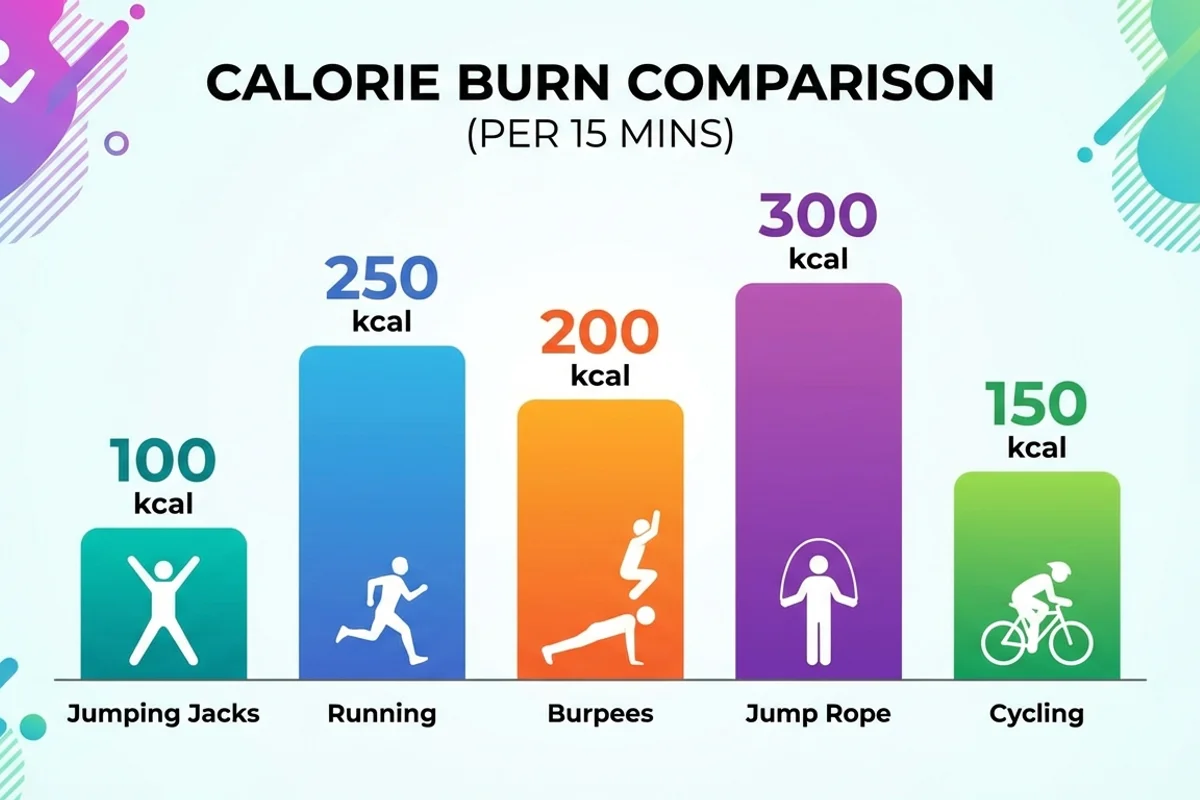
How do jumping jacks stack up against machines or burpees?
Vs. Treadmill or Stationary Bike
| Factor | Jumping Jacks | Treadmill/Bike |
|---|---|---|
| Planes of Motion | Frontal + Sagittal | Sagittal only |
| Joint Impact | Moderate (can modify) | Low to high (running) |
| Equipment | None | Required |
| Space Needed | Minimal | Large |
| Agility Benefit | High | Low |
Verdict: Jacks win for functional fitness and accessibility.
Vs. Burpees
- Complexity: Burpees require push-up + jump = higher skill.
- Upper-Body Demand: Burpees stress chest and triceps more.
- Cardio Efficiency: Jacks allow longer duration with less fatigue, making them better for pure conditioning.
Use Case: Jacks for warm-ups or active recovery; burpees for full-body finishers.
Sample Jumping Jack Workout Plans
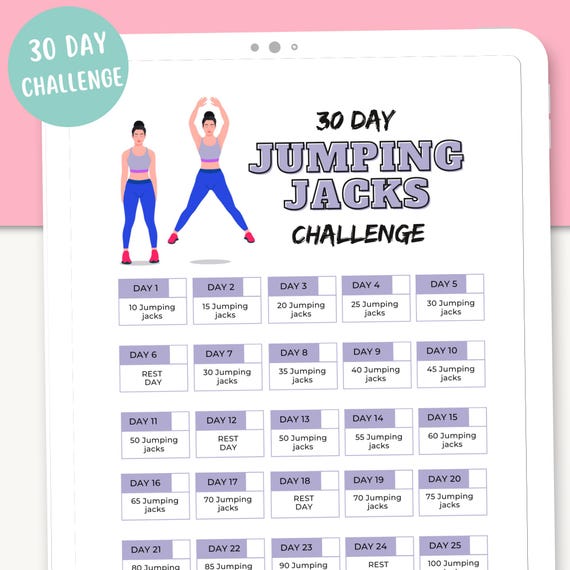
Beginner (0–4 Weeks)
- 3x per week
- 2 sets of 10 step jacks
- Rest 30 sec between sets
- Add 2 reps per set weekly
Goal: Build joint tolerance and rhythm.
Intermediate (10-Minute HIIT)
- 5 rounds:
- 40 sec – Power jacks
- 20 sec – Rest
- Cool down: 2 min step jacks
Calorie Burn: ~60–75 in 10 minutes.
Advanced (Complex Circuit)
- 1 min – Plyo Jacks
- 1 min – Jack Burpees
- 1 min – Slider Jacks
- 1 min – Oblique Jacks
- 1 min – Rest
- Repeat for 3 rounds
Best For: Fat loss, power, and core endurance.
Frequently Asked Questions About Jumping Jacks Cardio Workouts
How many calories do jumping jacks burn in 10 minutes?
A 150-pound person burns approximately 94 calories during 10 minutes of cumulative jumping jacks. A single 2-minute session (about 100 reps) burns roughly 19 calories.
Are jumping jacks good for losing belly fat?
Jumping jacks don’t spot-reduce belly fat, but they contribute to visceral fat reduction when combined with calorie control, strength training, and proper sleep. High-intensity cardio like jumping jacks helps burn deep abdominal fat over time.
Can I do jumping jacks every day?
Yes, you can do 10–20 jumping jacks daily to support bone health and circulation. However, listen to your body and rest if you experience joint pain or excessive fatigue. For intense plyometric sessions, allow 48 hours of recovery between workouts.
Are jumping jacks safe during pregnancy?
During the first trimester, previously active women may continue with doctor approval. In the second and third trimesters, switch to low-impact step jacks due to increased joint laxity, shifting balance, and higher fall risk.
What muscles do jumping jacks work?
Jumping jacks primarily target the glutes, quadriceps, hip flexors, deltoids, and core. Secondary muscles include the hamstrings, calves, obliques (in rotational versions), and upper back (especially in Seal Jacks).
How many jumping jacks should a beginner do?
Beginners should start with 2 sets of 10 step jacks or 30 seconds of continuous movement, three times per week. Gradually add 2 reps per set each week to build stamina and joint tolerance.
Key Takeaways for Your Jumping Jacks Cardio Workout
A jumping jacks cardio workout is a stealth powerhouse that is simple, scalable, and backed by science. From boosting heart health to strengthening bones and burning fat, it’s one of the most efficient exercises you can do anywhere, anytime. Master the form, choose the right variation for your fitness level, and integrate jumping jacks into your routine for real, measurable results.
Start today with just 2 minutes of step jacks, focus on soft landings and controlled movement, and progress gradually. Your heart, bones, and waistline will thank you.