Best Cardio Exercises for Amputees (2026 Guide)
Walking with a prosthesis can demand up to 80% more energy than natural gait, making cardio exercises for amputees essential for daily independence. Beyond heart health, the right routine builds stamina for stairs, longer walks, and an active lifestyle. It also reduces fatigue, sharpens balance, and supports mental resilience during recovery.
This guide breaks down safe, adaptable cardio options for every amputation level. You will learn which exercises to start with, how to modify equipment for prosthetic needs, and what foundational strength work supports long-term success. Most importantly, you will discover how to build a sustainable routine that matches your goals without pain or frustration.
Essential Safety Steps Before Starting Cardio Workouts
Before beginning any cardio program, safety must come first. Amputees face unique physical demands, and improper exercise can lead to skin breakdown, joint strain, or falls.
Get medical clearance from your doctor or rehabilitation team. This step is non-negotiable, especially if you have diabetes, vascular issues, or other comorbidities. Your physician can confirm readiness and flag any concerns.
Work with a physical therapist or adaptive fitness specialist. A qualified professional will assess your balance, strength, and gait, then design a personalized plan. They will also teach proper form to prevent harmful compensations.
Ensure your prosthesis fits perfectly. Ill-fitting sockets cause blisters, sores, and instability. Visit your prosthetist regularly, especially as muscle tone changes with exercise. A socket that worked six months ago may no longer be ideal.
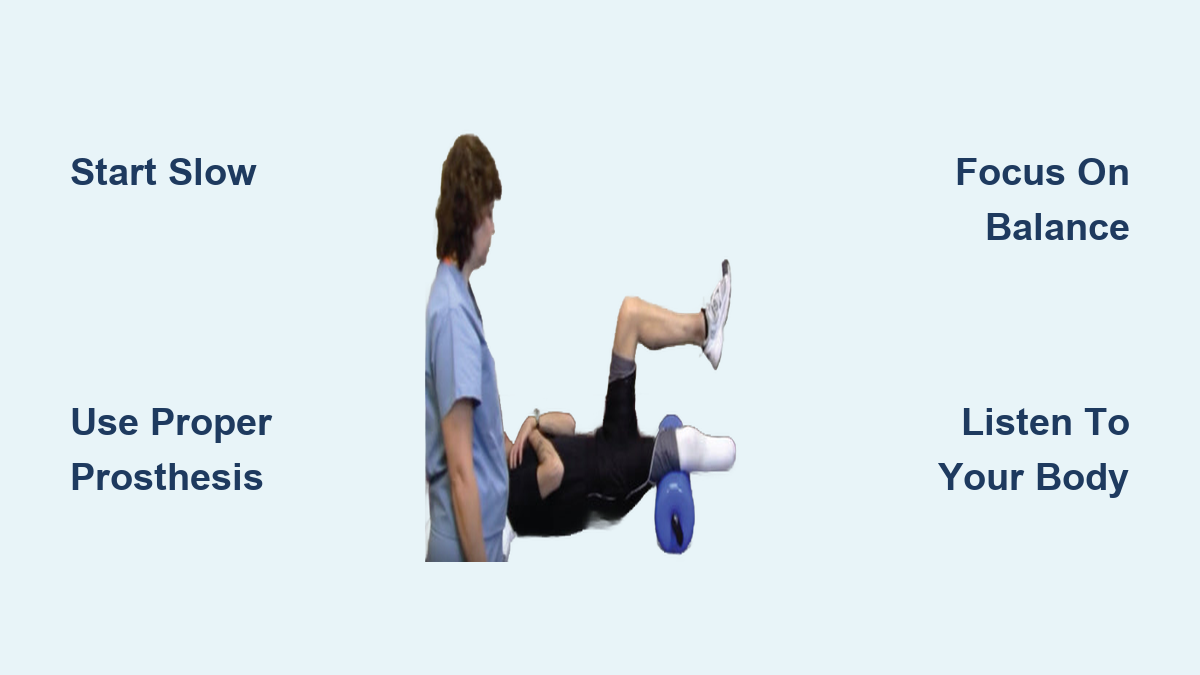
Start slow and progress gradually. Begin with 10 to 15 minute sessions, 3 times per week. Increase duration before intensity. Pushing too hard too soon leads to burnout or injury.
Listen to your body. Pain, numbness, or skin irritation are stop signals. Never power through discomfort. Take breaks, reassess your form, and adjust as needed.
Always warm up and cool down. Begin with 5 minutes of light movement such as arm circles, seated marching, or slow walking. Finish with static stretches to maintain flexibility and reduce soreness.
Best Cardio Options for Amputees
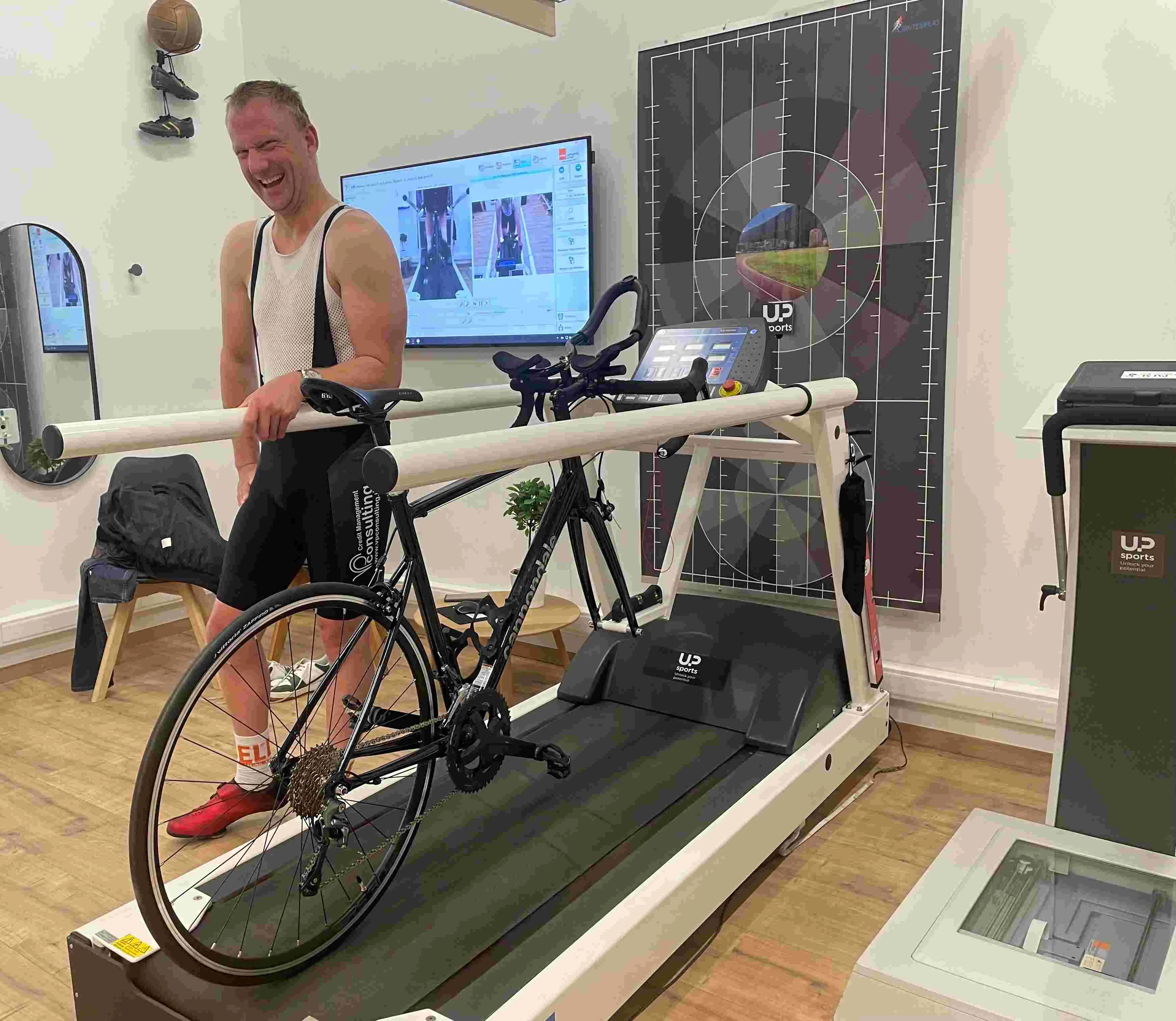
These proven modalities offer low-impact, high-reward cardiovascular training tailored to amputee needs.
Walking with Stability
Walking is the most functional cardio exercise for amputees. It directly improves real-world mobility and builds endurance for daily tasks.
Start indoors on flat, even surfaces. Use a treadmill with handrails for controlled pacing and safety. Alternatively, walk with walking poles to enhance balance and engage your upper body.
Focus on smooth gait mechanics. Keep your posture upright, engage your core, and avoid favoring your sound side. Overcompensating can lead to back or hip pain over time.
Begin with 10-minute walks, 3 days per week. Gradually increase to 30 minutes as stamina improves. Once comfortable, transition to sidewalks or parks, then challenge yourself with slight inclines or uneven terrain.
Pro Tip: Record your gait with a smartphone. Review the video with your PT to spot asymmetries and refine your stride.
Cycling with Prosthetic Adaptations
Stationary cycling is ideal for low-impact cardio, especially for new amputees or those with joint sensitivity.
Use a standard upright or recumbent bike. Secure your prosthetic foot to the pedal using a strap, clip, or sandal-style pedal. This prevents slippage and improves power transfer.
Adjust the seat height so your prosthetic knee has a slight bend at the bottom of the pedal stroke. Too high, and you will hip-hike; too low, and you will strain your knee.
Start at low resistance for 10 to 15 minutes. Focus on smooth, circular pedaling. As endurance builds, increase time and resistance gradually.
For upper limb amputees, hand cycles or upper body ergometers provide excellent cardio. These machines let you elevate your heart rate using only your arms.
Swimming for Pain-Free Conditioning
Swimming offers total-body cardio with zero joint impact. The water’s buoyancy supports your residual limb, reducing pain and swelling.
All strokes can be adapted. Freestyle and backstroke are excellent for building endurance. Use a kickboard to isolate upper body work if needed, or wear a flotation belt to support your legs.
If you are new to swimming, work with a therapist or adaptive swim coach. They will help you adjust your technique based on amputation level and ensure safe entry and exit from the pool.
Aim for 20 to 30 minutes of continuous swimming or water aerobics, 3 times per week. Even walking in chest-deep water provides resistance and cardiovascular benefit.
Skin Note: Rinse your residual limb after swimming. Chlorine or salt can irritate skin and increase infection risk.
Elliptical Training Tips
The elliptical mimics walking or running without the jarring impact, making it perfect for building leg strength and endurance.
Hold the moving handles to engage your upper body, but do not lean heavily. Support comes from your core, not your arms.
Place more weight on your sound side initially if balance is a concern. As coordination improves, work toward equal weight distribution.
Start at low resistance for 10 minutes. Use the machine’s handrails for stability, but focus on maintaining an upright posture.
Avoid ellipticals with steep inclines or aggressive motion patterns until you are confident in your gait control.
Rowing Machine Form
Rowing builds cardiovascular fitness while strengthening the upper body, core, and back, all of which are critical for balance and prosthetic control.
Proper form is essential to avoid socket pressure or back strain. The motion should come from your legs (if applicable), then core, then arms, not just your arms.
Sit tall, engage your core, and push through your feet or prosthetic interface. Lean back slightly at the hips, then pull the handle to your chest.
If you have a lower limb amputation, consult your PT before starting. They may suggest modifications to protect your residual limb during the drive phase.
Begin with 10-minute sessions at low resistance. Focus on rhythm and control, not speed.
Agility Drills for Real-World Mobility

Cardio is not just about endurance. It is also about moving confidently in dynamic environments. Agility drills train your body to respond quickly, change direction, and navigate obstacles.
Carioca for Coordination
Carioca (or grapevine) improves footwork, balance, and complex movement patterns.
Start standing with feet shoulder-width apart. Cross your prosthetic leg in front, then step your sound leg behind. Continue sideways in a flowing motion.
Reverse direction by crossing the sound leg in front.
Use a wall or chair for balance if needed. Practice slowly at first, then increase speed as coordination improves.
Do 2 to 3 sets of 20 seconds per side.
Lateral Shuffle Practice
Lateral shuffles build quick, controlled side-to-side movement, which is essential for crowded spaces or sudden changes in direction.
Begin in an athletic stance with knees bent, back straight, and weight on the balls of your feet.
Shuffle 5 to 10 steps to one side, leading with your prosthetic leg. Then reverse, leading with your sound leg.
Keep steps short and fast. Avoid crossing your feet.
Use this drill on flat, non-slip surfaces. Perform 2 to 3 sets of 15 seconds.
Figure-Eight Walking Pattern
This drill enhances turning ability and directional control, which are key for navigating tight hallways or busy sidewalks.
Place two cones 4 to 6 feet apart. Walk in a figure-eight pattern around them.
Focus on smooth transitions and maintaining balance during turns. Keep your core engaged and eyes forward.
Start slowly. As stability improves, increase speed.
Perform 3 to 5 laps in each direction.
Obstacle Stepping Drills
Step over low obstacles (4 to 6 inch boxes or foam hurdles) to simulate curbs, thresholds, or uneven ground.
Alternate leading with your prosthetic leg, then your sound leg. This prevents over-reliance on one side.
Keep your back straight and lift your knee high enough to clear the obstacle.
Use a wall for support if needed. Do 2 sets of 5 steps per leg.
Braiding Through Cones
Set up 5 to 6 cones in a zigzag line. Weave through them using crossover steps.
This drill sharpens foot placement awareness and dynamic balance.
Move at a controlled pace. Focus on precision, not speed.
Perform 2 to 3 passes. Increase difficulty by narrowing the cone spacing.
Strength and Balance Exercises That Support Cardio
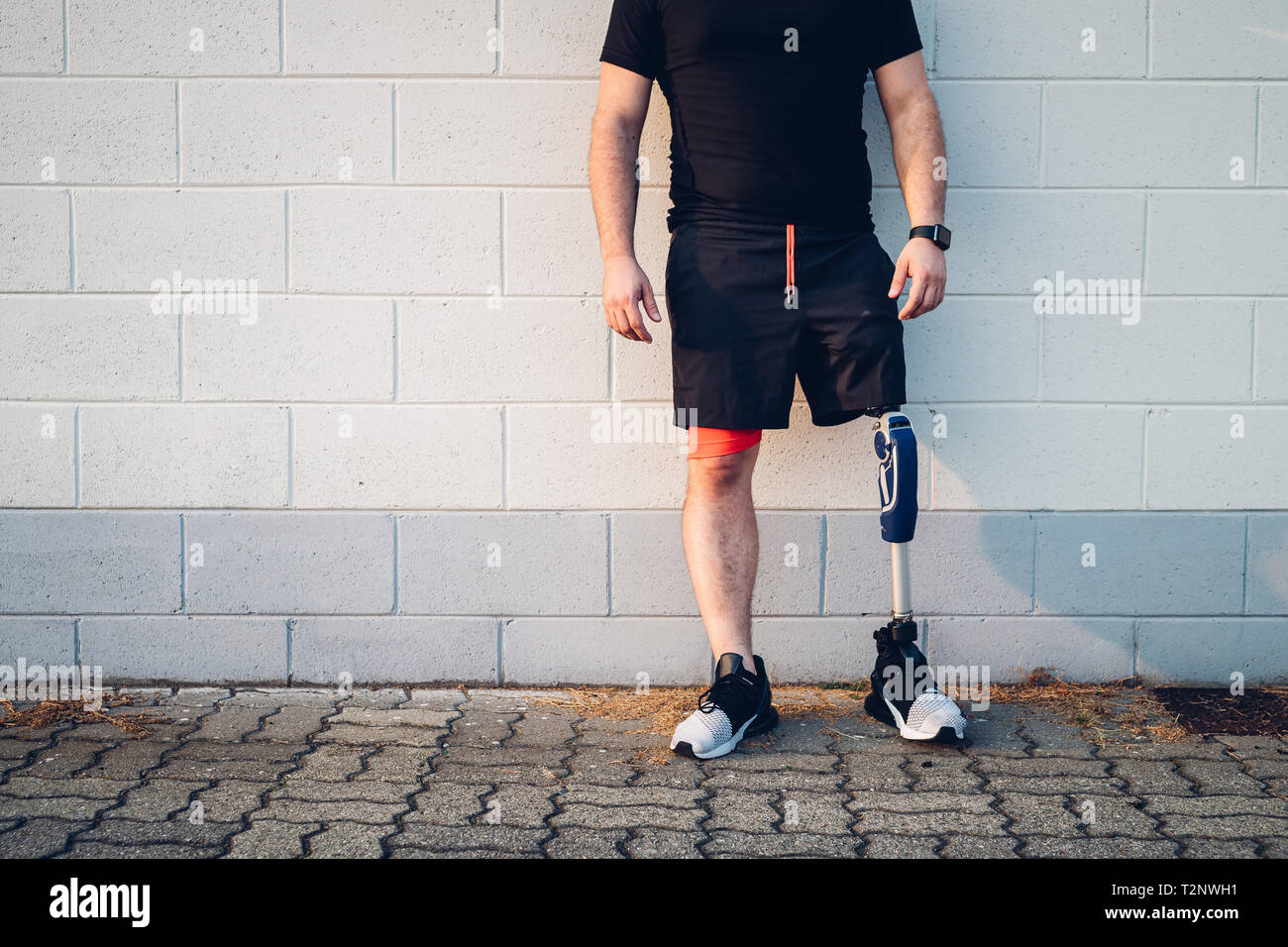
Cardio performance depends on underlying strength and stability. These exercises make your cardio safer and more efficient.
Single-Leg Stance Training
Stand on your prosthetic leg for 30 seconds. Use a chair for support if needed.
Focus on a fixed point ahead to improve balance. Slightly bend your knee to engage stabilizing muscles.
Progress by closing your eyes or standing on a pillow.
Do 3 sets daily. This builds confidence for walking and stair climbing.
Box Squats for Hip Strength
Ideal for above-knee amputees, box squats build hip and thigh strength without requiring deep knee control.
Sit back onto a sturdy chair or bench, then stand using your legs.
Keep your chest up and back straight. Avoid leaning forward.
Perform 3 sets of 10 to 12 reps.
Staggered Stance Squats
Best for below-knee amputees, this variation compensates for limited ankle motion.
Place your prosthetic leg slightly forward. Lower into a squat, keeping weight balanced.
This position improves stability and mimics real-world movements like climbing stairs.
Do 3 sets of 10 reps.
Single-Leg Deadlifts
Hinge at the hips while standing on your prosthetic leg, lifting your sound leg behind you.
Keep your back straight and core tight. This strengthens hamstrings and glutes, which are critical for gait stability.
Use a wall for balance. Perform 3 sets of 8 to 10 reps.
Wall Sits for Endurance
Slide down a wall until your knees are bent at 90 degrees. Hold for 30 seconds.
This builds quadriceps and core endurance for standing and walking.
Perform 3 holds. Increase time as strength improves.
Stretching Routines to Prevent Injury
Tight muscles increase fall risk and reduce range of motion. Stretch daily, especially after cardio.
Hamstring Stretch
Sit on the floor with your sound leg extended and prosthetic leg bent with foot against inner thigh.
Reach toward your toes. Hold 30 seconds, 3 reps.
Quadriceps Stretch
Stand holding a chair. Bend your prosthetic knee, bringing your heel toward your buttocks.
Gently pull your foot for a deeper stretch. Hold 30 seconds, 3 reps.
Calf Stretch
Face a wall. Place your sound foot forward and prosthetic foot back.
Lean in, keeping your prosthetic leg straight. Feel the stretch in your calf.
Hold 30 seconds, 3 reps.
IT Band Stretch
Cross your prosthetic leg behind your sound leg. Lean your torso toward the sound side.
Hold 30 seconds. Repeat 3 times.
Shoulder and Side Stretches
Pull one arm across your chest to stretch the shoulder. Then, interlock hands overhead and lean to each side.
Hold each 30 seconds. These counteract hunching from crutch or walker use.
Amputation-Specific Modifications for Cardio
Exercise must adapt to your level of limb loss.
Below-Knee Amputation Adaptations
You lack ankle motion, which affects squatting and balance.
Use staggered stance squats instead of standard squats. Lead with your prosthetic leg during step-ups to improve control.
Focus on ankle flexibility in your sound leg to compensate.
Above-Knee Amputation Adaptations
Hip strength is critical for controlling your prosthetic knee.
Prioritize box squats, Romanian deadlifts, and hip bridges.
Use elevated step-ups with a higher surface for your sound leg and lower for your prosthetic side to manage range of motion.
Upper Limb Amputation Modifications
You may rely more on lower body cardio.
Use leg press machines instead of bench press. Focus on squats, lunges, and calf raises for strength.
For cardio, swimming, cycling, and elliptical are excellent. Use adaptive hand cycles for upper body workouts.
Building a Weekly Cardio Routine
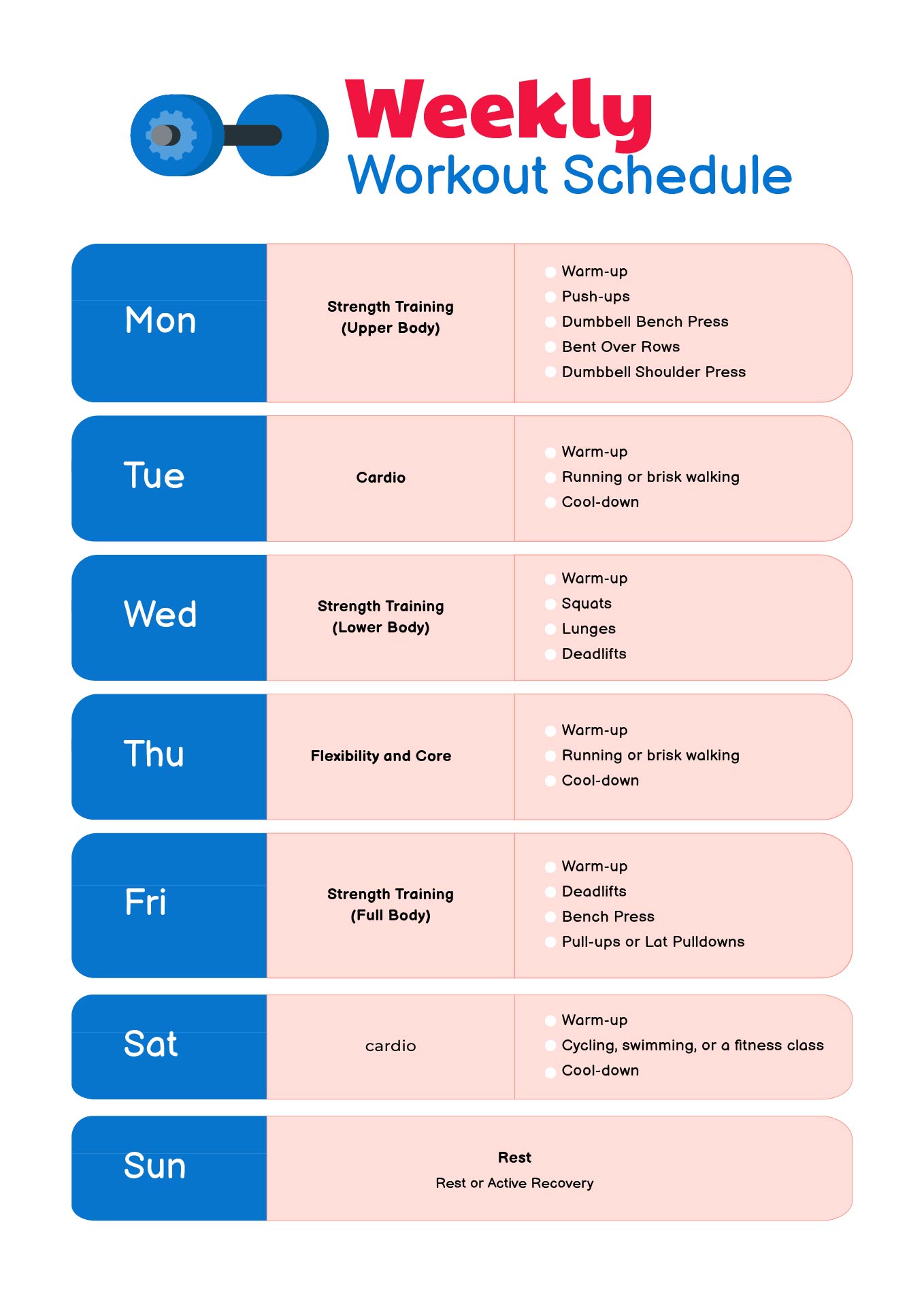
Start with this beginner-friendly plan (3 days per week):
| Day | Activity | Duration |
|---|---|---|
| 1 | Stationary cycling | 10 to 15 min |
| 2 | Rest or light stretching | — |
| 3 | Treadmill walking | 10 min |
| 4 to 7 | Rest or mobility work | — |
Add one day per week as endurance improves. By week 6, aim for:
- 30-minute walk (Day 1)
- 20-minute swim (Day 3)
- 15-minute elliptical plus agility drills (Day 5)
Include 2 days of strength and balance work such as squats, lunges, and single-leg stance.
Frequently Asked Questions About Cardio Exercises for Amputees
What is the safest cardio exercise for new amputees?
Stationary cycling and water walking are among the safest options. Both provide cardiovascular benefits with minimal joint impact and low fall risk, making them ideal during early rehabilitation.
How often should amputees do cardio each week?
Aim for 3 to 5 sessions per week. Beginners should start with 10 to 15 minute sessions and gradually increase duration as endurance builds.
Can amputees run or jog for cardio?
Running is possible for some amputees with specialized running prosthetics. However, the elliptical or treadmill walking is generally recommended as a safer entry point before progressing to running.
How do I protect my residual limb during cardio?
Ensure your socket fits properly, inspect your skin before and after exercise, and rinse your limb after swimming. Stop immediately if you notice redness, blisters, or pain.
What should I do if I feel pain while exercising?
Stop the activity right away. Pain is a warning sign that something is wrong. Rest, assess your form, and consult your PT or prosthetist before resuming.
Are hand cycles effective for upper body cardio?
Yes. Hand cycles and upper body ergometers provide excellent cardiovascular workouts and are particularly valuable for upper limb amputees or anyone wanting to diversify their routine.
Key Takeaways for Building Your Cardio Routine
Cardio exercises for amputees are about reclaiming freedom, not pushing limits. Start with low-impact options like walking, cycling, or swimming, and progress gradually based on your comfort and stamina.
Pair your cardio with daily strength and balance work to protect your residual limb and prevent falls. Always work with your care team, listen to your body, and adjust your routine as your fitness improves.
Your next step: Choose one cardio activity from this guide and try it for 10 minutes this week. Track how you feel, then build from there. Every step, pedal, or stroke is progress. Keep going.